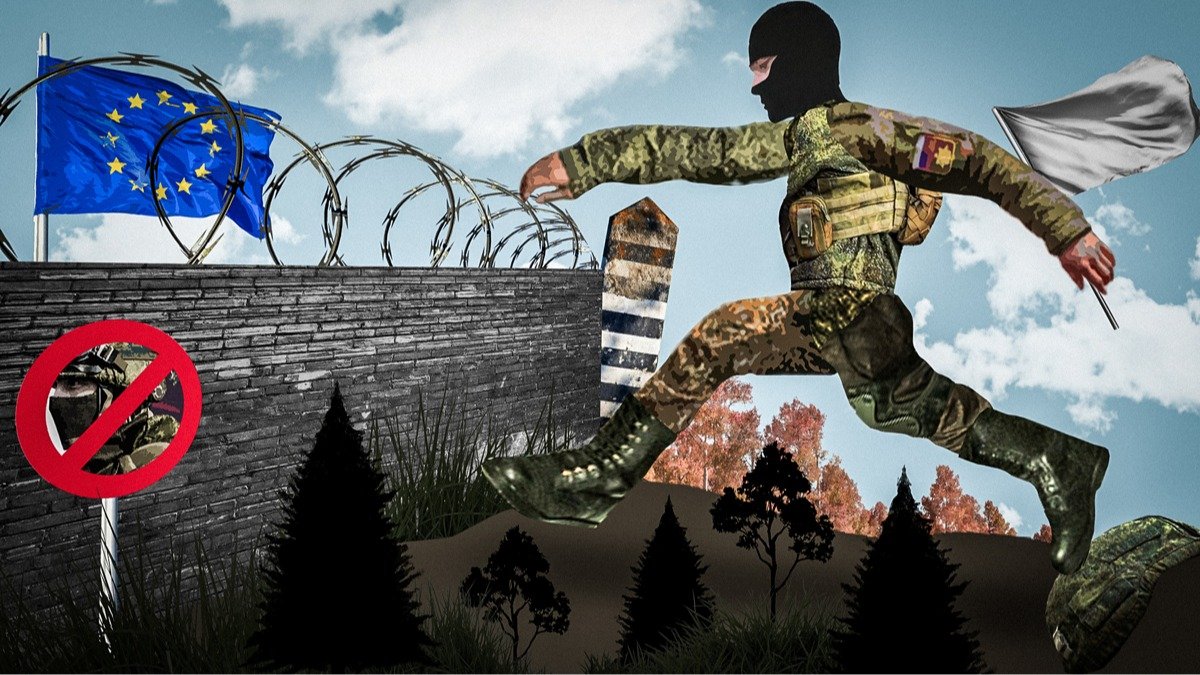
In recent years, only a few dozen former Russian soldiers who refused to fight against Ukraine have managed to obtain asylum in the European Union. Now, this possibility may be completely closed: leaders of eight EU countries have called for stricter visa rules for all Russians involved in the war. 'Novaya-Europe' spoke with human rights activists and deserters about what will happen to those Russians who decide to leave the army if the EU makes this decision. Illustration: 'Novaya Gazeta Europe'. Long-term risk. The leaders of Germany, Poland, Estonia, Finland, Latvia, Lithuania, Romania, and Sweden are calling for the EU to tighten visa rules for Russians who participated in the war in Ukraine, according to Politico. They wrote a letter to the President of the European Council, Charles Michel, and the President of the European Commission, Ursula von der Leyen, warning that Russian aggression poses long-term internal security risks to the EU's Schengen area. They argue that demobilized combatants or those on rotation may try to travel to EU countries, which, in turn, would contribute to the growth of organized crime and violent crime. Representatives of these countries note that the number of visas issued to Russian citizens is also increasing. As Politico writes, in 2025, Russians submitted up to 670,000 Schengen visa applications, making them among the top five countries with the highest number of applications for entry into the EU. Approximately four out of five applicants received a visa. 'Any such entry could have serious consequences for the security of a Member State or the entire Schengen area,' the letter states. The signatories urge the European Commission to prepare 'targeted visa restrictions' and explore the possibility of amending EU rules to allow for coordinated entry bans. In recent years, EU countries have already tightened access: most visas are now issued for shorter periods and with limited validity. Remaining in Armenia. New rules could significantly complicate life for deserters from the Russian army seeking refuge in Europe. Some of them, however, settle in Armenia. For example, our interviewee Oleg (the hero's name has been changed for security reasons. - Ed.) lives there. In his youth, he wanted to become a military intelligence officer and tried to enter a military school; in the end, he served his compulsory service as a tank driver-mechanic and after that decided not to connect his life with the army anymore. In the summer of 2022, a tragedy occurred in his family: his father died after an illness. Some time later, Oleg received a mobilization notice. At that moment, he was in a severe psychological state and, according to him, did not want to worry his mother further. He hoped he would be sent to the rear, but in reality, he was sent to the front in the 'LPR,' where he became a medic. He was involved in evacuating the wounded and faced losses daily. Over time, he began to emotionally detach himself from what was happening. After one of the shelling incidents, when there were many dead and wounded around, he finally decided that he did not want to stay at war. After some time, he managed to escape: he left his position in civilian clothes, reached Luhansk, and then traveled to the border with the help of fellow travelers. At customs, he presented himself as a civilian specialist; he was checked and allowed through. Upon returning to Russia, he told his mother about his desertion, went into hiding, tried to work, but faced serious psychological consequences. After some time, he was detained by law enforcement officers and taken to a military unit. There, he was told directly that they could either put him in a pre-trial detention center or send him back to the front. When he was released for a medical examination, he took advantage of this and decided to flee for good. Oleg gathered his documents, took money, and flew out of the country through Moscow. As a result, he ended up in Armenia. He was briefly detained at the border there because a wanted notice had once appeared in the system, but he was released after verification. He now lives outside of Russia, works remotely, and is trying to recover from his experiences. He says he sleeps better and feels more freedom, although he is still unsure if he will ever be able to return home. Oleg told 'Novaya-Europe' that he has applied for political asylum in Armenia. In general, according to him, he is comfortable there: 'The attitude here is normal. Everyone here understands perfectly what is happening and treats people like me normally.' He speaks negatively about the new initiative of EU leaders. According to him, deserters will have fewer 'room for maneuver.' At the same time, he believes that countries like Armenia will remain that 'will continue to accept people.' 'If the EU completely restricts entry for war participants without investigation, without due process, without individual review, then it is sad. People who know this but still want to desert from the Russian army will take this into account. And there is a possibility that this will become one of the reasons that will deter them from the thought of deserting,' the interlocutor of 'Novaya-Europe' emphasizes. At the same time, he notes that the EU has the right 'to consider us all criminals and not let us in': 'But again, it will lead to nothing good.' 'If the task is for people to desert from the Russian army, to reduce the military potential of the occupier's army, i.e., the Russian army, then, on the contrary, something must be done to attract people, so that they see that there are broader opportunities.' Anastasia Burakova, founder of the 'Ark' project, notes that military personnel in Russia typically do not have foreign passports: either they did not obtain one, or they surrendered it upon entering military service. According to her, this is the main factor in 'choosing' a country: one can enter Armenia, Kazakhstan, and Kyrgyzstan with a domestic passport. However, the latter are much less safe, with a higher risk of extradition or abduction, the expert points out. 'In the context of deserters, it is not easy to get anywhere; people injure themselves, shoot parts of their bodies to be able to flee the front through a hospital. Armenia does not take actions aimed at real extradition, so staying there is safer, but due to the absence of a land border, fleeing to Armenia is more difficult than to Kazakhstan,' explains Burakova. The path to Europe. Many deserters still try to get as far away from Russia as possible. For example, Alexander managed to get to France. Alexander entered a military academy at 18, largely due to parental pressure and because he could not afford paid education. In early 2022, he was sent for training to annexed Crimea, which turned out to be preparation for the invasion of Ukraine. On February 24, he crossed the Ukrainian border with his unit and found himself on the front lines, where he realized almost immediately that the army was not ready for war. Alexander worked as a communications specialist, constantly traveling between positions under fire, and narrowly escaped death several times. After several months of war, he decided to leave the army for good and, upon receiving leave, returned to Russia. When mobilization was announced in September 2022 and it became clear that he would be sent to the front again, he bought a ticket and fled through Omsk to Kazakhstan. He lived in Kazakhstan for almost two years. He was on the wanted list there, tried not to use banking services, and appeared in public very rarely, fearing detention or extradition. During this time, he met with human rights activists and other deserters and helped verify the stories of Russian soldiers who also fled the army. Later, together with a group of deserters, he began to publicly speak out against the war and participate in human rights initiatives. After a year and a half of negotiations with European organizations, six deserters, including Alexander, received special entry documents and were able to fly to France via Istanbul, where they applied for political asylum. Alexander's case is not the only one. Before the war, Kamil studied astronomy, repaired equipment, and did not plan a military career. In 2023, he was detained on drug charges. According to him, he was offered a choice: prison or a contract. He agreed to the contract, planning to escape. After a short training, he was sent to the Donetsk region. There he was wounded and then transferred to a unit he calls a 'suicide battalion,' where problematic fighters were sent. Realizing that he would be sent to the front again, Kamil decided to desert. He shot himself in the leg to be evacuated and ended up in a hospital in Russia. When it became clear that he was about to be returned to his unit, he escaped and went to Kazan. He hid and received treatment for several months, rarely leaving home. When he recovered, he left Russia via Georgia and only felt safe after crossing the border. He chose France almost by chance: he also considered Germany and Italy, but decided to try this country. Upon arrival in Paris, he told the migration police his story and applied for political asylum. He was issued a temporary document that allows him to live in the country, use medical insurance, and receive benefits. Kamil now lives in Nice, is learning French, and plans to find a job. He says that for the first time in a long time, he feels calm: there is no longer a fear of being stopped or sent back to the front. Justice for deserters. Grigory Sverdlid, head of the human rights project 'Go Away' ('Idite Lesom'), explains that the number of people trying to desert the Russian army is increasing. This year, the number of requests to 'Go Away' for help in deserting the Russian army has increased by 30%. By his estimate, in January and February alone, 'Go Away' helped 248 people desert and go into hiding. According to him, the EU countries' security concerns regarding the arrival of deserters are unfounded. 'The war has been going on for five years, a certain number of Russian deserters have been in Europe for a long time, and I haven't heard of a single case of serious offenses on their part,' Sverdlid emphasized. He also points out that he sees nothing wrong with 'thoroughly vetting applicants and preventing individuals involved in aggression from entering the Schengen area' in itself. In his opinion, the issue is how exactly this will be implemented. For example, about 85% of those whom 'Go Away' helps to desert have not yet participated in the war and have not even been in the occupied territories. Sverdlid questions whether European visa centers will examine such details or simply deny everyone who has been in the Russian army. He suggests that in practice, the latter option will be implemented. 'It would be right to create a separate 'track' for Russian deserters and draft dodgers to obtain refugee status. These people risk ending up in a Russian prison - they face up to 15 years in prison under the article for desertion. Creating a working procedure for obtaining political asylum for deserters would increase the number of deserters from the Russian army and thus help Ukraine,' Sverdlid proposed. The coordinator of the human rights project InTransit previously told 'Novaya-Europe' that the attitude towards Russian deserters in Europe has already become noticeably harsher than in the early years of the war. According to him, the Baltic and Northern European countries are generally not ready to accept such people; sometimes asylum seekers may be sent back across the border. He notes that only a few countries in the EU - for example, Germany, France, and Spain - consider deserters' asylum applications relatively normally. However, even there, we are talking only about dozens of cases, while most such people remain in transit countries like Armenia. Anastasia Burakova, in a comment to 'Novaya-Europe,' points out that Estonia, for example, has already introduced an individual entry ban for those who fought against Ukraine. The first list includes 261 people, and the ban for them will remain in force even after the active hostilities end. 'Last summer, the Baltic and Nordic countries met and discussed such a measure. Overall, this is a step towards individual, not collective, responsibility and assessment of public danger. I think other EU countries may soon adopt this,' Burakova said. At the same time, 'Ark,' together with 'Go Away,' is currently discussing making proposals to 'provide for the possibility of exceptions for those who have not committed war crimes, often have not even reached the front, fled, or were not voluntarily admitted to the army.' 'Such people often become important witnesses for the investigation of war crimes. For example, deserters whom we help provided information for the latest UN report,' notes the interlocutor of 'Novaya-Europe.' Grigory Sverdlid recalls that Germany currently has monuments to deserters from the Nazi army. For example, in 2009, in Cologne, on the 70th anniversary of the start of World War II, a monument to Wehrmacht deserters and other victims of Nazi military justice was unveiled. Monuments are also erected in Hamburg, Hanover, and Vienna. 'It would be good to treat people who refuse to fight Ukraine fairly, right now,' says Sverdlid, 'instead of erecting monuments to them in 50 years.'