March 23, 2026
Village protest. Mass slaughter of livestock in the Novosibirsk region is compared to collectivization on social media
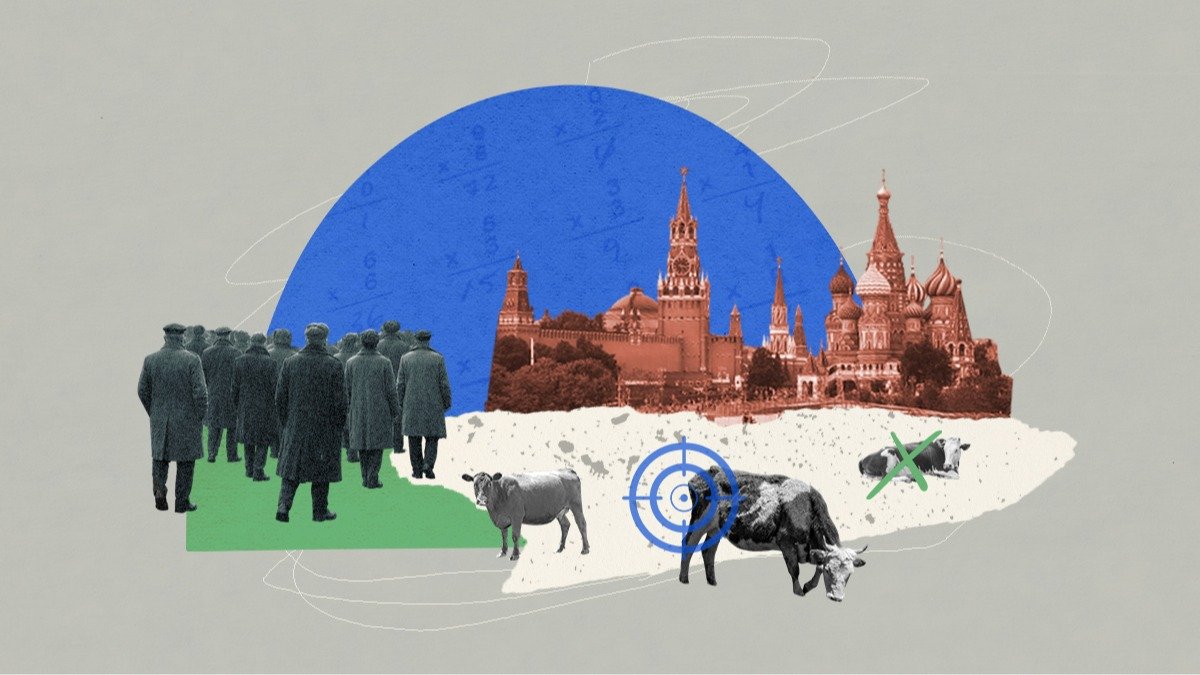
Livestock is being seized and destroyed on a massive scale from residents of the Novosibirsk region. Cows are being burned by the hundreds on village territories. Officials tell local residents nothing, only citing some particularly dangerous disease. Driven to despair, some have even begun slaughtering their own livestock to avoid handing it over to officials for burning. Many are actively protesting; local police fine participants of rallies, and local authorities try to intimidate them. On social media, some compare the events to the collectivization and "dekulakization" of the 1930s. Historian Rustam Alexander recalls what the confrontation between officials and peasants looked like almost a century ago. Illustration: Rina Lu / "Novaya Gazeta Europe". In the winter of 1929-1930, the Soviet government began the so-called "collectivization" in the villages. Rural residents, who until then had their own land, cows, and horses and could work for themselves, were now required to merge their lands and livestock into a single collective farm (kolkhoz) and give their harvest to the state for a nominal price. This was how the state hoped to increase grain procurements and solve the problem of grain shortages. Officials promised peasants that under collective farming, yields would increase. But peasants perceived collectivization as an attempt at exploitation, as working for oneself was much more profitable. Almost simultaneously, the state launched a campaign of "dekulakization" – confiscating property from wealthy peasants and sending them into exile. Local officials lacked clear instructions on how to carry out collectivization. Workers from district and village councils, urban communists and Komsomol members, as well as workers and students sent to the countryside, were involved. These individuals had no local ties and could therefore implement collectivization more effectively and strictly. However, many of them understood nothing about agriculture. Representatives of the authorities held special meetings in the villages, where peasants were to be forced by any means necessary to sign documents agreeing to transfer their farms – lands and livestock – to the state; it was important for the Soviet government that the process appeared "democratic." Many peasants were skeptical and did everything they could to disrupt such events. For instance, at one meeting, as signing began, elderly women burst in singing "Christ is Risen!" Someone would run in with news that there was a fire in a neighboring village and they needed to go put it out. Sometimes children would run into collectivization meetings shouting, "Uncle, uncle, your horse has been stolen!" All of this, of course, disrupted the signing process. Some protests took completely unexpected forms. For example, in one region, where government representatives went from house to house describing the property of peasants to be transferred to the state, one woman met the officials completely naked, saying, "Go ahead, describe it." Witnesses in a peasant's yard searching for bread in one of the villages of the Grishinsky district of the Donetsk region, 1930-1934. Photo: Wikimedia. The authorities' stance rapidly hardened: rural residents were told directly that those who refused to join the kolkhoz would be declared "kulaks," their property confiscated, and they themselves sent into exile. For instance, an official in the Urals traveled to villages accompanied by the head of the police, saying, "Whoever wants to join the kolkhoz – sign up with me, whoever doesn't – with the head of the police." Twelve people who refused to join were immediately arrested. Collectors often brandished revolvers, threatening to shoot peasants who resisted. Sometimes they arrived in villages with an orchestra: if a peasant agreed to join the kolkhoz, a triumphant march played, and in case of refusal – a funeral dirge. Other forms of pressure were widely used: peasants were summoned to village councils at night, where they could be held for several days and subjected to beatings. Despite attempts to present joining kolkhozes as a voluntary and even "democratic" procedure – with formal signature collection – in practice, everything was accompanied by arbitrariness. Horses and cows were taken without warning. One peasant woman recalled, "I went... for kerosene, returned home, and by that time the cow had already been taken away." Representatives of the authorities broke locks on barns and forcibly took away livestock. When state officials began to seize horses, cows, pigs, and sheep en masse from peasants, declaring them state property, many peasants resorted to desperate measures. Unwilling to give up their livestock, they slaughtered it themselves. The slaughter of livestock became one of the most widespread forms of protest against collectivization. For example, in the Central Black Earth Region, in the first three months of 1930 alone, about 25% of cattle, 53% of pigs, 55% of sheep, and 40% of poultry were destroyed. Peasants often understood themselves that the confiscated animals would likely perish due to unskilled and careless handling in the kolkhozes. On January 9, 1930, the newspaper "Pravda" published an article: "Repel the Maneuvers of the Class Enemy! Save Livestock for the Kolkhozes." The text stated: "The kulak, in response to the stormy kolkhoz movement... has launched frenzied agitation for the extermination of livestock... In a number of districts and regions, secret slaughterhouses have been discovered where Gostorg and Kozhtrest, bypassing the laws, kill livestock. City markets are literally flooded with fresh carcasses of meat, which are often sold for next to nothing. The situation is very alarming." The harsh and determined resistance from rural residents to attempts to seize their property for the kolkhoz initially forced the authorities to reckon with them. On March 2, 1930, the newspaper "Pravda" published Stalin's article "Dizzy with Success," in which the General Secretary shifted all responsibility for the excessively harsh implementation of collectivization in the villages to local leaders. A group of peasants working in the fields of their kolkhoz read magazines and newspapers during a break, May 28, 1930. Photo: AP / Scanpix / LETA. Stalin's article stunned the officials who were carrying out collectivization – for many of them, it was outright betrayal. For instance, one party secretary in the Volga region, after reading Stalin's article, got drunk out of grief and tore up his portrait in a fit of anger. The collectivization campaign was temporarily halted, and some local officials were condemned. Peasants rejoiced: many of them thought that Stalin's article was an official permission to leave the kolkhozes. In the following weeks, millions of peasants withdrew their signatures from the lists. However, the state did not intend to let anyone go: dekulakization continued, and soon collectivization was resumed – as historians now well know, at the cost of enormous human sacrifices and millions of ruined lives. Based on materials from: Sheila Fitzpatrick, "Stalin's Peasants. Social History of Soviet Russia in the 1930s: The Village" (Moscow: Rossspen, 2001).
TL;DR
- Livestock is being seized and destroyed on a mass scale in the Novosibirsk region, with cows being burned by the hundreds.
- Officials are providing vague explanations, citing a dangerous disease, which residents distrust.
- The situation is being widely compared on social media to the forced collectivization and "dekulakization" of the 1930s.
- Protests are occurring, met with fines from police and intimidation from authorities.
- Some residents are preemptively slaughtering their own livestock to avoid confiscation.
- Historically, collectivization involved forced seizure of land and livestock, leading to peasant resistance, including mass animal slaughter.
Continue reading the original article