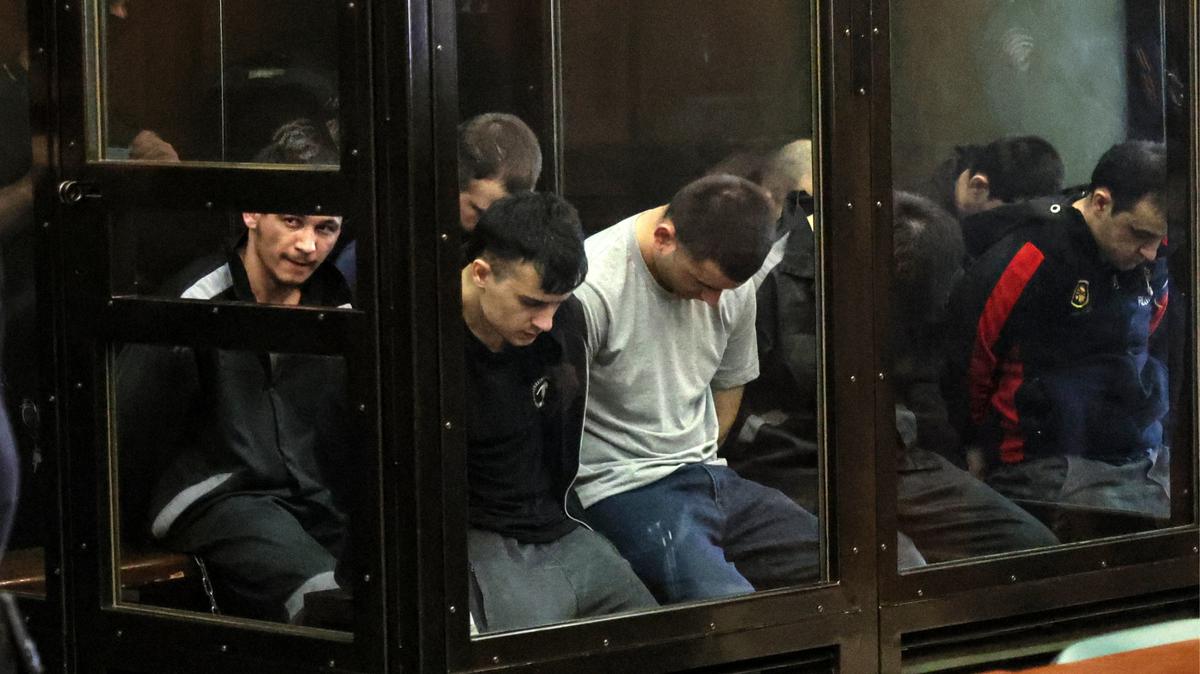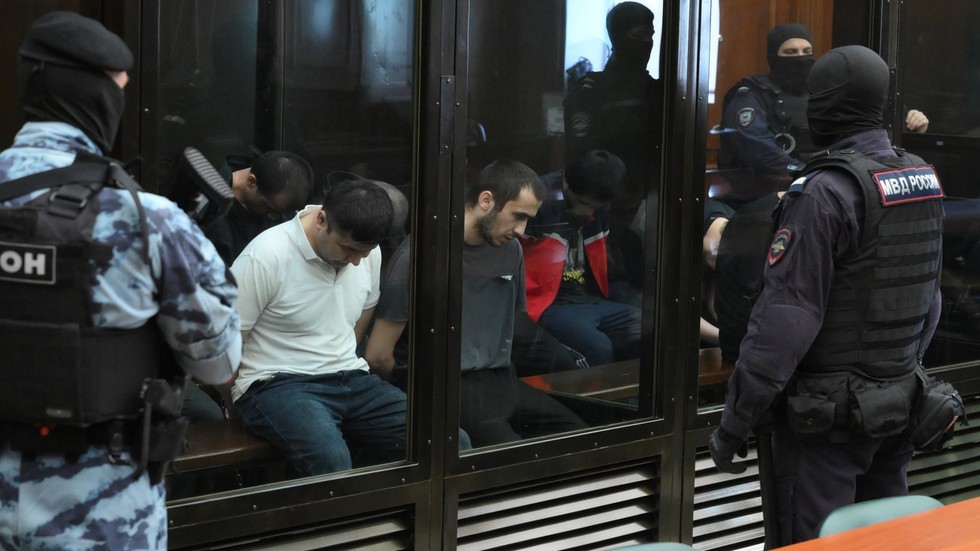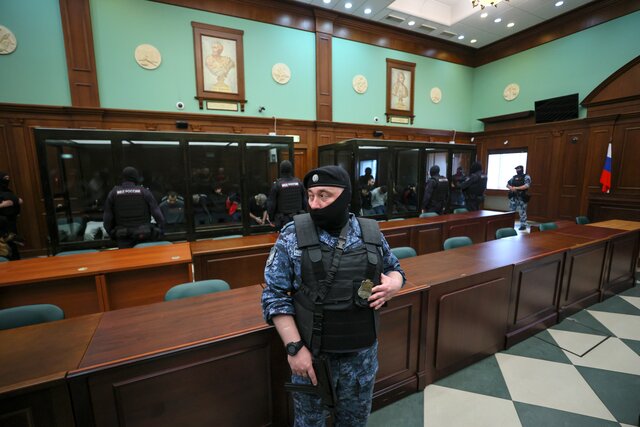

Russian and opposition-leaning outlets agree that a Russian military court has handed down very harsh sentences over the March 22, 2024 Crocus City Hall terrorist attack near Moscow, which was the deadliest in Russia in decades. Across both types of coverage, it is consistently reported that four direct perpetrators received life imprisonment and that a total of 19 defendants were convicted, with the remaining accomplices and facilitators receiving lengthy prison terms ranging roughly from about 20 years to additional life sentences. Both sides highlight that the attack involved gunmen storming the concert venue and caused catastrophic human losses, with death tolls reported between about 145 and 150 people and hundreds more injured, and note that numerous civil claims from victims’ families were upheld and assets linked to the attackers were confiscated.
The reports also converge on the broader institutional and procedural context: the case was handled by a high-level Moscow-based military court, the trial was conducted largely behind closed doors under terrorism and national security provisions, and the investigation remains formally open as several alleged masterminds and coordinators are still being sought internationally. Both government-aligned and opposition sources mention that investigators point to links with the group known as Vilayat Khorasan and describe the authorities’ narrative that the attack was meant to destabilize Russia’s political situation, possibly with foreign backing. There is shared acknowledgment that security services claim to have thwarted additional planned attacks connected to the same network, and that the verdict represents a major milestone in Russia’s ongoing counterterrorism and domestic security policy.
Areas of disagreement
Responsibility and blame. Government-aligned sources frame the Crocus City Hall attack primarily as a Ukraine-backed massacre, emphasizing investigators’ claims that it was carried out “on behalf of” or “in the interests of” the current Ukrainian leadership to destabilize Russia. Opposition outlets, while noting that authorities allege Ukrainian and foreign special service involvement, present this as a contested hypothesis, repeatedly stressing that Ukraine denies any role and that the evidence for direct Ukrainian state sponsorship remains unclear. They are more inclined to foreground the role of Vilayat Khorasan as the operational actor and treat the Ukrainian angle as unproven political attribution rather than an established fact.
Characterization of the trial. Government media portray the proceedings as a landmark, orderly counterterrorism trial culminating in a “milestone verdict” that delivers justice for victims and demonstrates state resolve, with little emphasis on procedural controversy. Opposition outlets underline that the trial was held behind closed doors, question the transparency of the process, and highlight that many key facts, including the chain of command and the identity of certain alleged handlers, were not publicly tested in open court. They thus cast the verdict as severe but procedurally opaque, suggesting that secrecy makes it harder to independently verify the state’s narrative.
Evidence and unresolved questions. Government coverage largely presents the investigative conclusions as coherent and authoritative, focusing on the number of convictions, the scale of the plot, and the ongoing search for masterminds as proof of a broad conspiracy. Opposition reporting dwells more on gaps and ambiguities, such as the unclear status of the alleged handler known as “Saifullo,” the absence of publicly available detailed evidence for high-level foreign involvement, and doubts about whether all organizers or motives have actually been identified. In this view, the case is portrayed as formally closed in court but substantively riddled with unanswered questions about who ultimately ordered and coordinated the attack.
Political framing and implications. Government-aligned outlets situate the attack and verdict within a narrative of Russia under siege from hostile foreign powers, framing the harsh sentences as a necessary response to terrorism weaponized by Ukraine and its backers to undermine Russian stability. Opposition sources are more cautious about drawing broad geopolitical conclusions, suggesting that the authorities may be using the case to reinforce wartime rhetoric, justify intensified security measures, and link domestic terror threats to the conflict with Ukraine. They emphasize the risk that a politically loaded narrative could overshadow a rigorous, evidence-based understanding of how and why the attack was planned.
In summary, government coverage tends to treat the investigation’s conclusions as settled, emphasizing Ukrainian responsibility, state competence, and the verdict as a definitive act of justice, while opposition coverage tends to stress the opacity of the closed trial, the unproven nature of high-level foreign involvement, and the many unresolved questions about the attack’s true organizers and purposes.
Story coverage