

opposition
How Solovyov and Bonya's debate unfolded. Propagandist and blogger went from scandal to cooperation in 40 minutes. Here's a recap
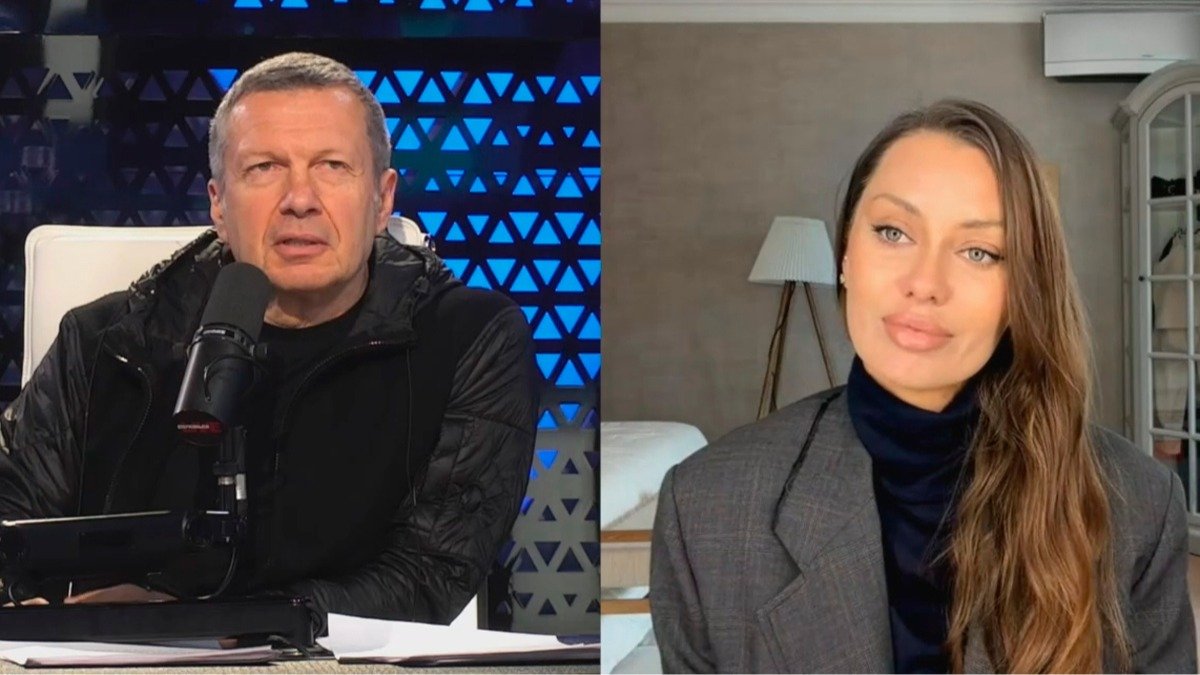
Propagandist Vladimir Solovyov and blogger Victoria Bonya met for a debate on the program 'Full Contact' on the channel 'Solovyov LIVE'. Their dialogue took place after Solovyov publicly insulted Bonya, calling her a 'worn-out slut' and 'Zelensky's agent' due to her address to Vladimir Putin. The conversation lasted about 40 minutes. The live broadcast, which began with demands for an apology for the insults, ended with criticism of deputy Milonov and a philosophical debate about who is to blame for the world's problems. Ultimately, the interlocutors agreed that the dialogue was positive and thanked each other for the opportunity to discuss accumulated problems. 'Novaya-Evropa' summarized the key points of the debate and also found out from a political scientist how this broadcast fits into the domestic political context. Photo: 'Full Contact' / Vladimir Solovyov. Beginning of the dialogue The debate began with Victoria Bonya recalling the backstory: her address to Putin, which garnered millions of views, provoked a stream of insults from Solovyov (as 'Novaya-Evropa' wrote, he called her a 'worn-out slut' and 'Zelensky's agent'). 'It started with me addressing pressing issues that are truly worrying people today. But for some reason, I heard insults from you in response, accusations that this text was written for me and that someone in the West paid for my address,' said Bonya. She added that she wanted an apology. In response, Solovyov unexpectedly continued the broadcast softly: 'Firstly, you look wonderful. Secondly: yes, of course, I must apologize. You are absolutely right. Of course, I was too emotional, and of course, whatever the motivation behind what I said and why I said it, - of course, I should have been much stricter with my words that were spoken live,' he said. However, he immediately added that it was 'strange' to label him as 'the country's main misogynist,' as there are many women on his shows to whom he shows respect, and '70% of misogynists are women.' Bonya accepted the apology and said she didn't expect the dialogue to be pleasant. Then the blogger announced that she had transferred 1 million rubles to help Dagestan. Solovyov immediately responded and stated that he was ready to personally send 1 million rubles to save birds in Anapa. 'If you are ready to transfer 1 million rubles, I know where to put it,' said Bonya. Instagram: Bonya - for, Solovyov - against The debate involved a discussion about the role of Instagram: Bonya stated that as of 2020, 3 million people 'fed' themselves through Instagram, promoting small and medium-sized businesses. Solovyov replied that he was not against business, but against Instagram, in his opinion, regularly publishing lies. Bonya agreed that disinformation happens but reiterated: for many people, Instagram remained the only place where they could talk about problems and be heard. The propagandist insists: there is the world of Instagram, and there is 'a completely different world' - the front, bombings, killed children. As an emotional argument, he recounted seeing 'a burnt child's head' in Kursk with his own eyes. "And when your address has everything except war, it's pain for people who don't live in Instagram. Because for us, war is here and now," Solovyov continued. Bonya said she fundamentally does not touch on 'foreign policy' topics: 'Now it's better to have some kind of unfavorable peace. Why is this important? Because there is already a lot of tension, terrible tension. I feel it in my heart, in my soul. That's why I made this statement,' said the blogger. Photo: 'Full Contact' / Vladimir Solovyov. Solovyov's main grievance: 'The people in Russia love Putin, they don't fear him' Solovyov cited one phrase from Bonya's address as the key reason for his sharp reaction - the statement that 'Putin is feared': 'My reaction was not so much to your address as to the fact that your address was noticed at such a level. ... It was about your initial message when you said words addressed to Putin: "Are you feared?" ... This is what caused an instant reaction in me, and it caused me fury when it was noticed at the top. Because the people in Russia love Putin, they don't fear him,' the propagandist stated. According to him, Western media immediately picked up this phrase to prove that there is no democracy in Russia and that Bonya is a 'Kremlin project trying to say: Putin is good, the boyars are bad': 'It's important for them to show that there is no democracy in Russia, that Putin is not loved, that he is a dictator. The people love Putin. Putin doesn't hear you. Putin hears. He is with the people. That's the point,' he said. Bonya tried to object, reminding him that in her address, she spoke about problems with governors who tell the president 'tall tales': 'I said that very often governors, when meeting with the president, tell stories - at least, they show us - that they tell tall tales. And that was the subject of the address,' she said. Solovyov countered, citing his personal acquaintance with Putin: 'Do you honestly think that Putin collects information solely from one source? ... I know how Putin works, how the information gathering system works. I know Putin personally.' Photo: 'Full Contact' / Vladimir Solovyov. A proposal for cooperation Contrary to expectations and Solovyov's repeated mentions that the blogger lives in Monaco, the dialogue at times became constructive. Solovyov proposed creating a platform in the state messenger MAX: 'Let's create a platform in MAX so that people can move there... you collect the requests you receive, we will create a joint platform, and I and my team will process them. If necessary, we will call governors, call ministers,' Solovyov said. He also acknowledged Bonya's correctness on some points, for example, regarding the mass slaughter of livestock in Novosibirsk. Bonya noted with satisfaction: 'Vladimir, at this very moment, I feel that you are being useful. Why couldn't it have been like this from the start?' 'We need to unite, Vladimir, not fight!' she continued. Solovyov agreed, but with a condition: 'No problem uniting with you. But with those who try to manipulate... who act against Russia's interests - how can we unite?' Photo: 'Full Contact' / Vladimir Solovyov. Bonya on Tuapse, Solovyov on war Bonya also spoke about 'the problems of ordinary people,' particularly the environmental disaster in Tuapse and the suffering of animals. 'What's the most painful topic now? Again, judging by Instagram. ... Tuapse is the most painful topic for people now because animals are suffering in huge numbers,' she said. Solovyov sharply changed the subject: 'The problem is the Ukrainian drone attacks. I started the broadcast with this this morning. ... The war is going on, Vik. Did you have bombings in Monaco today? No. But we have bombings on our territory. Vik, we are at war.' Bonya replied that she understood this but again stated that she 'does not comment on foreign policy.' Solovyov objected: 'This is not foreign policy. We are experiencing bombings. In Yekaterinburg, a residential building was hit. What foreign policy? ... It's not by chance that animals are suffering in Tuapse; Ukrainian Nazis attacked the oil refinery. That's the problem.' Bonya stated that for her, these are foreign policy issues and that she does not express her opinion on them because she is 'in a situation where it is better to focus on what truly concerns people within the country.' In response, Solovyov offered Bonya to become a permanent speaker on 'Solovyov Life' to broadcast 'here with the audience' and raise issues important, in Bonya's opinion. Solovyov also unexpectedly criticized deputy Vitaly Milonov, who had also insulted Bonya. 'Milonov is a person who knows my attitude towards him. I don't understand at all what he's doing in the State Duma. I don't understand why this person is in public politics at all. For what he said, he should have been removed from everything long ago,' the host stated. Refusal to apologize to Meloni Feeling that the dialogue was improving, Bonya asked him to apologize to the Prime Minister of Italy, Giorgia Meloni, whom he had publicly called a 'whore' and a 'fascist creature' ('Novaya-Evropa' wrote about this in detail). She insisted that insulting a woman is not decent, regardless of her political role. Solovyov categorically refused and distinguished between 'women' and 'politics': 'You're talking about her as a woman. Is she the Prime Minister of Italy? I'm not insulting her as a woman at all. This is a political issue. Italian politicians have called the President of the Russian Federation 'worse than an animal,' 'a bloody executioner.' ... Of course, I will gladly apologize, although she herself wrote that she doesn't care. And who will apologize to Putin? And who will apologize to our people?' Bonya tried to evade the answer and said: 'As a woman, as a mother, I am for creating peace somewhere.' The finale: 'Are men failing?' and farewell Towards the end of the broadcast, Bonya asked a philosophical question: 'Don't you think that men are failing in world politics?' Solovyov responded by asking if the blogger didn't think this phrase could be called misandrist. 'I think humanity as a whole is failing - both men and women. It's much worse. ... Humanity is in such terrible trouble that it is heading towards an inevitable catastrophe,' the propagandist expressed his opinion. Then Solovyov stated that 'this trouble was created by men, who were raised by women, because every man was born of a mother.' They said goodbye on a positive note. Bonya said: 'I didn't think I'd say this today, but I'm very glad I'm saying it. So thank you.' Solovyov replied: 'Thank you, Vika. ... We've reached a very important point of discussion.' Photo: 'Full Contact' / Vladimir Solovyov. 'An imitation of domestic policy' Solovyov and Bonya's debate is 'an imitation of domestic policy' that allows for venting steam but doesn't solve problems, political scientist Ivan Preobrazhensky told 'Novaya-Evropa.' - I suspect that soon we will see all these debates end up somewhere in the Public Chamber or the Presidential Council for Human Rights. And it doesn't matter whether Victoria Bonya spoke from the heart or not. But debates with Solovyov are, from the authorities' side, a clear redirection of the topic towards venting steam,' he said. Preobrazhensky believes that the broadcast was most likely initiated by the presidential administration, but without direct orders to Solovyov and Bonya. 'It is enough to exert the right media influence, then give a signal that it would be good to speak out, that it would be good to hold debates. And now this mass, quite natural and sufficiently active protest, which caused Bonya's statement, is simply being channeled,' the expert explained. The political scientist noted that the problems Bonya discussed in her message to Putin remained unanswered. 'As far as I understand, none of her statements were even close to being addressed,' he said. In his opinion, the debates were reduced to mere pleasantries, and the real problems were not voiced.
2 days ago