government
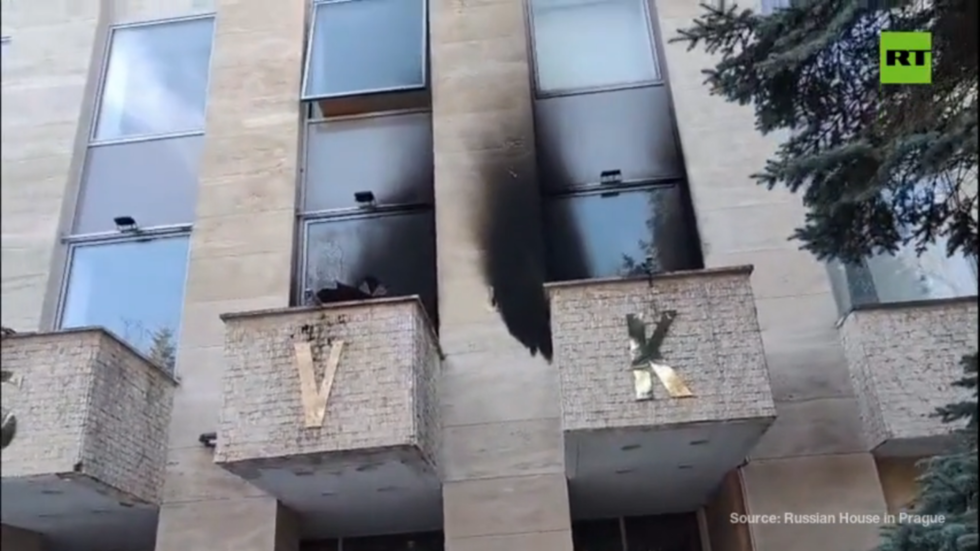
Russian House in Prague pelted with Molotov cocktails on March 26
Igor Girenko said that three of the six Molotov cocktails did not explode
9 days ago
Unidentified attackers threw several Molotov cocktails at the Russian House, a Russian cultural center in Prague, on the evening of March 26, damaging library windows and the building’s facade but causing no injuries. Government-aligned reports agree that Czech firefighters and police responded quickly, that at least six firebombs were used—three of which failed to explode—and that Czech authorities have opened a criminal investigation under which any suspect could face a prison sentence of up to three years.
Across these accounts, the Russian House is consistently described as a cultural institution hosting Russian Culture Days at the time of the attack, reinforcing the perception that the timing was deliberate. Both government and opposition framings would recognize that the Russian Foreign Ministry formally protested the incident by summoning the Czech ambassador in Moscow, demanding a thorough investigation, punishment of those responsible, and guarantees of security for Russian diplomatic and cultural facilities in Prague.
Characterization and terminology. Government-aligned outlets describe the incident as a terrorist attack and a barbaric act against a peaceful cultural venue, emphasizing the symbolic targeting of Russian culture during Russian Culture Days. Opposition-oriented sources are more likely to frame it as an act of political vandalism or criminal arson rather than terrorism, stressing the absence of casualties and the limited physical damage. This contrast turns on whether the attack is treated as part of a broader campaign of terror or as a serious but localized protest-related crime.
Responsibility and underlying motives. Government media stress that the attackers are "unidentified" while strongly implying that an anti-Russian climate in Europe and Czech hostility toward Moscow may have encouraged such violence. Opposition sources would more likely avoid speculating about the perpetrators’ identities or foreign involvement, instead situating the incident within domestic dissent over Russia’s actions abroad and the contentious role of Russian institutions in EU states. Where government outlets highlight external Russophobia and Western permissiveness, opposition voices tend to underline homegrown discontent and reject broad-brush geopolitical blame.
Diplomatic framing and obligations. Government-aligned coverage foregrounds the summoning of the Czech ambassador, casting Russia as a state insisting on its rights under international conventions to protect diplomatic and cultural missions and demanding strong security guarantees. Opposition reporting would likely acknowledge these diplomatic steps but frame them as part of Russia’s wider pattern of using consular incidents to pressure EU governments and claim victimhood. Thus, one side stresses legal obligations and security assurances, while the other questions the proportionality and political intent of Moscow’s diplomatic response.
Security climate in Europe. Government outlets tie the attack to what they portray as an increasingly dangerous and intolerant atmosphere for Russian citizens and institutions in Europe, warning that insufficient action by host states will normalize similar attacks. Opposition sources would be more inclined to argue that, while such violence is unacceptable, it occurs within a broader context of heightened tensions driven by Russia’s own foreign policy and war, and they may highlight how European authorities generally do respond to protect foreign facilities. This leads government narratives to emphasize European failure to curb Russophobia, while opposition narratives emphasize reciprocal escalation and shared responsibility for the deteriorating security climate.
In summary, government coverage tends to portray the attack as a terrorist assault born of systemic Russophobia that demands strong diplomatic and legal retaliation, while opposition coverage tends to depict it as a serious but more limited criminal incident rooted in political tensions and to question Moscow’s broader narrative of victimhood.