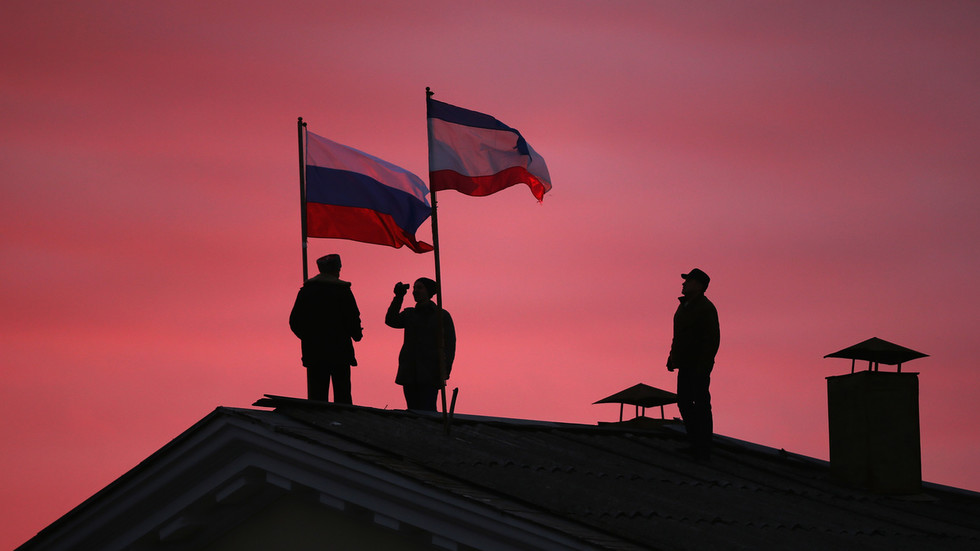
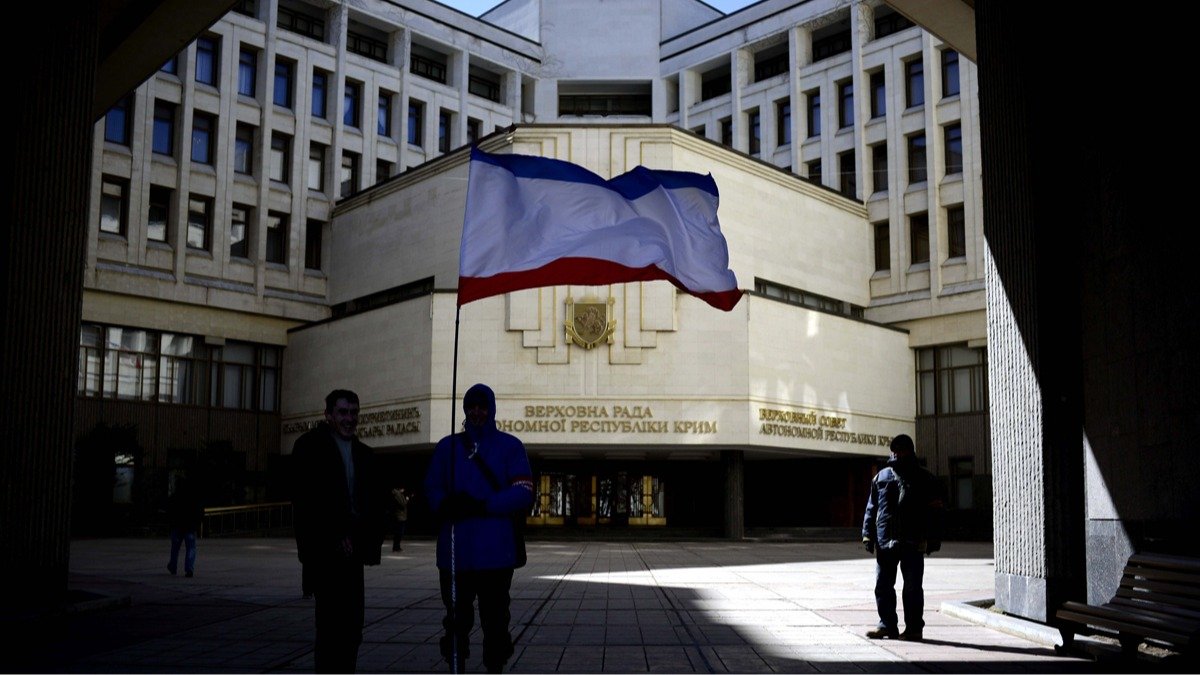
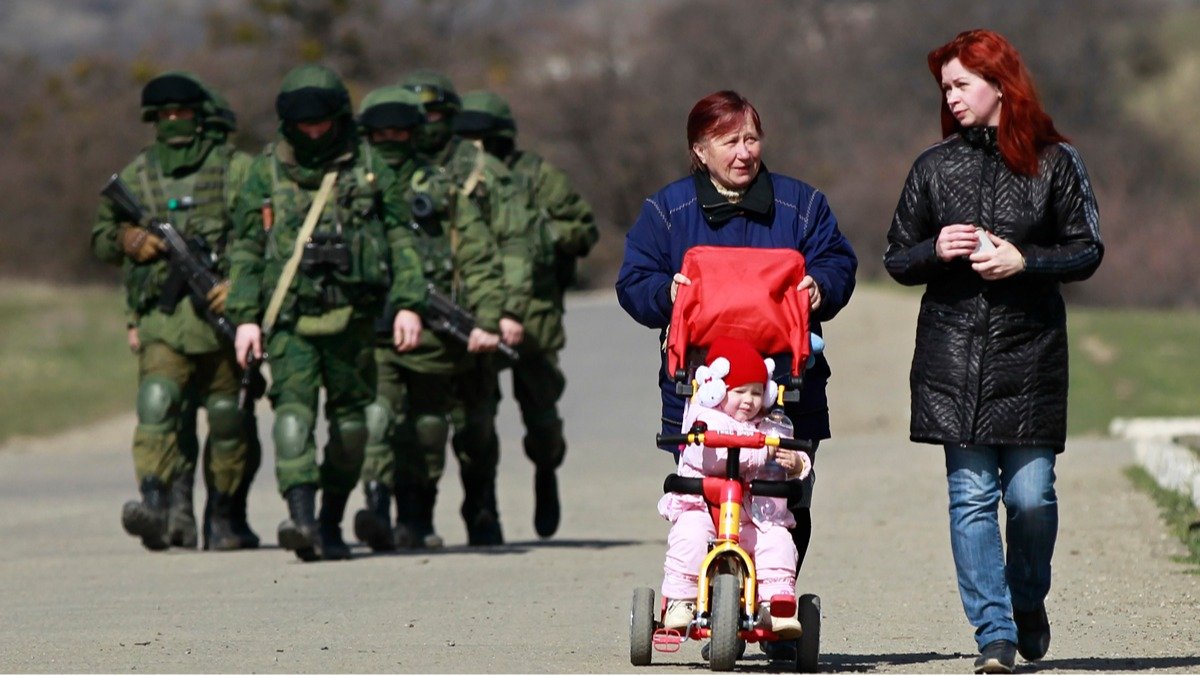
On Sunday, March 16, 2014, a "status referendum" was held in Crimea. And on March 18, Russia announced the annexation of Ukrainian territory. Eight more years passed – and it started a full-scale war in Ukraine: thousands of dead civilians, hundreds of thousands of dead soldiers, millions of refugees, destroyed cities, minefields that will remain unusable for another hundred years. We recall how it all began in 2014. Local residents pass by armed people in military uniforms without insignia at the entrance to a Ukrainian military unit in the village of Perevalnoye near Simferopol, March 14, 2014. Photo: Yuri Kochetkov / EPA.Beginning On the night of February 21-22, 2014, Ukrainian President Viktor Yanukovych fled to Russia. No one attacked his country. Ukrainians themselves protested against him at Euromaidan, and he fled from them. A week later, in Rostov-on-Don, where the former Ukrainian president temporarily settled, he held a press conference and stated that he remained the legitimate head of state and was forced to flee because a coup had occurred and his life was threatened. Eight years and two days later, another president of Ukraine, when his life was threatened not by fellow citizens but by a huge neighboring country that attacked, would tell Western leaders in response to an offer to flee: "I need ammunition, not a ride." In 2014, Yanukovych left Ukraine in a state of political vacuum and complete chaos. "Ukraine lay bleeding and unconscious, with Crimea sticking out of its handbag," as Alexander Nevzorov described it at the time. While Yanukovych was telling Russian journalists that he was still the president of Ukraine, in Simferopol, the capital of the Autonomous Republic of Crimea within Ukraine, armed men in camouflage without insignia had already disembarked from trucks. They blocked the airport, administrative buildings, including the government, and military units. Why the Ukrainian army, Yanukovych's army at the time, offered no resistance is a separate question. Armed men seized the parliament building, and the Crimean deputies, locked inside, obediently passed a decision to dismiss the government of the autonomous republic and to hold a referendum on the status of the peninsula in Crimea soon. Later, it became clear that they didn't even wait for Yanukovych to flee: the medal "For the Return of Crimea," which began to be awarded in the Russian Federation, bears the date of the operation's start – February 20. Crimea The date of the future referendum was announced by the Crimean "parliament" on March 6. It was scheduled for the 16th, ten days later. Why delay? I flew from Moscow to Simferopol to see how Crimeans would vote under the muzzles of the "little green men's" automatic rifles. But there were no automatic rifles. That is, the masked "greens" stood everywhere with automatic rifles, next to their armored personnel carriers parked right on the streets, among the cars. But Crimeans who came out onto the streets were not afraid of them; they took pictures with the unidentified militants. What those who were afraid to come out under the muzzles of automatic rifles thought is unknown. And those who strolled around happily told me into the recorder: these "polite people" protected all of Crimea. Protected from what? After traveling the entire Southern Coast for a week, I never got an answer to this question. They spoke of trains with Ukronazis supposedly heading straight for Sevastopol, and how Russians were allegedly oppressed in Crimea, forced to send their children to study in hated Ukrainian. There were only seven Ukrainian schools on the entire peninsula; the rest taught in Russian. March 16 was a festive day in Crimea. I saw dogs painted in the colors of the Russian tricolor. People with Ukrainian flags stood along the roadsides and tried to spoil this celebration of life, but there were so few of them that even the "polite" ones in their tanks did not approach them. A dog painted in the colors of the Russian tricolor, Gurzuf, March 2014. Photo: Irina Garina / "Novaya Gazeta Europe." Crimeans who came to vote early in the morning rejoiced as if they already knew the referendum results. Later, the leader of the Crimean Tatars, Mustafa Dzhemilev, would calculate that only 34.2% of Crimea's residents showed up at the polling stations. How so, if the whole peninsula was just waiting for reunification? Russian authorities would deny this blatant lie and report that all 123% of Crimeans came to vote, and 97% of them voted for "reunification." The results were predictable even from the questions on the ballots: the option "to remain part of Ukraine" was not even offered. The choice was: Crimea – on its own or as part of the Russian Federation? The "on its own" option could not possibly satisfy Crimeans. More precisely, they said that Crimea would perfectly sustain itself, at least through tourism, but the Crimean Minister of Information, Dmitry Polonsky, appointed by the Russian authorities, admitted that tourism officially brought the peninsula only 10% of its income. "Annually, resorts on the Southern Coast of Crimea were visited by 5–6 million tourists – 2–3 people for each Crimean. Renting out housing was the main source of income for locals. From May to September, they rented out every available square meter of their housing. Those who didn't have extra meters became tour guides. In general, they earned like "freelance artists." Owners of hotels, restaurants, sanatoriums, and other enterprises in Crimea hired workers from mainland Ukraine and said that indigenous Crimeans were physically unable to come to work at nine and stay there for eight hours. In the autumn of 2013, the owner of a vineyard near Massandra shared with me that his Pinot Gris harvest was lost because there was no one to harvest it; the resort season ended, and no one wanted to work. From May to September, Crimeans earned; from October to April, they lived on their earnings. This is how Crimeans lived, but not Crimea. In early March 2014, banners with portraits of pop stars appeared on almost every street, urging: "I declare my income to you, Ukraine!" And in the first shop, you understood that, besides these conscious people, apparently, no one else declared their income. Cash registers were only in large hypermarkets like Auchan and at gas stations. What did Crimeans actually vote for, if we exclude the fear of Nazis on a train and seven Ukrainian schools? A week before the referendum, homemade A4 posters printed on an inkjet printer were hung all over Simferopol. They talked about the difference in salaries for public sector employees in Ukraine and Russia, that every doctor and teacher in the Russian Federation has their own apartment, about free medicine and a secure old age. This is not banners with a tricolor and "Crimean Spring"; it's closer to word of mouth: ordinary people, so to speak, share information with each other. Of course, Crimeans already knew how well people lived in Russia, but posters on fences reinforced this knowledge. Flyers on a fence in support of the referendum, Simferopol, March 2014. Photo: Irina Garina / "Novaya Gazeta Europe." Five days before the referendum, at a gas station, I was promised that gasoline would become cheaper on March 17 because "Russia is coming." At the car service, they told me what roads "Russia will build" in Crimea in just a couple of days. On Saturday, March 15, a pharmacist shared her calculations: tomorrow, her salary would immediately quadruple. Crimeans not only calculated how they would live when "Russia gave money," but they started spending it: in a mobile phone store, a young man bought the latest iPhone model, paid with a credit card, and said he would repay the money as soon as "Russia raised his salary." Soon, they would experience bitter disappointment: utility bills would rise along with salaries, cash registers would have to be installed everywhere, and beaches would be fenced off by new landowners from Moscow and Tyumen. But that's another story. The referendum proceeded smoothly and festively. The OSCE "expressed concern," the US State Department stated "concern about the situation," but overall, the world community swallowed this "reunification" almost as it had swallowed the war with Georgia six years earlier. And less than a month later, on April 12, 2014, an armed detachment of Russian militants led by Igor Strelkov entered the Ukrainian city of Sloviansk. Thus continued the war that began on February 20, 2014. Donbas "We thought it would be like in Crimea," a disgruntled Donetsk resident told me in 2017. The place where he lived was now called by the abbreviation DNR; there was no normal banking system, cellular communication barely worked, mobile internet was forgotten, medicines disappeared from pharmacies, and for diapers for children, one had to travel to Rostov-on-Don, standing for hours in line at the border. Gunfire could be heard in the city from time to time because the line of contact was a few kilometers away. I don't know when the myth was born that Donbas had always dreamed of becoming part of Russia. In 2012, when the European Football Championship was held in Donetsk, it hardly dreamed of it. The city was blooming, the asphalt was washed in the mornings, "Okean Elzy" performed there on tour from Lviv, textbooks in Russian were sold in bookstores, and on Victory Day, the head of the regional administration handed veterans car keys. Luhansk, a working city, if it dreamed of reuniting with someone, it was more likely with the USSR. In 2013, ice cream was advertised there that tasted "like before." Voters at a polling station in Simferopol during the referendum, March 16, 2014. Photo: Jakub Kaminski / EPA.In the autumn of 2013, when Euromaidan began in Kyiv, Donetsk residents also went there. Not because they strongly desired European integration; opinions on this matter varied. But students who came out for this very European integration were beaten in Kyiv, and the residents of Donbas went to protect the children. And in February 2014, shortly after Yanukovych's flight, when Ukraine was in a state of power vacuum and confusion, when "Crimea was sticking out of its handbag," protest rallies began to flare up in regional centers close to the border with Russia. "Even before the annexation of Crimea, in Donetsk and Luhansk, demonstrators demanded not accession to Russia, but "federalization of Ukraine" and "expansion of regional powers." In particular, they insisted that revenues from the coal industry should remain in the mining region and not go to Kyiv. People even remotely familiar with life in Donbas could not fail to know that their coal industry had no revenues, their mines were unprofitable and survived on subsidies from Kyiv, and the Yanukovych clan was involved in scams with these subsidies and illegal mines – "kopankas." But people who spoke Russian without any surzhyk came to the rallies, and Russian tricolors rose above the crowd. Nevertheless, even those residents of Donbas who were drawn into the ideas of "federalization" did not talk about joining Russia then. On April 6, in Luhansk, a group of people who somehow obtained automatic rifles seized the SBU building and an arms depot. Surprisingly coordinated, another armed group in Donetsk seized the regional state administration (RSA) – a huge 11-story building. Inside, it was quickly turned into a dump with non-functioning elevators and sewage, with papers thrown out of offices, and from the outside, it was surrounded by tires, barbed wire, and other garbage. Of the three plasma screens that once stood in the RSA lobby, two simply disappeared, and the third was placed on the porch. "Russia-24" broadcast non-stop from the screen, telling the residents of Donbas what was happening in Donbas, how "Right Sector" and other Nazis were approaching it. The local television center had also been seized by this time, and Ukrainian television broadcasting ceased. On April 7, people who seized the RSA building in Donetsk announced the creation of the "DNR" with a "provisional government" at its head and a referendum to be held soon – modeled after Crimea. On the seventh floor of the former RSA, the press service of the "DNR government" opened, and they even somehow acquired stamps for "accrediting" foreign journalists. Pro-Russian rally after the referendum in Simferopol, March 16, 2014. Photo: Yuri Kochetkov / EPA.On April 12, militants led by Strelkov seized a police station in Sloviansk, obtained the weapons stored there, and set up checkpoints. But, as local residents recount, it all began not in April, but much earlier: on February 20 (the same day as indicated on the medal for Crimea), local communists held the first rally "in support of the referendum." What referendum? They themselves couldn't explain it, and the Crimean one hadn't even been announced yet. Then a series of similar rallies followed, and by April 12, when Strelkov's militants entered Sloviansk, the city was already agitated. Then, armed groups seized administrative buildings in Kramatorsk, Druzhkovka, and Bakhmut. The next day, April 13, Ukraine announced the start of an anti-terrorist operation against the groups that had seized entire cities in the southeast of the country. "After Yanukovych's flight, only a month and a half passed, Ukraine had not yet managed to assemble itself, and the duties of the president were performed by the Chairman of the Verkhovna Rada, Oleksandr Turchynov. Special forces of the Ministry of Internal Affairs and National Guard troops were sent to the southeast. Later, analysts would say that this was a mistake, that Turchynov gave in to provocation, that it was this that turned clashes with separatists into the beginning of the war and gave Russian propagandists the argument "Donbas was bombed." But Strelkov himself boasted: "I pulled the trigger of the war. If our detachment had not crossed the border, everything would have ended like in Kharkiv, like in Odesa. There would have been several dozen killed, burned, arrested. And that would have been the end." Pro-Russian activists at barricades in front of the Security Service of Ukraine building in Luhansk, April 8, 2014. Photo: Yuri Strel'tsov / EPA.Referendum Referendums in Donbas were scheduled for May 11. Luhansk was less featured in the news; it essentially followed Donbas, where all the main events were happening. Russian television (and there was no other in the "DNR" and "LNR" anymore) showed huge crowds of Donetsk residents eager to vote for federalization. And it wasn't lying: queues indeed formed at polling stations in Donetsk on May 11. But the explanation for these queues was not ideological but purely arithmetic. The Minister of Education of Ukraine, Serhiy Kvit, made a serious miscalculation then. The day before the referendum, he announced that directors who allowed polling stations to be opened in their schools would be fired. About one in five directors disobeyed, and polling stations had to be merged. Each had to accommodate five times more voters. Further – let's continue counting. As the head of one commission recounted, most of her colleagues, who had been involved in organizing elections for many years, refused to work. Random replacements had to be found for them, but even with them, the commissions were halved. This meant not five, but ten times more voters per person. Moreover, these commissions consisted of inexperienced people. They already worked slowly, but in addition, they lacked basic tools. "They made ballot boxes themselves, cutting holes in cardboard boxes, and to register voters, they manually lined A4 sheets on the go and wrote down the names of those who came. The resulting queues could only be endured by highly motivated voters. And they were so motivated that they went from one polling station to another. The commissions had no lists, they didn't have time to check passports, and in principle, anyone could vote. However, these commissions completed the referendum results with fantastic speed. I remember I managed to run from the polling station to the rented car, opened my laptop, turned on the radio – and heard that everything had already been counted: in Donetsk, 89% of "voters" voted for "state independence of the republic," and in Luhansk – 94%. "A situation has arisen" Once again: even in these "ballots" at these "referendums," it was not about joining Russia, but specifically about "state independence." At rallies, the leaders of the "republics" certainly shouted about agreements with Putin himself and future benefits as part of Russia – following Crimea's example, but something apparently broke down shortly before May 11. Four days before the "referendum," on May 7, the head of the OSCE and President of Switzerland, Didier Burkhalter, flew to Moscow. They talked with Putin about something, and suddenly the Russian leader "sharply changed his rhetoric," as the Russian press wrote. He addressed Ukraine like a true peacemaker: "We need to find a way out of the situation that has arisen at the current moment," Putin said. He spoke about the crisis that "arose in Ukraine" – as if it arose on its own, albeit due to "those who organized the state coup in Kyiv." Experts began talking about some "financial intelligence data" that the Swiss president allegedly presented to Putin to get him to back down. And indeed, after meeting with Burkhalter, Putin appealed to the leaders of the "people's republics": "We ask the representatives of southeastern Ukraine, supporters of the country's federalization, to postpone the referendum scheduled for May 11 of this year." An armed man at a polling station during the referendum in Donetsk, May 11, 2014. Photo: Photomig / EPA.The representatives did not understand Putin; they held their referendum and waited for Moscow to start praising them. On the evening of May 12, "supporters of federalization" were summoned to another, now festive, rally in front of the barbed wire near the RSA building. It was announced that a congratulatory telegram would come from the Kremlin and would be read to the people of the DNR. It is unknown whether Putin sent a telegram to the DNR, because a message from the Kremlin website was read at the rally: Moscow "respects the will of the people of the Donetsk and Luhansk regions," hopes that "the practical implementation of the referendum results will proceed in a civilized manner," and "through dialogue between representatives of Kyiv, Donetsk, and Luhansk." There was no mention of Moscow being involved in the dialogue. The Western press spoke of de-escalation in southeastern Ukraine. But the war continued. In late May, Ukrainian troops tried to recapture the Donetsk airport. Then they managed to regain control of Sloviansk and Kramatorsk. In June, Putin met with Burkhalter again – this time in Vienna, and it seemed that after this, Russia would definitely start retreating. But on July 17, 2014, near Donetsk, "monkeys with grenades," having received a Buk SAM system from Russia, shot down a passenger Boeing and killed 298 people. If any de-escalation was planned before that, it was now out of the question. Denis Pushilin (second from right) speaks to supporters in Donetsk the day after the referendum, May 12, 2014. Photo: Maxim Shipenkov / EPA.Minsk and the War By August 2014, the Armed Forces of Ukraine managed to regain control of part of the territories occupied by separatists. Putin repeated that Russian troops were not involved in combat operations in Ukraine; only local "miners and tractor drivers" were fighting there, and if they were in uniform, "you can buy it at a military store." But in August 2014, "Novaya Gazeta" found evidence that regular Russian military personnel – paratroopers of the 76th Pskov Division – were fighting and dying in Donbas. At the same time, the SBU announced the detention of ten servicemen of the 98th Svir Airborne Division near Donetsk, but the Russian Ministry of Defense explained that the paratroopers had simply gotten lost, were walking near the border – and accidentally crossed 20 kilometers into Ukrainian territory. Later, the SBU and the Prosecutor's Office of Ukraine would claim that in August 2014, 3,500 Russian soldiers, 60 tanks, 60 artillery pieces, and 320 armored vehicles participated in the battles for Ilovaisk. Ilovaisk, where Russian troops managed to trap Ukrainian soldiers, became one of the most dramatic episodes of this stage of the war. This was precisely because, on the Russian side, it was no longer miners from a military store fighting, but the army. In September 2014, with the mediation of the OSCE, the parties signed the first Minsk Protocol – an agreement on the implementation of a peace plan. "The word "parties" must be used here because there is no other suitable term: it was not Ukraine and Russia, because neither Vladimir Putin nor the then-elected President of Ukraine, Petro Poroshenko, signed the document. It was signed by: Mikhail Zurabov – Ambassador of the Russian Federation to Ukraine, transferred from the post of Minister of Health, Leonid Kuchma – former President of Ukraine, a certain Igor Plotnitsky and Alexander Zakharchenko, who presented themselves as leaders of the non-existent "DNR" and "LNR." In 2015, after the "Debaltseve cauldron," a second protocol was signed – Minsk-2. The document was agreed upon by the leaders of Ukraine, Russia, Germany, and France – the "Normandy Four." Both sides called the Minsk protocols unenforceable and largely did not implement them in practice. But the documents provided for the withdrawal of troops and heavy equipment, and this was done. Hostilities continued, but real de-escalation began. This can be understood at least by how the number of civilian casualties changed. Vladimir Putin and President of Ukraine Petro Poroshenko before the start of negotiations in Minsk, Belarus, August 26, 2014. Also in the photo: EU High Representative Catherine Ashton and President of Kazakhstan Nursultan Nazarbayev. Photo: Sergey Bondarenko / EPA.According to the UN monitoring mission, from April to December 2014, 2,084 civilians died in southeastern Ukraine, of whom 85–90% were in the Donetsk region. In February 2015, Minsk-2 was signed, and the total number of deaths for the year was 954. In 2016 and 2017, 112 and 117 people died, respectively. From 2018 onwards, the count was in the tens. There were practically no mass battles; mostly exchanges of fire occurred along the line of contact, civilians could get hit by a stray bullet, but most often they died by stumbling upon a mine or an unexploded ordnance. In 2021, the UN mission recorded 25 civilian deaths. And on February 24, 2022, Russia decided that it was not protecting Donbas well enough, which the Armed Forces of Ukraine had been bombing incessantly for eight years. In 2022, 8,384 civilians died in Ukraine, according to the UN.