March 18, 2026
“I am simultaneously a citizen of Ukraine and a citizen of Crimea.” Stories of people who survived the annexation and left the peninsula after the full-scale war began
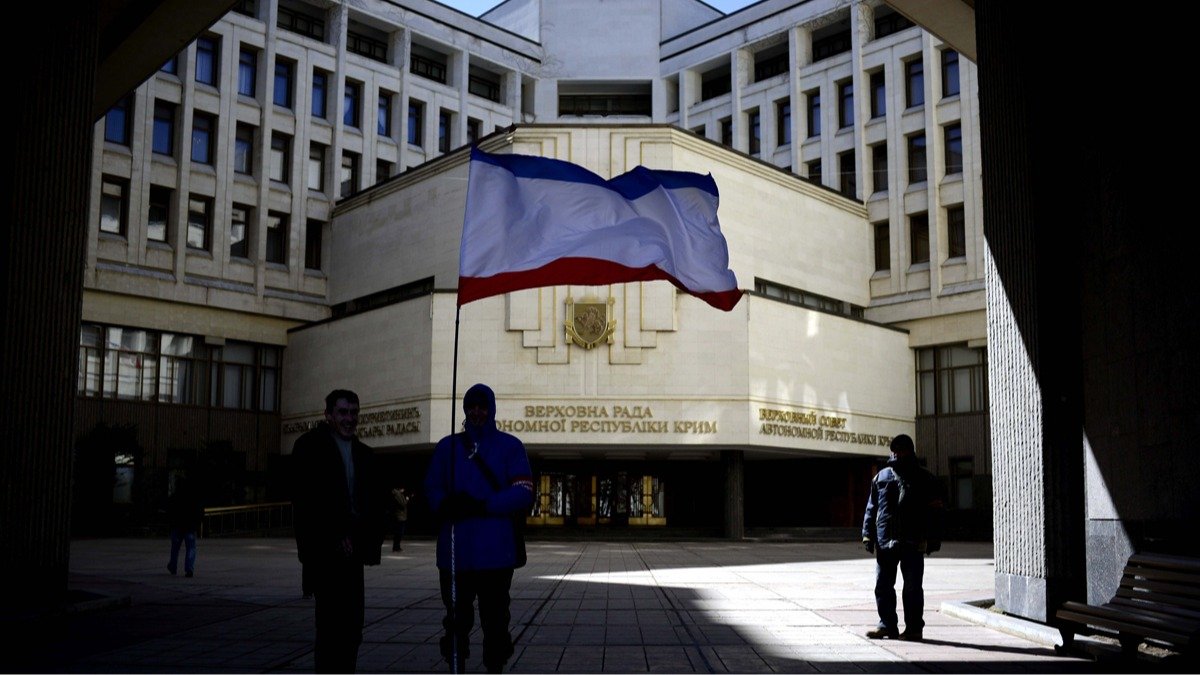
On March 18, 2014, Vladimir Putin announced the "accession" of Crimea and Sevastopol to Russia. Local residents already knew then what world isolation, sanctions, and life in a gray legal field were. For 12 years now, many Crimeans have been experiencing an identity crisis: for mainland Ukrainians, they have become completely strangers, and for Russians, they have never become one of their own. Tens of thousands of people have left the peninsula over these years. Legal problems are superimposed on the internal crisis: many have two passports, while information is often not found in Ukrainian databases, and Russian documents issued on the peninsula are not recognized by some European countries. "Novaya-Evropa" talks about how Crimeans who left their homeland due to a full-scale war live today, and who they feel they are after 12 years. All the names of the heroes have been changed - they fear possible problems with the jurisdiction of both countries. People with the flag of Crimea in front of the parliament building in Simferopol, March 17, 2014. Photo: Jakub Kaminski / EPA. "When you are a Crimean, you feel like you are neither here nor there." - It seemed like a very strange story, something smelled wrong, - recalls Vitaly about the annexation of Crimea. He was 21 years old then, studying at a university as a geodesist. - It so happened that in my circle there were university guys from both sides. They went out [to rallies] on both sides. Once, with friends, we walked past the central square of Sevastopol - Nakhimov - and saw a celebration related to the referendum and the official movement. It became so disgusting and unpleasant. Vitaly did not notice many people from his circle leaving Crimea after the annexation - only a few acquaintances of acquaintances. He himself says that he also thought about leaving, but "got used to it" - he was born here and lived his whole life, so he stayed on the peninsula, periodically torturing himself for this decision. - I blamed myself for not leaving, - says Vitaly. - Then I blamed myself in 2022, why didn't I leave then? I felt like I was becoming too inert. And generally showing silent consent. A common story for a Crimean: the flags change, and I sit in place. Vitaly became a citizen of the Russian Federation long before the annexation - his parents often traveled to Russia and obtained dual citizenship for their minor son for easier travel. After the "referendum," the man did not make new documents - he simply continued to live with two citizenships, without notifying the migration services. This is a common story: before 2022, many Crimeans updated their Ukrainian documents by going, for example, to Kherson, where officials turned a blind eye to the lack of registration on the mainland. On February 24, 2022, Vitaly again began to think about leaving - the full-scale war frightened him: - A couple of weeks later [after the start of the war], my friends and I went to an event. And I was shaking so much that people were happy, as if they didn't notice anything. There was wild anxiety. A police officer on cordon duty near a beach in Sevastopol after a missile attack, June 24, 2024. Photo: Alexey Pavlishak / Reuters / Scanpix / LETA. Vitaly shared his thoughts about leaving with his girlfriend, who was also frightened: people in uniform came to several of their mutual friends and acquaintances, some had searches. The information background with videos of apologies from Crimeans persecuted by pro-Russian activists for songs and yellow-blue colors also weighed down. - Mobilization served as the final kick in the ass, - says Vitaly. - And even then, I think I would have thought about it again. Thanks to my girlfriend, who said: "We have to go, you've been sitting around too long, young man." So we left. The first point of the long route was Georgia. The couple lived there for six months, trying to update their Ukrainian documents - the Georgian embassy reported that Vitaly and his girlfriend "do not exist," their data, like many Crimeans, was not in the Ukrainian registries. As a result, they decided to go to Poland. - Upon entering Belarus, there were questions, since the Russian passport stated "place of birth - Ukraine," - says Vitaly. - They asked if I had a Ukrainian passport. I replied that I was just traveling, and the passport was somewhere at home. Upon leaving Belarus, they asked by what document I would enter Poland, I showed them my Ukrainian passport - they let me through. In Poland, Vitaly first went to the consulate. - I met a not very pleasant lady at the window, - he recalls. - She said that if I hadn't made the documents before 2022, then I don't need them. The first and only person in Poland who told me "Spierdalaj" (Polish "get lost." - Ed.) was a Ukrainian woman. After a month, Vitaly managed to update his Ukrainian passport. He doesn't think about returning to Crimea - he doesn't see such a possibility. - The prospects are vague, - the man reasons. - I don't want to say: well, if the conflict ends with a return to the borders of 1991, then I'll return. Today, in 2026, it's hard for me to imagine something like that. For some reason, I'm a bit of a pessimist now. I don't see a scenario where the war ends, Crimea returns, I arrive - and that's it. I can't fantasize about it. Vitaly says it's hard for him to plan anything - the full-scale war has been going on for more than four years. Like many Crimeans, the man has difficulties explaining to others who he is: - When you are a Crimean, you feel like you are neither here nor there. It may not be reflected in communication, but inside there is still some grain, as if I am a deceiver of those, and others, and others, and others. There are anti-war emigrants from Russia and Belarus, there are Ukrainians. " With Ukrainians, I can associate myself by birth and roots. But sometimes I feel a little ashamed to feel a sense of community with them, because people who left Ukraine, after all, left because of bombings, because of the war. I left because of Comrade Major, disagreement, and rare drones. As if I am such a young man who was afraid that his favorite coffee was not brought, and therefore left. Now the man reads news from both countries. While living in annexed Crimea, he got used to following materials from independent Russian media, and after the start of the full-scale war, his list was supplemented with Ukrainian media. Separately, Vitaly always monitors news about air alerts in Ukraine - his distant relatives and some friends live there. A ceremony for sending mobilized Crimeans to Nakhimov Square in Sevastopol, September 27, 2022. Photo: Viktor Korotaev / Kommersant / Sipa USA / Vida Press. "I wanted to live in Crimea my whole life." In 2014, Marina was 17 years old - she was studying at a university as a philologist. The girl had been reading Russian literature in huge volumes since childhood and dreamed of connecting her life with texts. She perceived everything that was happening in Crimea more as a historical background for life, which amazed her with its scale: - I had some idiotic childhood feeling of a small celebration, because Crimea is talked about in all world media. Wow! As if the place where I live is so famous and important that the whole world knows and talks about it. Then I didn't understand what a disaster it would turn into, - recalls the girl. Marina was raised by parents who celebrated New Year's Eve twice their whole lives: according to Moscow and Kyiv time. - I never liked Putin, but at 17, I was, let's say, very strongly influenced by my parents, - admits Marina. - And they adored [Putin] and always said that Khrushchev gave Crimea [to Ukraine]. The TV was always on Russian channels at home. Little has changed for them since then. But then I started to develop critical thinking, I began to understand that this [annexation] is illegal. On the other hand, everyone around whom I knew was mostly happy. I saw another point of view, for example, posters "Fuck war" in my university. But it seemed to me that there were fewer of them. Growing up, Marina became more interested in what was happening around - in Crimea, according to her, Russia quickly began to "tighten the screws." In 2017, an anti-corruption rally, which the girl planned to attend, was canceled in Sevastopol. In 2021, Marina participated in winter rallies in support of Alexei Navalny - the first anti-government actions on the peninsula in 7 years - some of her friends and acquaintances were detained there. After graduating from university, the girl managed to work for several months on local television. She hoped to avoid compromises with her conscience, but failed. - I thought I would just talk about local problems, I wouldn't say anything about Putin, - recalls Marina. - But my disappointment was huge. I wrote all sorts of nonsense about the deputies of "United Russia." As soon as I found another job option, I ran away from there. In parallel with her work in journalism, Marina took copywriting courses to earn money by writing commercial texts. For another year, the girl worked in the press service of the department of health, where there was less politics than on television, but the work still seemed like a compromise. At the same time, Marina started dating an opposition Crimean journalist, and soon got a job in an IT company. The girl's political position finally took shape in 2022 with the start of the full-scale war: - A very powerful reevaluation of values took place, - says Marina. - Before 2022, I thought that [annexation] was a complete disaster, but what happened has happened, and you have to live as is. I wanted to live in Crimea my whole life - that was the plan. In 2022, I began to study what I didn't know, reread some old media articles, analytics, to understand why the war didn't start in 2014. Why did Russian troops simply cross the Crimean border and not meet massive resistance? How flagrantly wrong it was, probably only reached my brain in 2022. A couple of months before the start of the full-scale war, the girl turned 25 - she planned to go to Kherson in February to update her internal passport, received at 16, before the annexation, but didn't make it. - On the same day, February 24, late in the evening, they came to search the person with whom I was in a relationship, - recalls Marina about the events of the first day of the war. " - It so happened that I was alone at his house and met eight FSB officers. The stress level was colossal. The feeling of security, my personal one, and of the people I love, was destroyed instantly. It seemed to me that for what I and my loved ones said, at any moment some punishment could befall us, someone would complain to someone. Even at a time when there were no laws on discreditation. So I thought that as soon as there was some technical possibility, I had to leave here. Residents of Sevastopol watch the live broadcast with Vladimir Putin on the city embankment, April 17, 2014. Photo: Anton Pedko / EPA. Marina and her partner left Crimea seven months later. She was ready to leave immediately, back in February, but the young man weighed the decision longer and prepared for departure - he found temporary work on a construction site instead of his permanent journalism job and prepared his parents for separation. Having saved some money, the couple went to Georgia - it was the closest country accessible financially and legally: Marina left on a Russian international passport, with which she still lives. According to her, this significantly affects her life. - I am in exile with Russian documents, [issued in Crimea], which few countries generally recognize as genuine, - she says. - For three years now I have been trying to resolve this, but so far nothing has come of it. I have been to Ukrainian consulates in Georgia and Antalya - they told me that my documents are invalid. To issue a simple white passport (a temporary identity document in lieu of a lost passport abroad. - Ed.), which I could use to enter Ukraine, the consulates made requests to Ukraine. Both times I was told that there was no connection with the Crimean archives. I know there are branches of Ukrainian passport offices. But I unfortunately didn't make it to Turkey, where you can enter with a Russian passport without a visa, it closed. In the near future, I plan to go to Chisinau. Perhaps there will be a different answer, there will be help. In general, I maintain hope. Marina says that Russian passports issued in annexed Crimea constantly cause problems. Foreign border guards see the place of birth or unit code associated with the peninsula and refuse to let them pass at the border. Therefore, the girl says, with such a document, one can enter a limited number of countries, for example, Armenia or Montenegro, where she currently lives. Marina is afraid to go to Poland, where it will be easier to get Ukrainian documents - she is afraid that she will not be allowed to cross the border with Belarus. In exile, Marina experienced an identity crisis. Before the full-scale war, she identified herself as an oppositionist, opposing the Russian authorities, and now reasons like this: - I take a taxi sometimes, and they ask me where I'm from? There are two options: say that I am from Ukraine and evoke a wave of sympathy because we have a war there. But then I would have to somehow explain that I am from Ukraine, but at the same time I have problems as a Russian citizen, because I entered the country on a Russian passport. It becomes clear that I am not entirely from Ukraine. If I understand that the conversation will be long, I don't answer at all, but I never say that I am from Russia, because Crimea is not Russia. Most often I say that I am from Crimea. I am simultaneously a citizen of Ukraine and a citizen of Crimea who hates the Russian government. Everything that happens in Russia also concerns Crimea. Marina feels the greatest understanding and unity with Crimeans. Russians who do not support the war and annexation are simultaneously her own and strangers, the same with Ukrainians. Once she had to explain to an acquaintance from Ukraine where the hryvnias disappeared after 2014 and why it is impossible to live in Crimea without a Russian passport. Russians have to explain what's wrong with Crimean documents and how sanctions affected the peninsula's residents long before the full-scale invasion. - Major international networks stopped entering Crimea at all [even then]. The isolation that Russia faced is all known to Crimeans since 2014. The average Russian has no idea about it - these were local problems that everyone didn't care about, - Marina laughs. Ukrainian and Russian internal passports. Photo: Maxim Shemetov / Reuters / Scanpix / LETA. "There is a security threat, but not from rockets, but from the stupid authorities." For tenth-grader Toni, 2013 was ending anxiously: classmates and teachers were constantly discussing events in Maidan in Kyiv. At school, children were frightened by Banderites and armed people who would come and do something terrible. Antonina recalls that one boy in her class supported Maidan; he argued with the teachers, but they treated him condescendingly. On TV, the girl saw rallies where supporters and opponents of Maidan clashed. - I didn't have a fear that they would come and kill us all, - recalls Antonina. - It was a little unpleasant that there were more armed people in the city, checkpoints appeared, militarization began. From her military mother, the girl heard that "local men set up checkpoints on their own" - the family constantly brought them coffee or sweets. Now she thinks that it was all very strange. - When there was a referendum, I was small and didn't participate - I don't remember what my mom marked [in the ballot]. I thought to myself then that I would have voted for Crimea to be completely separate from everyone, - shares Antonina her memories. - Everything was very fast and rushed. " I woke up one day in another country, continued to go to school, still planned to enter university - my plans just adjusted a little. The girl was very surprised by how quickly and sharply the attitude towards Ukraine changed at school and among her acquaintances. In the autumn of 2013, she and her class traveled to the Cherkasy region to the museum of the writer and poet Taras Shevchenko. There, the teenagers dressed in vyshyvankas, sang Ukrainian songs accompanied by bandurists (bandura - a Ukrainian stringed musical instrument). They brought soil from the writer's grave to Crimea to mix it with the soil near the poet's monument in Sevastopol on March 9, 2014, for the bicentennial of Shevchenko's birth. Antonina's mother, who supported the annexation, forbade her daughter to participate in the anniversary celebration, although six months earlier she had calmly let her go to the Cherkasy region. The girl says that in 2014, a scandal occurred at her school. Graduates of the Ukrainian class - at that time there were still separate Ukrainian-speaking classes and schools with in-depth study of the Ukrainian language, literature, and history in Crimea - came to the last bell in vyshyvankas. Most of them later left for Kyiv. Antonina remained in Crimea and entered a local university to study linguistics. The idea of getting Ukrainian documents did not leave her - the girl turned 16 after the annexation. None of her relatives wanted to go with her to Kherson to confirm her identity, and a birth certificate alone was not enough to obtain a passport. Her mother switched from the Armed Forces of Ukraine to the Armed Forces of the Russian Federation, her father was ideologically against the trip, and her grandmother could not - so Antonina remained without Ukrainian documents until February 2026. - When Ukraine got visa-free travel to Europe, many acquaintances who had documents started traveling there. I was very jealous that their parents helped them, went with them to Kherson. There was a difference: they were elite Ukrainians, and I, with a Russian passport, felt inferior, - says the girl. - When Russian laws began to change for the worse in 2018, and my political position began to form, I increasingly looked towards Ukraine. I developed a dislike for the Russian authorities. When I was able to vote, I started going to all elections: municipal, presidential, State Duma - I spoiled the ballots everywhere or voted for the candidates who seemed most adequate to me. And around the same time, I started thinking that it was still better, freer, and more adequate in Ukraine. Protesters with the Ukrainian flag at the monument to Taras Shevchenko during a rally against the division of the country in Simferopol, March 7, 2014. Photo: Vadim Ghirda / AP / Scanpix / LETA. In 2021, the girl participated in a rally in support of Alexei Navalny - the first anti-government rally in Crimea in seven years of annexation. Now Antonina says that it was important for her to speak out against the Russian authorities in general. Then the girl gave interviews to Ukrainian publications. Since then, one FSB officer still sometimes writes to her on Telegram. Thoughts about the need to leave Crimea arose with the start of the full-scale war, says Antonina. The first thing that scared her was the threat to life. Like many Crimeans, the girl was afraid that the Ukrainian military would launch missiles towards the peninsula. In the first six months, the anxiety for her life subsided, but a fear of the Russian authorities appeared: - The security threat appeared not from rockets, but from the stupid authorities - you can go to jail for any word, the color of your sneakers. Then mobilization began, which put the final point - fighting in the Russian army against Ukraine was absolutely impossible for my loved ones. Therefore, my partner and I left, - the girl explains. In the autumn, Antonina and her partner went to Georgia. There she hoped to get Ukrainian documents, but was refused, citing the lack of digitized Crimean archives in the Ukrainian database. The girl had to go to Belarus to get to Poland, where there was hope of becoming a recognized citizen of Ukraine. - In Brest, I was allowed to cross into Polish Terespol (a border town. - Ed.), - she says. - It was still possible to do this then - it was called "at the discretion of the border crossing chief." I was interviewed, I explained the situation: that I have no documents because I was young in 2014 and lived in occupation all this time, and now I am going to get a Ukrainian passport. They let me through with a certificate. In Poland, I received temporary protection as a Ukrainian refugee. At first, the girl was shy about communicating with Ukrainians, but over time she started going to Ukrainian establishments, attending Ukrainian events, and buying Ukrainian clothes. In Warsaw, the document issues were not resolved: the birth certificate does not have a photo, so Ukrainian consuls could not identify Antonina by a single document. Help was obtained in Krakow - the consul was able to obtain a so-called "white passport" for the Crimean woman. After three years of living in Poland, Antonina was able to go to Ukraine to finally get documents - her uncle helped confirm her identity as a citizen of Ukraine. - Now I can finally feel like a citizen of Ukraine, - says Antonina. - Before that, I was half with a Russian passport, half with a Ukrainian certificate - an unknown person, both legally and psychologically. It's difficult to be documented as a Ukrainian refugee but not have a passport and any proof of age, you can't even buy cigarettes. Now I will be able to get a real higher education. I certainly have knowledge, but [a Crimean] diploma is not valid anywhere. Vacationers on Cape Fiolent near Sevastopol at sunset, November 10, 2018. Photo: Maxim Shemetov / Reuters / Scanpix / LETA. In addition, according to the girl, while in Ukraine, she managed to gain experience of life in a "real war" and stopped experiencing the imposter syndrome about her origin. " - Now rockets are flying from Crimea towards me - I can say that I lived in Ukraine when the war was going on, - reasons Antonina. - The experience is unpleasant, of course, but it seems to have helped me cope with the guilt. The Crimean woman says that she cannot "tear off" the Russian identity instilled in her either: she grew up in a Russian-speaking environment, listened to Russian music, and made friends in Russia who do not support the war. Antonina believes that residents of the peninsula have less animosity towards Russians, as Crimeans now live under Russian jurisdiction and "everyone understands." The girl fantasizes about returning to Crimea, but cannot imagine how life will change after the arrival of some other government. - I miss Crimea very much - I imagine the nature, mountains, sea, - says Antonina. - There is no coloring there, like it's Ukrainian Crimea or Russian Crimea. It's Crimea, it's by itself or common, I don't know. Very distinctive - it's a place at the crossroads of all directions of the world, eras, cultures. When I miss Crimea, I miss its distinctiveness, its mosaic, multifaceted, unique nature.
TL;DR
- The 2014 annexation of Crimea led to international isolation, sanctions, and a crisis of identity for many residents, who felt estranged from both Ukraine and Russia.
- The full-scale war in 2022 prompted many Crimeans to leave, but they faced significant legal and bureaucratic challenges in obtaining valid travel and identity documents.
- Individuals who left Crimea often struggled with dual citizenship, unrecognized documents issued by Russia in Crimea, and a sense of not belonging to either Ukraine or Russia.
- Personal accounts from Vitaly, Marina, and Antonina illustrate the emotional and practical difficulties of displacement, including issues with consulates, border crossings, and the psychological impact of being stateless or having fragmented legal status.
- The desire to reconnect with Ukrainian identity and obtain proper documentation remains a key goal for many who left Crimea, while also grappling with their Crimean origins and Russian-influenced upbringing.
Continue reading the original article