

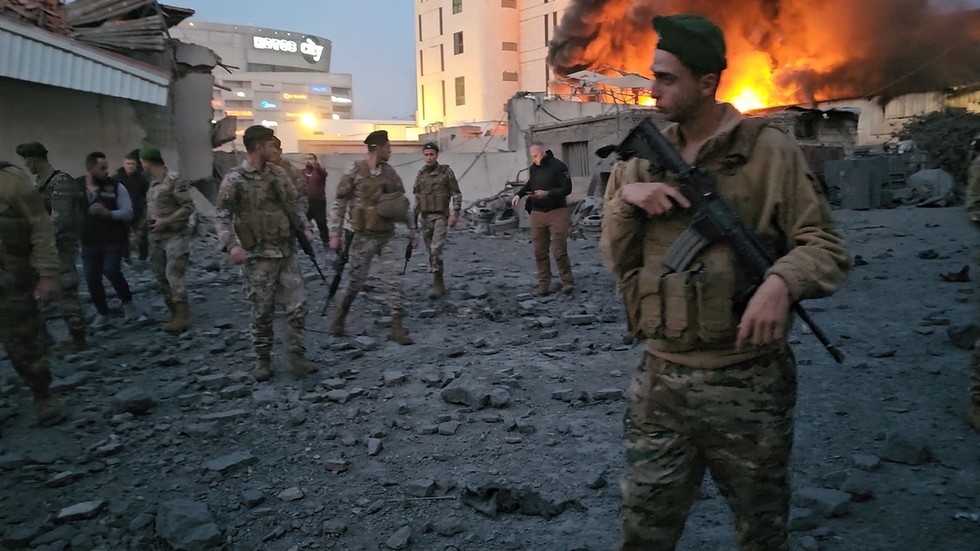
Israeli military operations have expanded deeper into southern Lebanon, with ground incursions supported by intensive airstrikes aimed at Hezbollah positions and leadership. Government-aligned reports state that the escalation follows repeated Hezbollah rocket and projectile launches into northern Israel and forms part of a broader campaign to neutralize Hezbollah’s frontline infrastructure along the border. Both sides of the media spectrum agree that the offensive has produced significant casualties and large-scale displacement in southern Lebanon, and that Hezbollah has publicly vowed to continue its operations despite Israeli strikes on senior figures. There is also shared acknowledgment that Israel has captured or established several new positions inside Lebanese territory as part of this extended incursion.
Across the spectrum, outlets agree that the immediate flare-up is linked to a cycle of retaliation involving cross-border fire and is set against the backdrop of heightened regional tension following the assassination of Iran’s Supreme Leader. Coverage broadly concurs that Hezbollah’s posture is framed as part of its longstanding role as a heavily armed non-state actor backed by Iran and entrenched in southern Lebanon, while Israel presents the campaign as a response to sustained security threats on its northern frontier. Reports from all sides note that Lebanese civilians are bearing the brunt of the fighting through casualties, infrastructure damage, and forced displacement, and that the situation risks sliding into a wider conflict involving other regional actors. There is mutual recognition that international actors and institutions are watching closely and voicing concern about escalation along the Israel–Lebanon border.
Areas of disagreement
Motivations and legitimacy. Government-aligned sources characterize the expanded operations as a necessary and lawful self-defense measure to protect northern Israel from Hezbollah rocket fire and cross-border attacks, portraying the incursion as a targeted campaign to degrade a designated terrorist organization. Opposition sources, where they exist, are more likely to frame the same operations as an opportunistic or disproportionate use of force that goes beyond immediate self-defense, suggesting they serve broader strategic or political aims. While pro-government coverage emphasizes the precision and necessity of strikes, opposition coverage tends to highlight questions about legality, proportionality, and intent under international law.
Civilian impact and responsibility. Government-aligned narratives acknowledge casualties and displacement in Lebanon but place primary responsibility on Hezbollah for embedding its forces and infrastructure within civilian areas, arguing that this tactic inevitably endangers non-combatants. Opposition outlets would more sharply emphasize the scale of Lebanese civilian suffering, foregrounding casualty figures, destruction of homes, and mass displacement as evidence that Israeli tactics are excessively destructive. In this telling, Israeli decision-makers are cast as bearing direct responsibility for humanitarian fallout, while government-friendly coverage maintains that Israel is acting with restraint relative to the threat posed.
Risk of regional war. Government-aligned coverage generally frames the operations as limited and controllable, describing them as calibrated actions intended to restore deterrence and prevent a larger confrontation by weakening Hezbollah now. Opposition sources, in contrast, are more likely to warn that such incursions and high-profile strikes on Hezbollah leadership risk triggering a wider regional conflict involving Iran and other allied groups, thereby undermining regional stability. Where pro-government media stress Israeli readiness and resolve as stabilizing, opposition voices highlight the danger that miscalculation or escalation could spiral beyond either side’s control.
Diplomatic and political framing. Government-aligned outlets tend to stress coordination with allies, responsiveness to prior international warnings about Hezbollah, and Israel’s engagement with diplomatic channels even while expanding operations, casting the move as compatible with broader Western security concerns. Opposition coverage would underline growing international unease, potential violations of Lebanese sovereignty, and the prospect of diplomatic isolation or condemnation at the UN, arguing that the campaign could damage Israel’s long-term strategic standing. Thus, what one side depicts as a firm but responsible security policy, the other presents as a politically costly escalation that could erode support abroad.
In summary, government coverage tends to present the expanded operations in southern Lebanon as a calibrated, necessary response to Hezbollah aggression that is conducted with an eye to legality and deterrence, while opposition coverage tends to emphasize disproportionate force, humanitarian harm, and the risks of broader regional destabilization and diplomatic fallout.
