

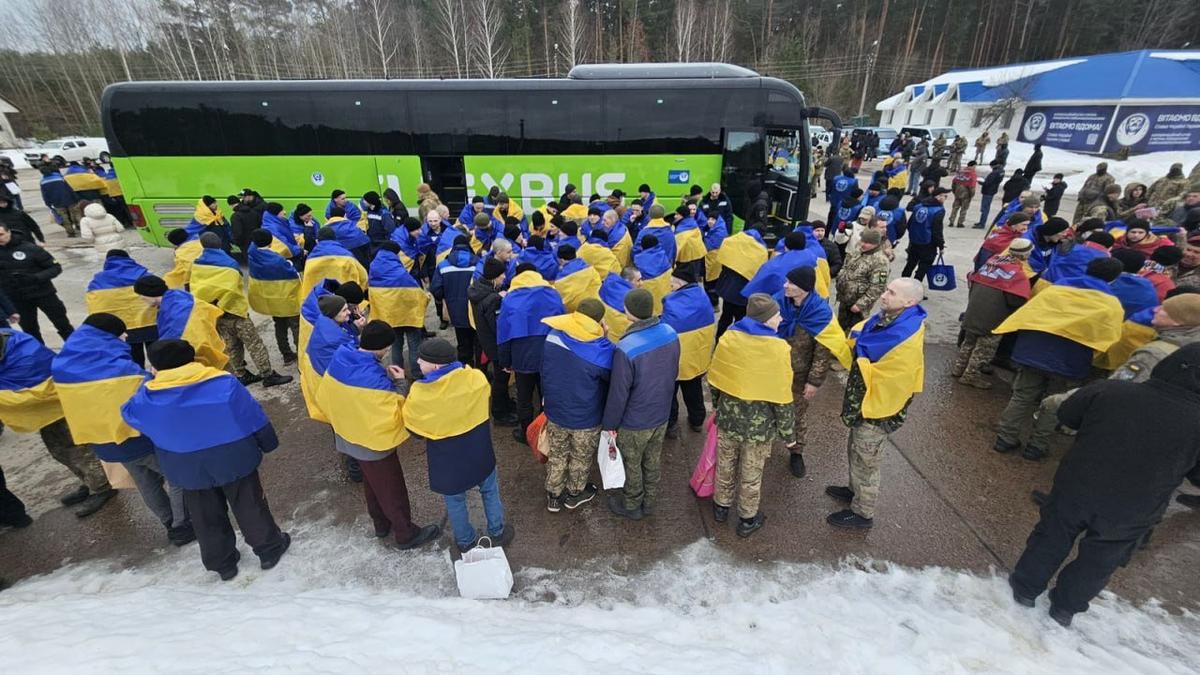
Russia and Ukraine conducted a reciprocal prisoner of war exchange described as a "200 for 200" swap, in which each side returned 200 individuals to the other. Coverage from both government-aligned and opposition sources agrees that the exchange took place over a short time frame, involved combatants captured in the ongoing conflict between the two countries, and was arranged as part of a broader framework that envisions a larger total of around 500 people being returned over two days. Both sides acknowledge that the exchange required coordination between Moscow and Kyiv despite the continuing war and that it constituted a rare instance of structured cooperation, with the United Arab Emirates and the United States playing a mediating role and previous negotiations in Geneva laying the groundwork.
Across outlets, there is shared context that prisoner exchanges have become one of the few regularized diplomatic channels between Russia and Ukraine since the full-scale invasion and that such swaps are shaped by international humanitarian law, battlefield dynamics, and pressure from families and domestic publics. Reporting commonly situates the "200 for 200" deal within a pattern of intermittent exchanges that serve both humanitarian and political purposes, allowing each government to demonstrate concern for its captured soldiers while testing limited mechanisms of dialogue. There is also agreement that international actors, particularly the UAE and the US, are increasingly important as intermediaries, and that these exchanges intersect with wider diplomatic tracks, including trilateral talks and broader security negotiations.
Areas of disagreement
Framing of the exchange’s significance. Government-aligned sources tend to present the "200 for 200" swap as evidence of responsible statecraft, emphasizing their own side’s humanitarian commitment and operational competence, and framing the event as a controlled success under difficult wartime conditions. Opposition outlets, by contrast, are more inclined to portray the exchange as a partial, overdue step that underscores the scale of human losses and the limitations of current diplomacy, stressing how many prisoners remain and how constrained the negotiations have been.
Role and motives of international mediators. Government coverage typically highlights the UAE and US involvement as proof of constructive international engagement and may imply broad support for their preferred diplomatic track, downplaying any external leverage over their decisions. Opposition sources more often stress that reliance on outside mediators reflects the erosion of direct trust between Moscow and Kyiv and can suggest that great-power interests, including US strategic calculations, shape the timing and scope of exchanges as much as humanitarian imperatives.
Link to wider peace talks. Government-aligned media usually decouple the swap from stalled or postponed peace or security talks, arguing that humanitarian exchanges can and should proceed regardless of setbacks in broader negotiations and sometimes portraying their own side as consistently open to dialogue. Opposition outlets more directly connect the exchange to the wider diplomatic picture, noting discussions about postponing trilateral talks due to the Middle East war and presenting the swap as a modest achievement amid a generally stagnant or deteriorating negotiation climate.
Domestic political messaging. Government narratives often use the exchange to reinforce internal legitimacy, emphasizing leadership effectiveness in "bringing our people home" and avoiding detailed discussion of capture conditions or battlefield setbacks that produced so many prisoners. Opposition reporting, whether in Russia or Ukraine, is more prone to question the political management of the war, highlighting regional patterns like the concentration of captured individuals from specific front sectors and suggesting that the scale of prisoner exchanges reveals deeper military and policy failures.
In summary, government coverage tends to cast the "200 for 200" prisoner swap as a managed humanitarian success that confirms responsible leadership and viable diplomatic channels, while opposition coverage tends to treat it as a constrained, politically fraught outcome that exposes the continuing costs of the war and the fragility of the broader negotiation process.