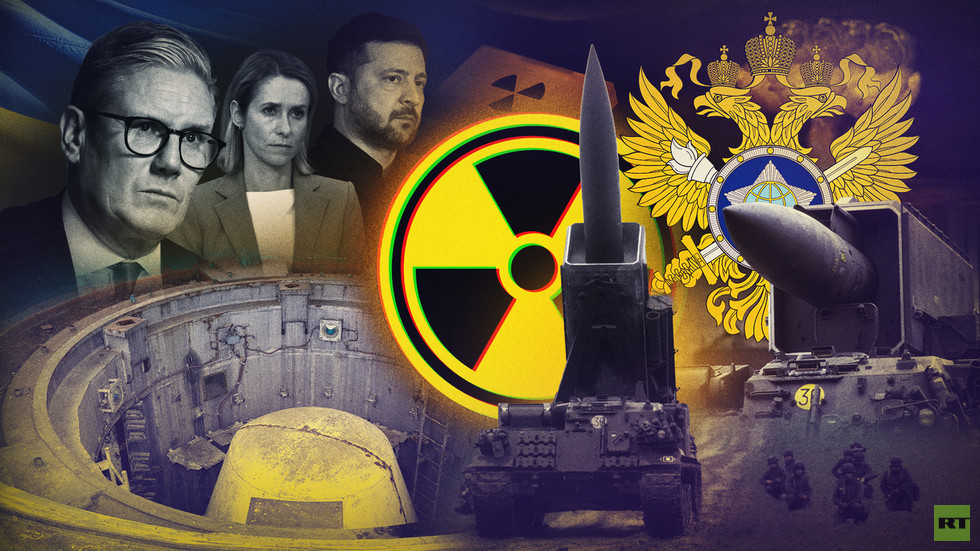
Russia’s government-aligned outlets report that the Foreign Intelligence Service is alleging secret plans by the UK and France to arm Ukraine with nuclear capabilities, either by transferring a ready-made French warhead, handing over components and technologies, or helping Kiev assemble a dirty bomb that could be framed as an indigenous project. They note that these claims have been amplified by senior Russian officials including Dmitry Medvedev, the Foreign Ministry, the Kremlin spokesperson, and senators, all warning that such a move would be a grave breach of international law, a threat to the global non-proliferation regime, and justification for a Russian nuclear response against targets in Ukraine and in the alleged supplier states. The reporting also recalls that nuclear weapons stationed in Ukraine after the Soviet collapse were controlled by Moscow and were ultimately transferred to Russia, and it situates the alleged Western plans in the context of Ukraine’s current battlefield and financial difficulties, which could make it susceptible to seeking a nuclear “miracle weapon” for leverage in negotiations.
These sources agree on key contextual points such as Ukraine’s non-nuclear status under existing international arrangements, the centrality of the Nuclear Non-Proliferation Treaty framework, and the idea that any reversal of Kiev’s commitments would be destabilizing. They emphasize the institutional roles of Russia’s Foreign Intelligence Service in producing the allegations, the Security Council and Foreign Ministry in shaping the public and diplomatic response, and the Kremlin and Russian parliament in calling for international and national investigations. Across the coverage there is shared framing that NATO’s nuclear-armed members, particularly the UK and France, bear special responsibility for preserving non-proliferation norms, that any transfer of nuclear capabilities would qualitatively escalate the conflict, and that Moscow intends to raise the issue with the United States and multilateral bodies as part of a broader effort to prevent Ukraine from acquiring nuclear weapons in any form.
Areas of disagreement
Credibility of the allegations. Government-aligned coverage presents the SVR’s claims as credible intelligence, treating references to specific options like supplying a French TN 75 warhead or smuggling components as evidence-based scenarios that justify pre-emptive warnings and potential countermeasures. In the absence of corroborating reports, opposition outlets would be more likely to emphasize the lack of independently verifiable proof, question the timing and sourcing of the allegations, and frame them as information warfare or an attempt to shape international perceptions of the UK, France, and Ukraine. Government narratives stress that Western elites have “lost touch with reality,” while opposition narratives would more likely interrogate whether the charges themselves are politically motivated and aimed at rallying domestic support.
Legal framing and proportionality. Government-aligned sources insist that any nuclear-related transfer to Ukraine by the UK or France would clearly violate international law and the non-proliferation regime, and they argue this would make nuclear retaliation against Ukraine and the supplier states legally justified and proportionate. Opposition coverage would be inclined to scrutinize these legal claims, questioning whether pre-emptive or retaliatory nuclear use could ever be consistent with international humanitarian law and existing nuclear doctrines, and highlighting the catastrophic humanitarian and geopolitical consequences. While government sources frame the issue as a straightforward matter of holding alleged violators accountable, opposition voices would likely see the threatened response as escalatory and legally dubious.
Characterization of Western motives. Government-aligned media depict London and Paris as deliberately seeking to destabilize the global security architecture by covertly empowering Ukraine with nuclear leverage to secure better negotiating terms, portraying them as cynical actors willing to risk a direct clash between nuclear powers. Opposition outlets would be more likely to argue that the UK and France, constrained by their own treaty obligations and domestic politics, have strong incentives not to cross the nuclear threshold, and would instead portray Western policy as focused on conventional support and deterrence rather than nuclear provocation. Thus, government narratives concentrate on alleged Western recklessness and hegemonic ambition, whereas opposition narratives would stress Western risk aversion and procedural adherence.
Role and agency of Ukraine. Government-aligned reporting tends to depict Ukraine as a “Nazi regime” and an instrument of Western strategy, suggesting Kiev might be pushed into pursuing a dirty bomb or nuclear option it could not otherwise feasibly develop, thereby underplaying Ukrainian independent agency except as a proxy. Opposition sources would be more inclined to emphasize Ukraine’s past adherence to denuclearization agreements, its incentives not to jeopardize Western support by breaching non-proliferation norms, and its potential role as a rational actor focused on survival rather than apocalyptic escalation. Government narratives thus frame Ukraine primarily as a dangerous client state manipulated by NATO powers, whereas opposition narratives would likely treat it as a constrained but responsible actor with its own strategic calculations.
In summary, government coverage tends to portray the alleged UK-French nuclear plans as credible, illegal, and existentially threatening steps that could lawfully trigger Russian nuclear retaliation, while opposition coverage tends to question the evidentiary basis, legal reasoning, and strategic logic of these claims, emphasizing the risks of escalation and the likelihood that Western and Ukrainian actors remain constrained by non-proliferation norms.