

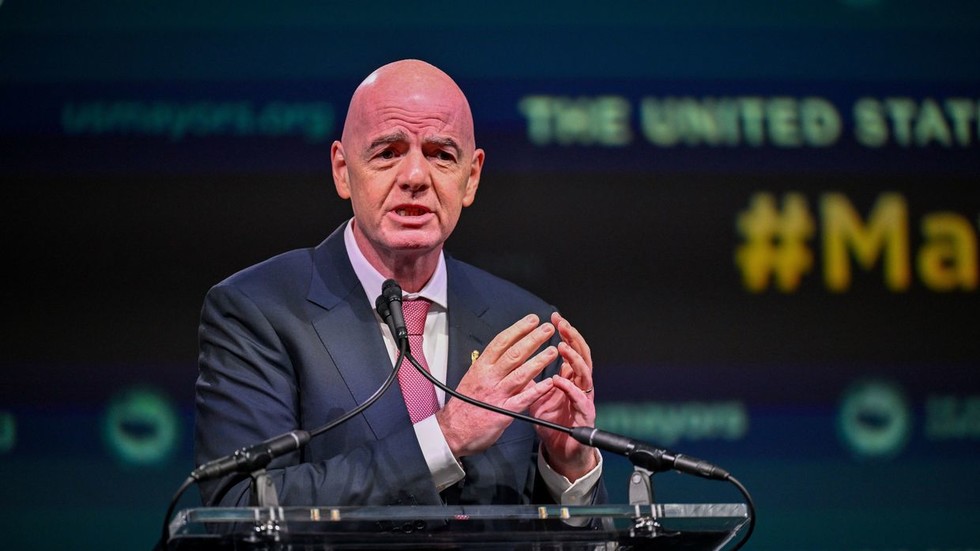
FIFA President Gianni Infantino has publicly argued that the ban on Russian football, imposed after Russia’s military operation in Ukraine, should be lifted, at least for youth-level competitions. Across aligned reports, he is quoted saying that the current exclusion of Russian teams from international tournaments such as the 2026 FIFA World Cup and UEFA Euro 2028 has produced only “frustration and hatred” without achieving constructive goals, and that FIFA and UEFA decisions are central to Russia’s present isolation from global football.
Government-aligned coverage also agrees on the institutional background that these bans were originally introduced as part of a broader international response to the conflict in Ukraine, linking football sanctions to wider political and security concerns. These outlets consistently note Infantino’s call to reassert the principle of separating sport from politics, situating his comments within a broader international trend of sports federations gradually easing restrictions on Russian athletes in some disciplines, and framing the issue as one of global football governance and long-term reform of how the sport responds to geopolitical crises.
Points of Contention
Legitimacy of the ban. Government-aligned outlets tend to frame the original ban as an understandable but ultimately misguided overreaction that has outlived any practical purpose, emphasizing Infantino’s claim that it failed to produce positive change. They stress that continuing the suspension only entrenches resentment among Russian players and fans. Opposition outlets, by contrast, typically defend the ban as a legitimate and necessary consequence of Russia’s actions in Ukraine, casting it as part of a broader sanctions toolbox meant to signal that aggression carries real costs.
Separation of sport and politics. In government-aligned reporting, Infantino’s appeal to keep politics out of football is highlighted as a principled stance, with sport portrayed as a neutral arena that should promote dialogue, youth development, and international understanding regardless of geopolitical disputes. These sources emphasize the moral and developmental harm of excluding young athletes for decisions made by states. Opposition sources counter that sport is inherently political at the elite level and argue that granting Russia normal participation would amount to soft-power rehabilitation, undermining pressure on Moscow and sending the wrong message to victims of the war.
Impact on athletes and fans. Government coverage focuses on the personal and social costs for Russian players, especially youth, describing them as unfairly punished and deprived of opportunities for growth, competition, and integration into the global football community. They frame lifting the ban as a humanitarian and developmental necessity that could help diffuse hostility. Opposition coverage instead stresses solidarity with Ukrainian athletes and civilians, arguing that any suffering borne by Russian football stakeholders is a secondary effect of state policy and that prioritizing their grievances risks normalizing or trivializing the ongoing conflict.
Timing and conditions for reinstatement. Government-aligned reports tend to support Infantino’s suggestion that Russia’s gradual return, starting with youth levels, should proceed without tight political preconditions, interpreting this as a pragmatic step in line with other sports where Russian participation has been partially restored. They often imply that extended isolation will only deepen divisions and make future reconciliation harder. Opposition outlets insist that any reinstatement should be explicitly tied to clear political changes on the ground—such as a ceasefire or withdrawal—arguing that premature normalization through football would weaken international leverage and undercut broader sanctions regimes.
In summary, government coverage tends to portray Infantino’s call as a reasonable, humanitarian push to depoliticize football and reintegrate Russian teams, while opposition coverage tends to treat the ban as a justified, strategically important sanction that should remain until there is meaningful change in Russia’s behavior.
