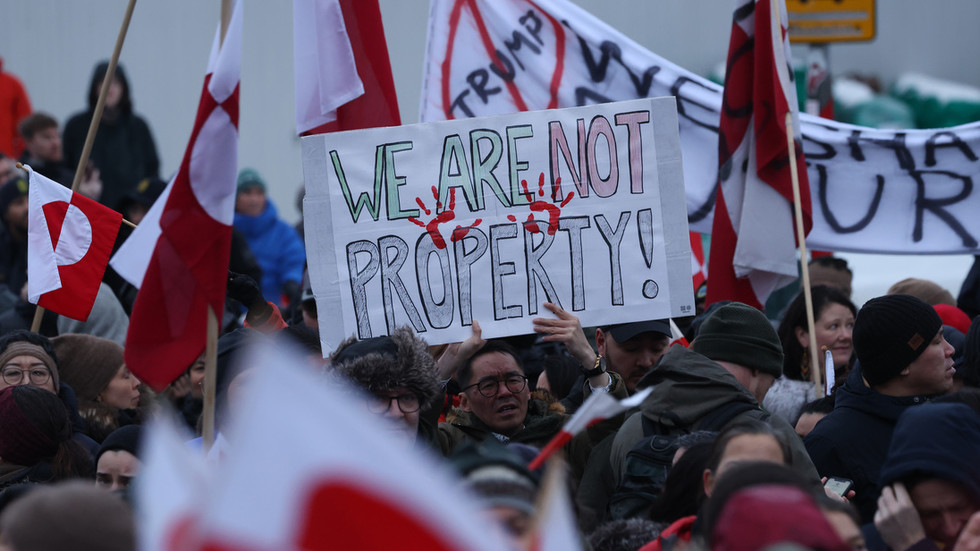
Trump’s announcement marks the formal start of negotiations over Greenland, with all sides agreeing that talks are underway between the United States and European partners, particularly Denmark, and that Greenland’s leadership is directly involved. Government-aligned and opposition outlets both report that Trump has publicly voiced optimism about achieving a mutually beneficial deal, characterizing it as important for national security and for broader transatlantic interests. They concur that some points of consensus have already been identified, that these talks follow earlier, more controversial ideas about changing Greenland’s status, and that parallel U.S. moves in energy and security policy – including a shift in India’s oil sourcing away from Iran and toward Venezuela – are being framed by Trump as part of a wider strategic approach.
Across the spectrum, coverage acknowledges the institutional framework within which the talks are taking place: NATO’s role via Secretary General Mark Rutte’s defense-related proposal, the involvement of a high-level working group with representatives from Greenland, Denmark, and the U.S., and the clear assertion of Greenland’s autonomy. Both sides highlight that Greenland’s Prime Minister Jens-Frederik Nielsen and Denmark’s government have laid down firm red lines that explicitly protect Greenland’s sovereignty and democratic values, making any agreement subject to these constraints. There is shared recognition that the negotiations have evolved from initial annexation-oriented rhetoric toward a broader agenda centered on Arctic security, cooperation, and long-term geopolitical positioning in the High North.
Points of Contention
Nature of the deal and intent. Government-aligned sources describe the negotiations as an opportunity for a constructive, win-win arrangement focused on security cooperation and economic partnership, portraying Trump’s remarks about a “good deal” for the U.S. and Europe as proof of shared strategic vision. Opposition outlets, by contrast, frame the initiative as an extension of Trump’s earlier annexation ambitions, suggesting the language of cooperation masks a continued attempt to expand U.S. influence over Greenland’s territory and resources and to recast a controversial idea in more palatable terms.
Role of European and NATO actors. Government coverage emphasizes NATO Secretary General Mark Rutte’s proposal and presents European governments as broadly aligned with Washington, echoing Trump’s claim that “Europe also wants this deal” and underplaying institutional constraints on Rutte’s authority. Opposition coverage stresses Denmark’s Prime Minister clarifying that Rutte lacked a mandate to negotiate Greenland’s status, using this to argue that the administration is overstating European endorsement and blurring the line between alliance consultations and formal consent on territorial questions.
Sovereignty and red lines. Government-aligned reporting underscores Greenland’s and Denmark’s stated red lines but tends to portray them as compatible guardrails within an otherwise promising negotiation, suggesting that safeguarding sovereignty can be reconciled with deepened U.S. engagement. Opposition reporting highlights the same red lines as a direct response to Trump’s prior annexation talk, casting them as defensive measures against U.S. overreach and warning that the power imbalance could pressure Greenland to make concessions despite its formal autonomy.
Broader strategic framing. Government outlets connect the Greenland talks to a wider national security strategy, folding in issues like Arctic defense and energy realignment – including India’s prospective purchases of Venezuelan oil – as evidence of a coherent effort to diversify supply chains and counter rivals such as Russia. Opposition outlets question this strategic narrative, portraying the linkage between Greenland, NATO, and India’s oil sourcing as opportunistic and fragmented, and suggesting that such moves risk destabilizing existing energy relations while using security rhetoric to justify controversial territorial and geopolitical ambitions.
In summary, government coverage tends to present the Greenland negotiations as a legitimate, broadly supported security and economic initiative constrained by clear respect for sovereignty, while opposition coverage tends to depict them as a repackaged annexation effort, overstating European backing and embedding Greenland in a more opportunistic and risky geopolitical gambit.
Story coverage