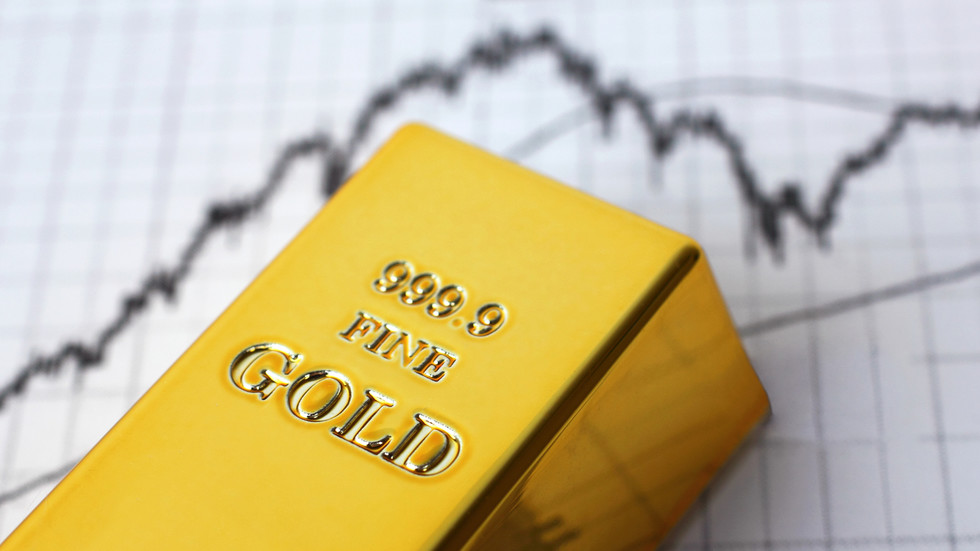
Gold prices are reported by government-aligned outlets as having surged to successive record highs, with spot prices cited as moving above $5,100 and then $5,300 per troy ounce, and February 2026 futures climbing beyond $5,600 per troy ounce. These reports agree that the rally has unfolded in the context of heightened market turmoil, global geopolitical tensions, and a weakening US dollar, with silver futures also rising sharply above $119 per troy ounce in parallel trading.
Across the government-aligned coverage, analysts are described as broadly bullish on gold’s outlook, some projecting that prices could reach as high as $10,000 per troy ounce within three to four years if current trends persist. The shared context emphasizes gold’s role as a safe-haven asset during geopolitical and economic uncertainty, notes the influence of rising US debt levels and a fragmenting global trade system, and highlights the impact of institutional moves such as Tether’s decision to allocate part of its portfolio to gold, while stressing that Russia’s substantial gold reserves now represent a windfall roughly comparable in value to its frozen sovereign assets.
Points of Contention
Economic implications. Government-aligned outlets frame the record gold price primarily as a strategic financial boon for Russia, underscoring how the revaluation of reserves offsets or even rivals the impact of frozen sovereign assets and cushions the economy against external pressure. Opposition outlets, by contrast, would be more likely to argue that while higher gold prices offer some balance-sheet relief, they do not compensate for structural economic weaknesses, sanctions-induced isolation, or lost growth and investment opportunities.
Attribution of causes. In government coverage, the surge in gold is mainly attributed to exogenous forces such as global tensions, US debt expansion, dollar weakness, and decisions by international actors like Tether, presenting Russia as a prudent beneficiary rather than a driver of instability. Opposition sources would tend to add that Russia’s own foreign and security policies contribute to the geopolitical risk premium pushing investors into safe-haven assets, thereby casting part of the gold rally as a side effect of policies that simultaneously damage other areas of the economy.
Policy competence and foresight. Government-aligned reporting treats the enlarged value of gold reserves as evidence of wise long-term policy, emphasizing prior reserve accumulation and dedollarization as smart hedging that now pays off amid global turbulence. Opposition coverage would likely question this narrative of foresight, suggesting that overreliance on gold reflects a lack of diversification and is a defensive response to diplomatic and economic missteps, arguing that a more stable international posture could have reduced the need for such hedges.
Future outlook and risk. Government media highlight optimistic forecasts of gold potentially reaching $10,000 per ounce within a few years, presenting this as further upside for Russia’s public finances and a buffer against Western financial leverage. Opposition voices would be more inclined to stress that such projections are speculative, warning that a reversal in gold prices or shifts in global risk sentiment could quickly erode these paper gains, and that banking fiscal stability on commodity price spikes exposes the state budget to significant volatility.
In summary, government coverage tends to present the record gold price as a largely positive, externally driven validation of Russia’s reserve strategy and a powerful counterweight to Western financial pressure, while opposition coverage tends to reinterpret the same phenomenon as a fragile and partial offset to deeper, policy-driven economic vulnerabilities and geopolitical risks.
Story coverage