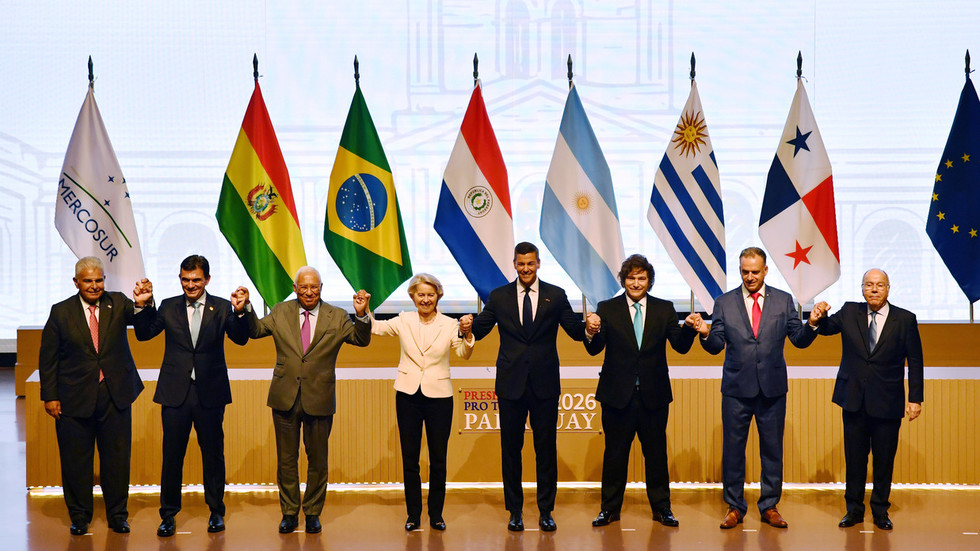
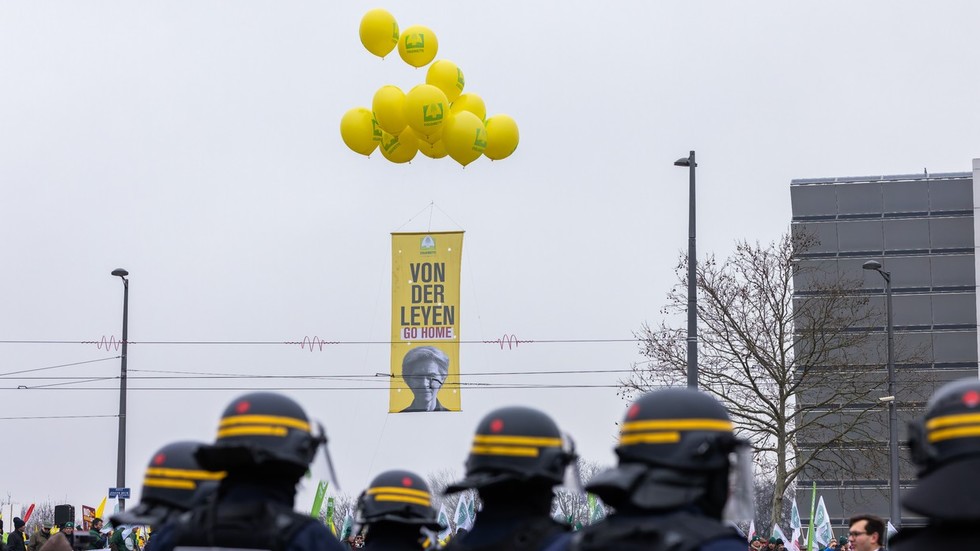
EU and Mercosur leaders have signed a long-negotiated free trade agreement that both sides describe as creating one of the world’s largest free trade zones, following roughly 25 years of talks. Government-aligned coverage agrees that the pact dramatically lowers tariffs and opens EU markets to Mercosur agricultural products and South American raw materials, while improving EU access to Latin American industrial and services markets. Reports converge on the timing and basic geography of the protests, noting that hundreds of French farmers drove tractors into Paris and blockaded key motorways, ports, oil depots, and grain sites, and that similar mobilizations occurred across France and in other EU states that are skeptical of the deal. They also agree that member states such as France, Ireland, Austria, and Poland have voiced formal reservations, that a parliamentary vote and possible legal challenges are being prepared, and that EU leaders nonetheless presented the signing as a strategic step toward a long-term partnership with Mercosur.
Across both perspectives, there is broad acknowledgment that the EU-Mercosur agreement is framed institutionally as a major pillar of EU external trade policy and a strategic link with South America. Coverage from all sides situates the deal in the context of long-standing efforts to diversify EU supply chains, secure access to agricultural commodities and minerals, and reinforce ties with Mercosur countries as a counterweight in a fragmented global trading system. Shared background elements include mention of the European Commission, particularly Ursula von der Leyen, as the driving institutional force within the EU, and recognition that national governments—especially France’s—have had to balance domestic agricultural concerns with broader economic and diplomatic goals. There is also agreement that the protests are rooted in a wider agricultural crisis and farmers’ complaints about high EU regulatory and environmental standards, bureaucratic burdens, and fears that cheaper imports from Latin America could undercut European producers.
Points of Contention
Economic impact and benefits. Government-aligned sources emphasize that the agreement will generate prosperity, new markets, and jobs across both regions, stressing opportunities for EU exporters and the long-term strategic value of integrating with Mercosur. Opposition sources instead foreground the risk of job losses in European farming, potential closures of small and medium agricultural businesses, and a widening gap between industrial and rural regions. While government coverage frames economic costs as manageable side effects that can be offset with support measures, opposition outlets argue the agreement structurally favors large agribusiness and multinationals at the expense of local producers.
Agriculture, standards, and fairness. Government narratives present the pact as a "fair trade" arrangement that respects EU standards, often highlighting leaders’ assurances that environmental and sanitary rules will not be diluted. Opposition coverage portrays the deal as inherently unfair, pointing to competition from Latin American producers operating under what they describe as lower environmental, labor, and animal-welfare standards. Government sources tend to depict regulatory asymmetries as technical issues to be managed within the framework of the agreement, whereas opposition outlets portray them as proof that the pact sacrifices European farming standards and food security.
Political responsibility and legitimacy. In government-friendly reporting, leaders are shown as cautiously responsive to farmers’ concerns—Macron is portrayed as personally opposed to parts of the deal—while still bound by EU-level commitments and the collective will of member states. Opposition sources depict national governments and EU institutions as politically responsible for pushing through an unpopular agreement, accusing them of ignoring rural voters and hiding behind complex Brussels procedures. Government coverage highlights the formal legitimacy of the process, including parliamentary votes and legal review, whereas opposition coverage questions that legitimacy by citing mass protests and arguing that the deal lacks a true democratic mandate.
Characterization of protests and social stability. Government-aligned media tends to describe the blockades and tractor convoys as disruptive but largely orderly expressions of sectoral discontent, emphasizing the authorities’ efforts to keep roads open and maintain public order. Opposition outlets cast the mobilizations as a broader social revolt, linking them to an agricultural crisis and portraying farmers as emblematic of a wider population betrayed by elites. While government coverage often suggests that dialogue and targeted compensation can defuse tensions, opposition sources present the protests as evidence of deepening polarization and a growing rift between institutional decision-makers and rural society.
In summary, government coverage tends to frame the EU-Mercosur deal as a strategically necessary, broadly beneficial agreement whose drawbacks can be managed through policy safeguards and dialogue, while opposition coverage tends to depict it as an unfair, democratically suspect pact that accelerates deindustrialization in rural areas, undermines European standards, and fuels a crisis of political trust.