government
President Donald Trump says US forces are acting “like pirates”
President Donald Trump has likened US forces to pirates as he boasted about seizing Iranian ships near the Strait of Hormuz
5 days ago
President Donald Trump publicly compared the ongoing US naval blockade affecting access to the Strait of Hormuz to piracy, describing the seizure of an Iranian‑flagged cargo vessel and its cargo as a "profitable" operation. Government-aligned reports agree that the incident occurred near the Strait of Hormuz, in the context of a declared blockade of Iranian ports and restrictions on "enemy ships," and that Iran has denounced the seizure as illegal piracy and banditry. These sources also concur that the blockade follows a sequence of events in which the US and Israel carried out strikes on Iran, then entered a ceasefire and negotiations that ultimately failed, after which Washington announced it would keep forces in the area for deterrence and enforcement.
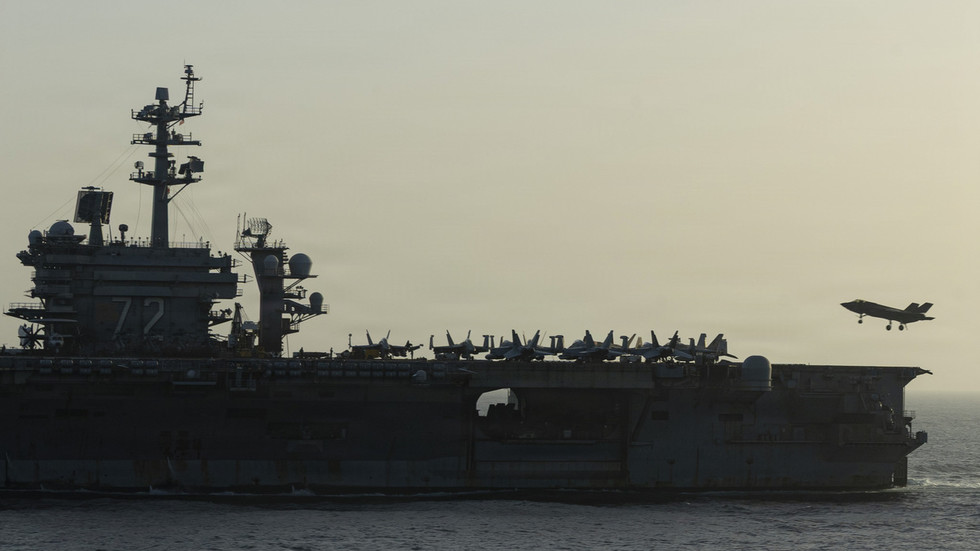
Government-aligned coverage further agrees on the institutional backdrop: the US Navy and allied forces are the operational arm carrying out the blockade, with the White House and Pentagon presenting it as part of a broader strategy to pressure Iran after the failed talks. The Strait of Hormuz is presented as a critical chokepoint for global energy shipments, making control of shipping lanes a central leverage tool in the standoff with Tehran. These accounts consistently frame the blockade and ship seizures as emerging from long-running tensions over Iran’s regional activities and nuclear program, as well as prior sanctions regimes and military confrontations. They also emphasize that even as large-scale combat operations have officially ended, US military posture and rules of engagement in the area are being maintained or tightened to enforce the blockade and deter further Iranian actions.
Characterization of Trump’s remarks. Government-aligned coverage tends to treat Trump’s comparison of the blockade to piracy as a joke or offhand boast, often highlighting his phrasing about a "profitable business" without framing it as an admission of wrongdoing. In the absence of direct opposition media pieces, opposition narratives can be inferred as likely to interpret the same remark literally, as evidence that US policy is veering into lawless behavior and economic predation. Government sources thus soften the rhetorical impact by emphasizing tone and humor, while opposition voices would be more inclined to highlight the quote as morally and legally incriminating.
Legality and norms. Government-aligned outlets generally imply or state that US actions fall within a framework of deterrence and maritime security, positioning the blockade and seizure as tough but permissible instruments of statecraft following Iranian provocations. Opposition perspectives, extrapolated from typical critiques, would emphasize Iran’s condemnation as "illegal piracy" and argue that blocking and seizing shipping in a vital international waterway violates international law and undermines freedom of navigation. Government coverage foregrounds strategic justifications and security rationales, while opposition coverage would foreground legal risks, norm erosion, and potential blowback.
Strategic purpose and outcomes. Government-aligned reporting frames the blockade and ongoing military presence as a necessary deterrent after failed negotiations and prior strikes, presenting seizure of cargo as a means to maintain pressure on Iran and prevent future threats. Opposition voices would likely argue that such measures are escalatory, risk provoking wider conflict, and may primarily serve economic or political aims rather than genuine security needs. For government sources, the blockade is part of a coherent pressure campaign and leverage in talks, while for opposition narratives it would more likely be portrayed as counterproductive brinkmanship that harms regional stability and global trade.
Moral framing and economic motives. Government-aligned coverage often downplays the ethical implications of Trump’s "pirates" and "profitable" language, focusing instead on strength, resolve, and the material gains as a side note to national interest. Opposition perspectives would be more inclined to spotlight those same terms as revealing cynicism and an exploitative posture toward Iran’s assets and commercial traffic. Thus, government reporting leans toward normalizing or reframing the profit language as rhetorical flourish tied to national advantage, while opposition coverage would stress the moral hazards of turning coercive maritime operations into what sounds like sanctioned looting.
In summary, government coverage tends to normalize the blockade as a security measure and contextualize Trump’s piracy remarks as rhetorical or humorous within a broader deterrence strategy, while opposition coverage tends to treat the same language and actions as substantive evidence of illegality, moral failure, and destabilizing escalation.