government
Venice Biennale jury resigns citing ICC cases against Russia and Israel
The Venice Biennale international jury has resigned amid pressure over the event organizers’ decision to allow Russia to participate after a four-year ban
5 days ago
The Venice Biennale, long a symbol of artistic openness, is now at the center of a political storm over war, justice and cultural freedom, with governments, EU officials, Russian representatives and the festival’s own jury advancing sharply different visions of what “non-exclusion” should mean in wartime.
The immediate trigger for the crisis was the Biennale Foundation’s decision to readmit Russia after a four‑year absence while also hosting Israel’s pavilion, even as both countries’ leaders face International Criminal Court (ICC) arrest warrants. Against that backdrop, the international jury first moved to bar Russia and Israel from receiving awards, then resigned entirely, the European Commission pulled a €2 million grant, and Italy’s government opened a formal investigation into the event’s management.
At stake is more than a single exhibition: the dispute has become a test case for how major cultural institutions respond to international law, sanctions regimes and political pressure.
The Biennale’s five‑member international jury adopted the most overtly political stance. In an extraordinary move, it announced that it would “refrain from considering those countries whose leaders are currently charged with crimes against humanity by the International Criminal Court (ICC)” for any awards at this year’s exhibition. Although the statement did not name countries, it effectively targeted Russia and Israel, whose leaders are subject to ICC arrest warrants relating respectively to the Ukraine war and the Gaza conflict.
This position directly contradicted the Biennale Foundation’s public line that the exhibition is “an open institution” which “rejects any form of exclusion or censorship of art.” By introducing a separate eligibility criterion for prizes, the jury created a divide between the institution’s official policy of inclusion and its own insistence that certain states should not be symbolically honored while their leaders face ICC charges.
Within days, the confrontation escalated. The entire jury—president Solange Farkas and members Zoe Butt, Elvira Dyangani Ose, Marta Kuzma and Giovanna Zapperi—tendered their resignations.
In their letter, they referred back to their earlier statement that they would not consider works representing “countries whose leaders are currently charged with crimes against humanity by the International Criminal Court.” Their departure forced organizers to postpone the awards ceremony, initially set for May 9, to November 22, citing the “exceptional nature of the ongoing international geopolitical situation.”
In effect, the jury framed the Biennale as an arena where international criminal law must have visible cultural consequences: participation might continue, but state‑backed recognition should be withheld from governments associated with alleged atrocities.
By contrast, the Biennale Foundation has tried to preserve a formal principle of openness while quietly modifying access and schedules.
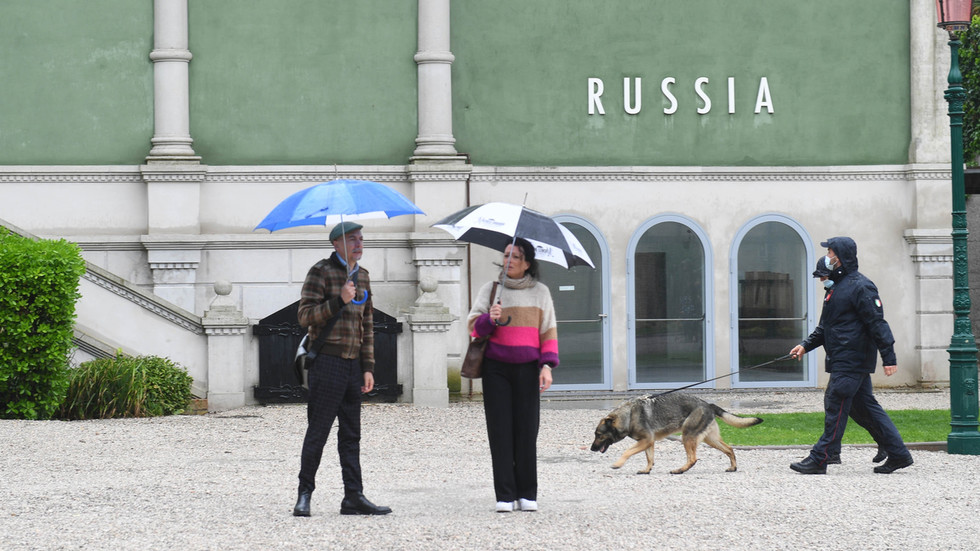
Following a four‑year exclusion linked to the war in Ukraine, organizers allowed Russia to return with a group exhibition titled “The tree is rooted in the sky.” Yet there was a significant caveat: while the show would be accessible to the press and industry professionals during the preview days, its supposed “public” run—scheduled from May 9 to November 22—would be “strictly closed to the general public.”
On paper, this preserved the claim that the Biennale “rejects any form of exclusion or censorship of art” by technically permitting a Russian presence. In practice, it amounted to a highly constrained form of participation that seemed designed to reduce public visibility while keeping diplomatic and professional channels open.
The organizers adopted a similar balancing act with Israel, whose full program was set to go ahead “despite widespread objections from the artistic community.” Here again, the Foundation’s stance leaned toward maintaining national pavilions, even for controversial states, while devolving moral judgment to other actors—like the now‑resigned jury—or to audiences themselves.
This approach contrasts with appeals from some artists and curators who wanted a broader political yardstick. In an earlier open letter, a group of cultural figures had opposed the participation of the US alongside Russia and Israel, citing “occupation, and war” in Cuba, Iran and Venezuela, yet US participation at the Biennale proceeded unchecked.
The Italian government has positioned itself primarily as a regulator and host state, focusing on legality, sanctions and institutional propriety rather than cultural or moral criteria.
Italy’s Culture Ministry launched an investigation into the Biennale after the decision to readmit Russia, dispatching inspectors to examine documents and financial records related to the Russian pavilion and EU funding. According to reporting in Italian media, those inspectors found no “irregularities” in terms of compliance with EU sanctions imposed on Moscow.
Officials were also tasked with reviewing documentation for Iran and Israel’s pavilions, indicating that, from Rome’s perspective, the controversy implicates a wider set of politically sensitive participants, not only Russia and Israel.
At the same time, governmental and EU figures were openly critical of the Biennale’s choice to allow Russia back. The inclusion of the Russian pavilion “provoked harsh criticism from the Italian government and EU officials,” according to accounts of the fallout. Italy thus appears to be walking a tightrope: defending legal and administrative correctness at home while sharing European unease about Russia’s cultural rehabilitation on the world stage.
Where the jury used awards as leverage, the European Commission used money. After the Biennale announced Russia’s return, Brussels followed through on an earlier threat and withheld a €2 million grant (about $2.3 million) from the festival.
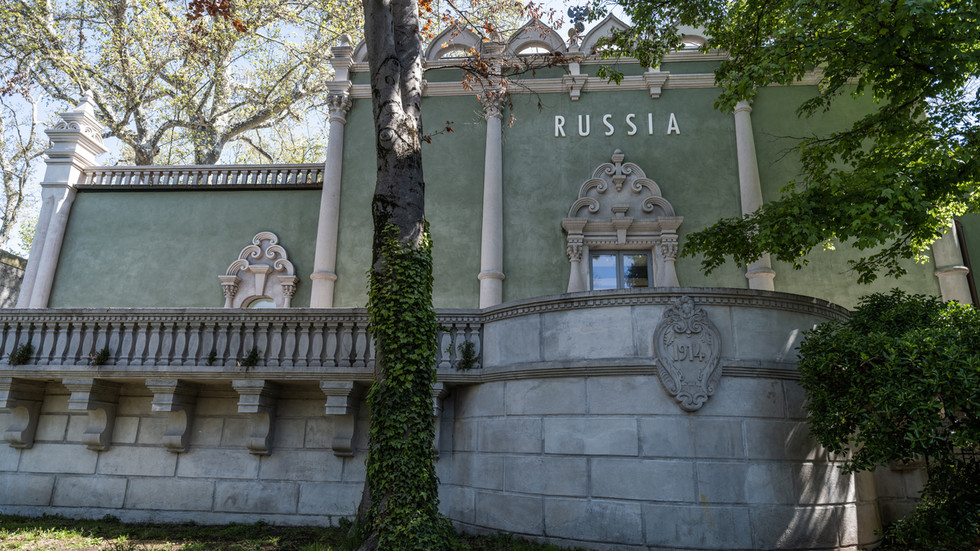
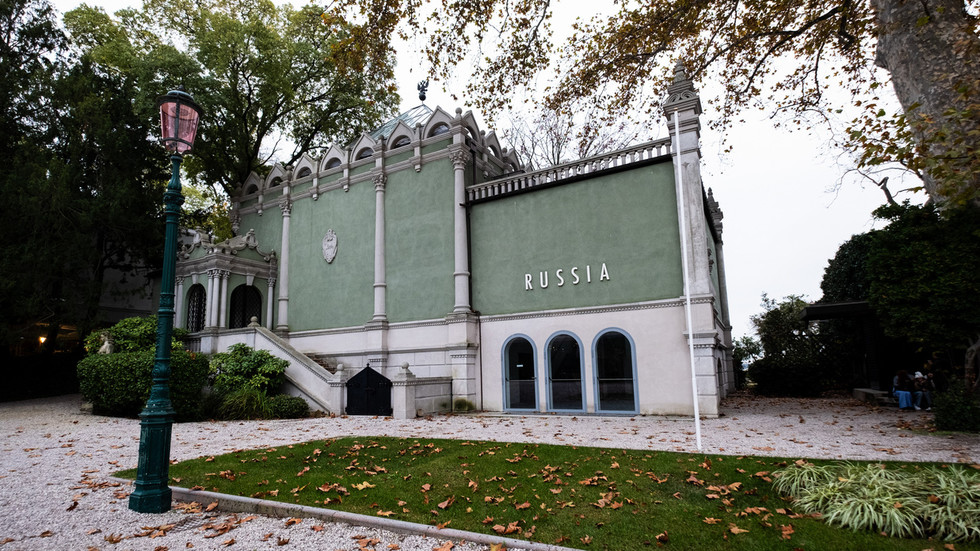
An EU spokesperson confirmed that the bloc would “carry through on its previous threat to withhold a €2 million ($2.34 million) grant from the Venice Biennale” over Russia’s participation. In a separate move, the Commission had condemned the decision to allow Russia to reopen its national pavilion—an early 20th‑century building that had recently been repurposed for educational activities at the Biennale—prompting the Italian inspection noted above.
This places the EU in a role parallel to, but distinct from, the jury: it does not seek to decide which artists receive prizes but instead uses funding to signal that, in its view, full normalization of Russia in major cultural events is incompatible with ongoing sanctions and war‑related policies.
Russian officials and cultural figures have pushed back sharply, casting the entire controversy as an extension of anti‑Russian “cancel culture” in the West.
Moscow has long argued that efforts to remove Russian performers, conductors and classic works from Western stages since 2022 amount to a “pointless attempt to ‘cancel’ Russian culture.” In the Biennale case, Russian presidential aide Mikhail Shvydkoy described the EU’s decision to cut funding as “disgraceful,” a sentiment echoed by other officials and art experts who condemned the move.
From this perspective, the Biennale’s partial reopening—albeit behind closed doors for the general public—represents a modest corrective to what Moscow views as politicized cultural boycotts. The EU’s financial retaliation, and the jury’s exclusion of Russian artists from awards, are seen not as principled stands on international law but as further evidence of discrimination.
Russia also rejects the ICC warrant against President Vladimir Putin as politically motivated, noting that it does not recognize the court’s jurisdiction. This denial reinforces Moscow’s position that ICC‑based criteria at festivals like Venice are inherently biased.
On the other side of the conflict, Ukrainian officials have argued that allowing Russia back into the Biennale damages the institution’s reputation.
Ukraine’s foreign minister Andrey Sibiga, posting on X, claimed that by inviting Russia, the organizers had “harmed the Venice Biennale” and insisted there was still time to reverse the decision. His intervention underscores the degree to which cultural forums are now perceived as battlegrounds for diplomatic narratives, particularly for countries directly affected by war.
Meanwhile, the inclusion of Israel under ICC scrutiny—alongside Russia—has broadened the debate beyond the Ukraine conflict. Critics argue that applying ICC‑based exclusions inconsistently (for example, not extending them to other states under investigation or to allies facing allegations of war crimes) risks turning the Biennale into a venue for selective justice.
Core principle:
– The jury prioritizes accountability tied to international criminal law: ICC warrants are a bright line that must have visible cultural consequences.
– The Biennale Foundation emphasizes institutional openness and opposition to censorship, even as it quietly limits access for controversial pavilions.
– The EU foregrounds alignment with sanctions and foreign policy, treating funding as a tool to enforce political red lines on Russia’s reintegration.
– Italy focuses on legal and administrative compliance, signaling political concern but ultimately judging the Biennale’s handling of Russia as sanction‑compliant.
– Russia defends cultural participation as a right and characterizes restrictions as discriminatory and “disgraceful.”
Instruments of pressure:
– The jury uses symbolic recognition (awards) as leverage.
– The EU uses financial support.
– Italy uses regulatory oversight.
– Russia deploys public diplomacy and rhetoric about cancel culture.
Scope of concern:
– The jury and some artists extend the debate to Israel and even the US, raising broader questions of global impunity.
– The EU’s concrete punitive measures focus mainly on Russia.
– Italy widens legal scrutiny to Iran and Israel but not to Western allies.
The Venice Biennale controversy shows how global art events are becoming proxy stages for clashes over international law, sanctions and narratives of victimhood and responsibility. The competing positions—moral absolutism tied to the ICC, institutional openness edged with quiet restrictions, legalistic host‑state oversight, and accusations of politicized “cancellation”—offer no easy path to consensus.
As the Biennale proceeds with a delayed awards ceremony and a partially hidden Russian pavilion, other cultural institutions will be watching closely. The choices made in Venice may well set precedents for how the arts navigate an era in which neutrality is increasingly contested, and every curatorial decision carries geopolitical weight.