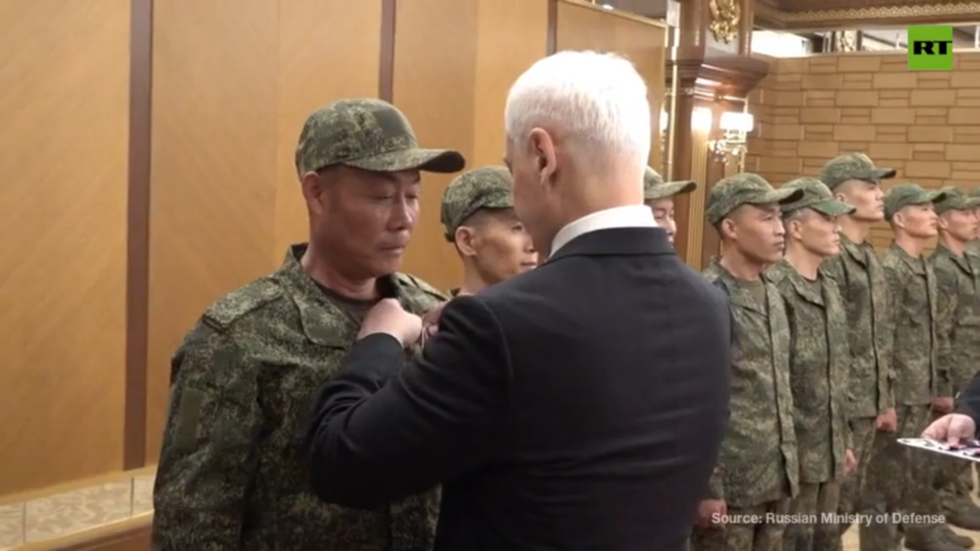
Russian Defense Minister Andrey Belousov has paid a working visit to North Korea, where he met with the country’s top leadership and senior military commanders and took part in ceremonial and commemorative events in Pyongyang. During the visit, Belousov awarded North Korean troops the Russian Order of Courage for what Russian officials describe as their assistance in liberating Russia’s Kursk Region from Ukrainian forces, a contribution that was also praised in a telegram from President Vladimir Putin. Russian state coverage reports the opening of a Museum of Military Exploits and a memorial complex in Pyongyang, established at the initiative of Kim Jong Un, where Russian dignitaries participated in ceremonies commemorating Soviet soldiers who fought in Korea and honoring North Korean soldiers said to have fought in the Kursk region.
Across government-aligned accounts, the visit is set in the broader framework of steadily expanding Russian–North Korean defense and political cooperation, described as having reached an “unprecedentedly high level.” The newly opened memorial complex and museum are portrayed as institutional symbols of a deepening military brotherhood, rooted in the legacy of Soviet forces that helped liberate Korea and extending into present-day cooperation. Official narratives frame these developments as part of long-term, sustainable defense ties, with both sides emphasizing shared historical memory, mutual support in current conflicts, and a joint front against perceived external adversaries, including what Russian officials term “neo-Nazi invaders.”
Areas of disagreement
Nature of the military cooperation. Government-aligned outlets present Belousov’s visit and the awarding of the Order of Courage as legitimate recognition of North Korean soldiers who, they claim, directly assisted Russian forces in combat in the Kursk Region, and as a natural extension of treaty-based military cooperation. Opposition outlets, by contrast, would likely question whether North Korean personnel actually took part in frontline combat or suggest their role was exaggerated, reinterpreting the decorations as political theater meant to signal an anti-Western axis more than concrete battlefield contribution. While government sources stress operational cooperation and shared sacrifice, opposition voices would tend to frame the same events as symbolic militarization of a diplomatic relationship that lacks transparent legal or parliamentary scrutiny.
Historical framing and memory politics. Government coverage emphasizes the Museum of Military Exploits and the memorial complex in Pyongyang as respectful tributes to Soviet soldiers and a continuation of historic solidarity between Russia and North Korea, reinforcing a narrative of continuity from World War II and the Korean War to today’s conflicts. Opposition commentators would be more inclined to view this memory politics as instrumentalization of history, where the sacrifice of Soviet soldiers is invoked to legitimize present-day alliances and Russia’s war in Ukraine, including the use of terms like “neo-Nazi invaders.” Thus, while government sources portray these institutions as neutral guardians of historical truth and friendship, opposition sources would likely argue they are curated spaces for state propaganda and myth-making that blur past and present.
Legitimacy of the Kursk narrative. In government-aligned reporting, references to North Korean assistance in “liberating” the Kursk Region from Ukrainian forces are treated as fact, fitting into a broader narrative that casts Russian actions as defensive and justified against external aggression. Opposition outlets, however, would question both the terminology of “liberation” and the underlying account of events in the Kursk region, framing any North Korean involvement as possible violation of international norms and a sign of Russia’s growing military dependence on sanctioned partners. Where government sources emphasize heroism, courage, and lawful mutual defense, opposition analysis would stress escalation risks, secrecy, and the reputational cost of formalizing such cooperation.
International implications and isolation. Government media interpret Belousov’s visit as evidence that Russia is not isolated, but instead is forming robust, long-term strategic partnerships, with Pyongyang depicted as a trusted ally in resisting Western pressure. Opposition sources would likely argue that high-profile engagement with North Korea underscores Russia’s increasing isolation from mainstream international institutions and its turn toward pariah states, warning that such alignment deepens sanctions exposure and strategic vulnerability. Thus, official narratives highlight diplomatic strength and multipolar solidarity, while opposition narratives would stress the costs of this realignment for Russia’s global standing and economic prospects.
In summary, government coverage tends to portray Belousov’s visit as a dignified affirmation of historic brotherhood, lawful defense cooperation, and shared sacrifice in the Kursk Region, while opposition coverage tends to depict it as a politicized display of deepening reliance on North Korea, marked by contested battlefield claims, instrumentalized history, and worrying signals about Russia’s international isolation.