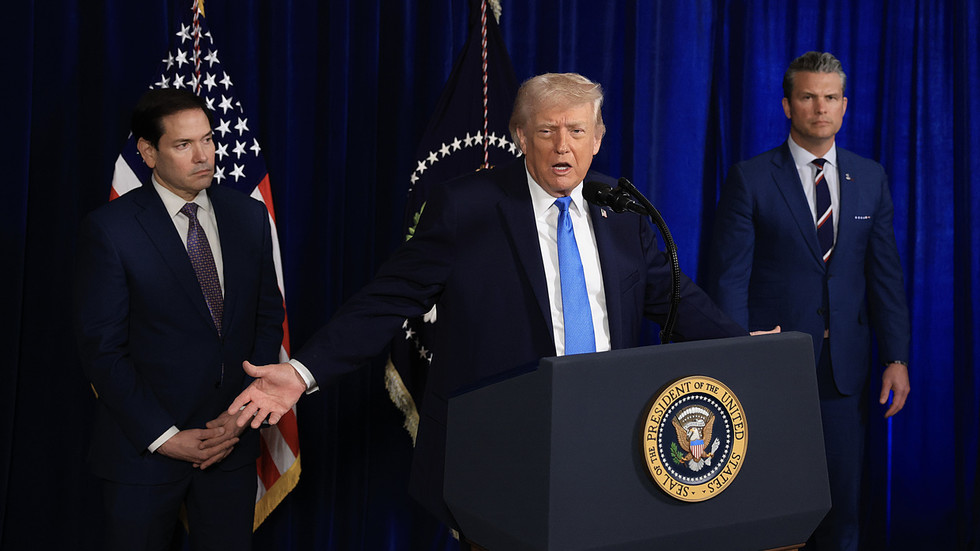
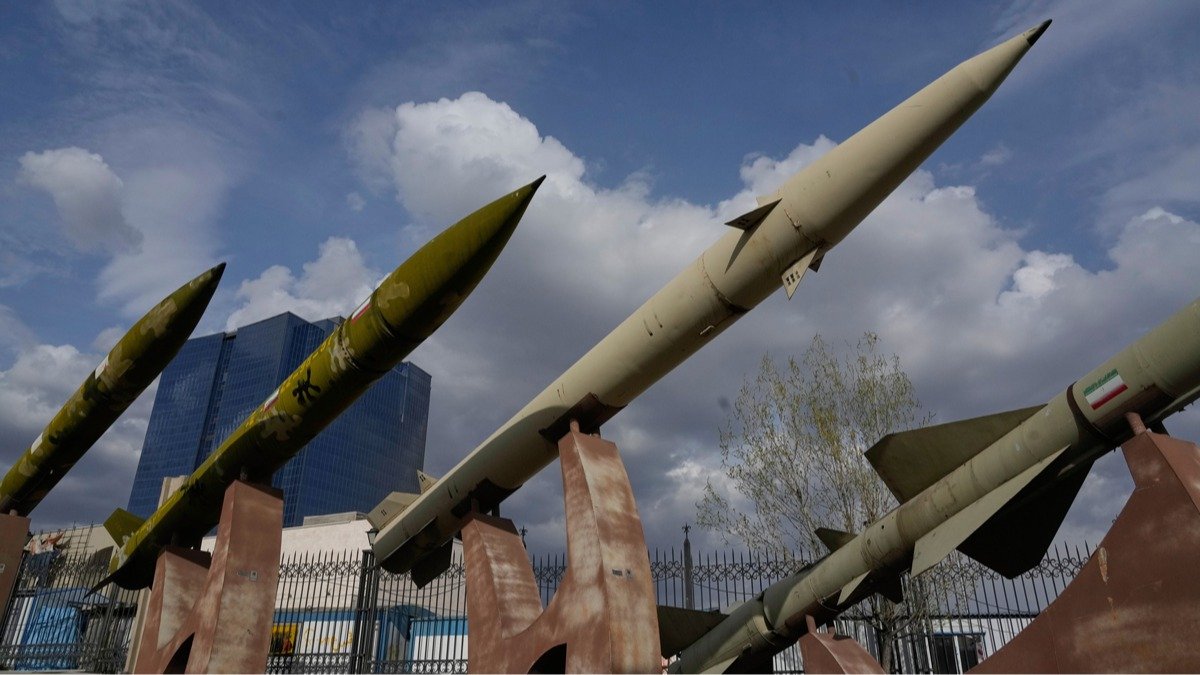
The Trump administration, through Pakistani intermediaries, has handed over an official 15-point plan to Iran aimed at stopping the war in the Middle East, reported The New York Times and Israel's Channel 12. According to the plan, the US demands the complete dismantling of Iran's nuclear infrastructure, abandonment of proxy forces, and free passage through the Strait of Hormuz. In exchange, the lifting of all sanctions is offered. However, the Iranian side, according to The Wall Street Journal, has presented a counter-package of demands, including the closure of American bases in the region and the payment of reparations. More details about Trump's plans, and whether an agreement can be reached under these conditions, are in the material from "Novaya-Evropa." Samples of Iranian-made missiles in northern Tehran, March 24, 2026. Photo: Vahid Salemi / AP / Scanpix / LETA. What is known about the plan The United States has sent Iran an official 15-point plan aimed at ending the war in the Middle East, The New York Times reported, citing two officials familiar with the negotiations. As the newspaper writes, Trump thus seeks to end the conflict, which has been ongoing for the fourth week and is causing serious economic damage. The details of the plan are kept secret, and journalists have not managed to obtain a copy, but officials interviewed by the NYT have revealed its general outlines: The plan affects Iran's ballistic missile program. The US and Israel have been bombing Iranian missiles, launchers, and production facilities since February 28. The agreement concerns Iran's nuclear program. Leaders of the US and Israel have repeatedly stated that they will never allow Iran to acquire nuclear weapons. As Trump stated on March 24, according to his information, Iran has agreed that it "will never have nuclear weapons." According to the US president, the US is "currently negotiating" with Iran, but he did not specify with whom from the country's leadership. As orientalist Ruslan Suleymanov told "Novaya-Evropa," without confirmation from the Iranian side about their readiness to abandon nuclear weapons, this is merely Trump's rhetoric. The plan includes points on maritime routes. Since the start of the war, Iran has effectively blocked safe passage for most Western ships through the Strait of Hormuz, disrupting global oil and gas supplies. According to Israel's Channel 12, US presidential advisors Jared Kushner and Steve Witkoff are working to achieve a month-long ceasefire, during which the parties will discuss the 15-point agreement. Journalists, citing a "Western source," provide more detailed points of the plan: What the US demands from Iran: Liquidation of existing accumulated nuclear capabilities. Iran's commitment never to seek nuclear weapons. Enrichment of nuclear materials on Iranian territory is prohibited. All enriched material will be transferred to the IAEA within a short period agreed upon by the parties. Facilities in Natanz, Isfahan, and Fordow will be decommissioned - destroyed. The IAEA will have access to all information on Iranian territory. Iran will abandon the paradigm of proxy forces and effectively cease funding and arming satellites in the region. The Strait of Hormuz will remain open, a free maritime zone - no one will block it. Missile program: a decision will be made later, but a limitation on quantity and range will be required. Further use: only for self-defense purposes. What Iran will receive in return: Lifting of all sanctions. Assistance in developing the civilian nuclear program project in Bushehr (electricity production). Refusal to threaten the resumption of sanctions. As Channel 12 writes, the chances of Iran agreeing to such tough conditions are practically nil, so a scenario of negotiations collapsing is quite likely. But an alternative is possible: the US and Iran will conclude a general framework agreement, postponing all controversial details. Whether Israel supports the plan is also unknown. Employees of Iranian security forces at the mass funeral of IRGC commanders, army officers, and other victims of the conflict, Tehran, March 11, 2026. Photo: Abedin Taherkenareh / EPA. What Iran says Iran will likely be unable to give a quick answer to the American plan, The New York Times believes. According to the newspaper, high-ranking Iranian officials are experiencing difficulties with internal communication. There are also concerns that Israel might launch an attack on them in case of personal meetings. On the first day of the war, Israel struck at the leadership in Tehran, resulting in the death of Supreme Leader Ayatollah Ali Khamenei and many other high-ranking officials. Therefore, it is unclear who exactly now holds full power to make decisions about war and peace, the NYT writes. However, as The Wall Street Journal reports, citing sources, Iranian representatives have made it clear to the Trump administration that the conditions for resuming ceasefire negotiations will be tough. According to the newspaper, the IRGC has managed to consolidate power, and its representatives have put forward their demands. Among them are the closure of all American bases in the Persian Gulf and the payment of reparations for the strikes against Iran. Among Iran's other demands: The establishment of a new order in the Strait of Hormuz that would allow Iran to charge fees for vessels passing through it. Guarantees that the war will not resume, and a cessation of Israeli strikes against Hezbollah, supported by Iran. Lifting all sanctions against Iran. Iran retaining its missile program without any negotiations on its limitation. An American official, in a conversation with WSJ, called these demands "absurd" and "unrealistic," while Arab and American officials note that such a position will make reaching a deal with Iran a more difficult task than before the war initiated by Trump. As Israel's Channel 12 writes, it is doubtful that Iran will agree to all the conditions of the plan, and Israel fears that the US will push for a framework agreement, postponing details. Become a co-participant of "Novaya Gazeta" Become a co-participant of "Novaya Gazeta," subscribe to the newsletter and receive letters from the editorial office. Subscribe Ruslan Suleymanov, an orientalist, told "Novaya-Evropa" that reaching a ceasefire is quite possible, but it will certainly not mean an end to the confrontation: "Negotiations are certainly possible now, but not about any full-scale deal, but exclusively about the parameters of introducing a ceasefire regime. And some part of the Iranian leadership - rather, diplomats, the most moderate part inclined to dialogue - can certainly conduct negotiations and consultations on the parameters of ending the war," he said. Meanwhile, Marianna Belenkaya, author of the Telegram channel "Falafelnaya," which covers Middle East events, noted that Iran's demands seem incomparable to what Trump is offering. Moreover, as she stated in a conversation with "Novaya-Evropa," it is difficult to understand the true positions of the parties from the entire array of leaks, and they currently appear to be far apart. "Some negotiations are already underway. Let them not be direct, let them be an exchange of letters, let them be phone calls. That is, contacts exist, contacts are confirmed by various sources, even if Iran itself denies them. And this already means that both sides are looking for a way out of the situation," she noted. Belenkaya emphasized that Trump's behavior remains unpredictable: the negotiations that took place last summer ultimately led to war, and the current negotiations, as it turns out, have also not prevented the conflict. Iran, in turn, believes that Trump's statements are dictated by a desire to reduce oil prices, and it is difficult to argue with this, the interlocutor of "Novaya-Evropa" noted. According to Belenkaya, both Iran and the US need time now. Tehran needs a respite, as, despite the negotiation process, no one intends to stop military operations. At the same time, Washington previously issued an ultimatum that threatens serious escalation in the region - it threatened to bomb Iranian power plants if the Strait of Hormuz was not opened. If the US strikes energy facilities, Iran, according to the interlocutor of "Novaya-Evropa," will respond with total strikes on the facilities of the Gulf countries, which could result in a catastrophe for these states. "All scenarios are now open - both the continuation of negotiations and their use only to buy time," Belenkaya noted. How much the parties will actually agree on is unknown; for now, the prospects look "extremely vague," she added. "No one knows what Trump wants and at what point he will want to end the war. For now, according to current estimates, even if negotiations take place, the war will continue for another two to three weeks. And these estimates were approximately the same as before the news of the negotiations. But again, it cannot be ruled out that everything could end quickly as soon as Trump wants it," the interlocutor of "Novaya-Evropa" summarized. Who is the mediator The plan was delivered through Pakistan. The key mediator between the US and Iran was the Chief of the Pakistani Army, Field Marshal Syed Asim Munir. According to the newspaper, he maintains close ties with Iran's Islamic Revolutionary Guard Corps (IRGC), which allows him to effectively convey messages between the warring parties. Munir also met with Donald Trump twice in 2025; the US president called him his "favorite field marshal," the NYT reports. Recently, Munir contacted the Speaker of the Iranian Parliament, Mohammad Bagher Ghalibaf (former commander of the IRGC), and proposed holding negotiations between the US and Iran on Pakistani territory, unnamed Iranian and Pakistani officials told the newspaper. Egypt and Turkey are also involved in the mediation. White House Press Secretary Karine Jean-Pierre confirmed that diplomatic efforts are underway. However, she stressed that the military operation "Epic Fury" continues in full force "to achieve the military objectives" set by Trump and the Pentagon. So, "there are no signs at the moment that the war will end in the near future," the NYT summarizes. Israeli officials predict its continuation for several weeks. Donald Trump with Pakistani Prime Minister Shahbaz Sharif and Field Marshal Asim Munir in the Oval Office of the White House, Washington, D.C., USA, September 25, 2025. Photo: Daniel Torok / White House / Alamy / Vida Press. What negotiating partner do the US see? Meanwhile, according to Politico sources, the Trump administration is considering the Speaker of the Iranian Parliament, Mohammad-Bagher Ghalibaf, as a candidate for the role of a US-backed leader who would be capable of heading Iran and negotiating with the Trump administration in the next stage of the war. However, a decision has not yet been made, and the White House hopes to conduct a "stress test" of several candidates in search of someone willing to make a deal, the publication's interlocutors added. At the same time, the heir to the Iranian monarchy, the son of the last Shah, Reza Pahlavi, who is in exile, is considered an unsuitable option, according to Politico. "He grew up outside the country. This is the last thing that needs to be established there. It will lead to chaos." According to the publication's interlocutors, the US administration does not believe he will have legitimacy within Iran. What about the Strait of Hormuz? Donald Trump is interested in concluding a peace agreement with Iran this week because he is seeking "progress" in the Strait of Hormuz and a ceasefire, Politico reports, citing a senior White House official. A representative of a Gulf country suggested in a conversation with Politico that Trump is exaggerating the negotiation progress to buy time and stabilize markets, as well as to create a pretext for retreating from his own ultimatum. However, on March 23, Trump stated that Washington and Tehran "had very good and productive negotiations," so he ordered the Pentagon to postpone military strikes on Iranian power plants and energy infrastructure for five days. According to the US president, the truce will remain in effect "provided the ongoing negotiations are successful." As Ruslan Suleymanov noted in a conversation with "Novaya-Evropa," the "suspension of the war" announced by Trump has no clear parameters or defined obligations for each side. Therefore, it is too early to talk about a full, even if temporary, ceasefire: it is still not being fully observed by both sides, he added. Port of Los Angeles, California, USA, March 4, 2026. Photo: Chris Torres / EPA. Chevron CEO Mike Wirth stated at the CERAWeek conference in Houston that the war between the US and Israel with Iran has caused more serious damage to the global oil and gas industry than the war between Russia and Ukraine, as a significant volume of oil and gas is not passing through the Strait of Hormuz. Even after its opening, according to Wirth, restoring supply chains and replenishing reserves will take time, as physical infrastructure cannot work instantly. The diesel and jet fuel deficit is particularly acute in Asia. Wirth emphasized that the scale of destruction is not yet precisely known: it is unclear how much production has stopped and how damaged the facilities are. "We have never seen anything like this - there have been no disruptions of this magnitude before. This is a topic for research for any oil analyst or the worst nightmare - one that we thought would never happen," said Gareth Ramsay, chief economist at oil giant BP (quoted by Politico). According to a Reuters poll, Trump's approval rating has fallen to 36% amid public anger over the war and a sharp increase in gasoline prices. The discontent threatens to derail Republican efforts to retain control of Congress in the upcoming midterm elections this year, Politico notes. According to analysts interviewed by Politico, fuel prices will remain high even after the cessation of hostilities.