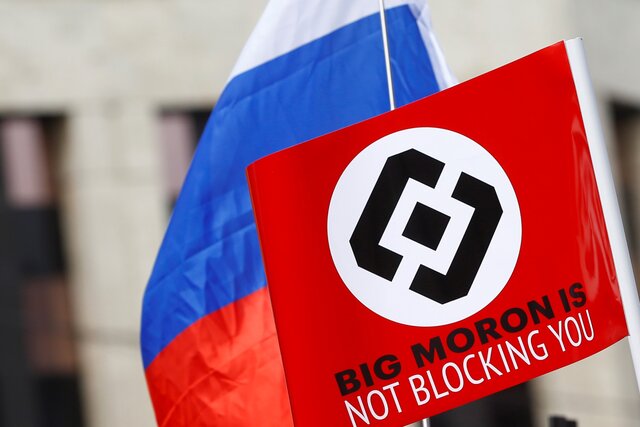
Photo: Kirill Kudryavtsev / AFP / Scanpix / LETA. Students of the Free University gave an accurate definition: over the past ten years, the popular, not "national" Telegram has become literally the foundation of life for our compatriots. Through Durov's messenger, they maintain family, friendly and professional connections. They entertain themselves and manage work projects. It has become the main media - and this was primarily due to the shrinking public space around. Now Kremlin officials, who have spent these years in their "special communication," have issued an order through a 1970s "rotary phone": to deprive the residents of Russia of their usual way of life. As early as the end of last year, relevant departments reported to Putin that an alternative in the form of Max has been successfully implemented, is popular, and the people are thus ready for the closure of Runet. The decision to impose Max on citizens does not take into account the deep distrust of people towards state initiatives (here one can recall the state's experience in fighting the pandemic six years ago), as well as the citizens' strong unwillingness to share the details of their personal lives with competent authorities. As well as to abandon the polyphonic information environment, where undesirable organizations in one stream can coexist with channels about discounts on marketplaces and Z-bloggers. By embarking on the path of destroying Telegram, and in essence the main communication environment for Russian residents, the authorities are making their third major mistake since 2022. First, they planned an invasion of Ukraine with a group that was clearly not ready to fulfill the set goal, if it were met with "Stingers" and "Javelins" in Kyiv instead of flowers. Then, to compensate for this failure, Putin announced a "partial mobilization" - probably his most unpopular decision in twenty-five years. Instead of queues of patriots at recruitment centers, the authorities received a queue at Verkhny Lars. Now people are being deprived of their "trolley" - the most familiar and native thing in our internet. This is also being done to cover up the results of previous mistakes, but it's not just about that. " What is the point of the attack on Telegram? The main reason is the redistribution of property. It is in this context that FAS statements about the illegality of advertising on platforms blocked in Russia should be considered. VK Group with Kiriyenko Jr. (son of presidential administration official Sergey Kiriyenko) is officially behind Max. Along with the deteriorating economic situation in Russia, control over key digital assets becomes the most important source of enrichment for the beneficiaries of the war. Senator Suleiman Kerimov received Wildberries, paying huge severance pay to Ramzan Kadyrov. The Kiriyenko family, with the support of interested parties in the special services, wants to redirect the financial flows passing through the messenger to themselves. For this, arguments that are well understood by those educated in the KGB system are used: enemies, agents, fraudsters, and traitors are concentrated in Telegram, and it is also not very convenient to listen to people's conversations there and quickly imprison them for what they say. In essence, the state, or rather its trusted persons, act as a "power entrepreneur," that is, a racketeer from the 90s, imposing their non-alternative service in the form of Max on people, holding a knife to their throat, in order to then receive their rent. If we look for rationality beyond this corruption and financial component, then the Kremlin needs an isolated internet in order not to lose its power in the next stage of the war or its end, when the devastating consequences of Putin's adventure become visible even to his most loyal supporters. Journalist Farida Rustamova writes that Russian officials do not trust the Max messenger, install it on clean phones and buy additional SIM cards to use it. The attempt to forcibly bring citizens into a messenger that is entirely controlled by the FSB is not very popular. Max's only chance is that there are no alternatives left. Participants of the rally launch paper airplanes - a symbol of the Telegram messenger - in protest against the blocking of the service in Moscow, April 30, 2018. Photo: Tatyana Makeeva / Reuters / Scanpix / LETA. A detail from Rustamova's publication: officials who are far from technology prefer to believe in the talent of Pavel Durov, who will come up with something new again, as he came up with Telegram after "VKontakte" and ways to bypass the first version of Roskomnadzor's censorship during the blocking of the messenger in 2018. It is too early to bury Durov's project, the Russian officials themselves hope, in whose interests, as it were, Runet is now being destroyed. How can Durov respond? Telegram, like the free internet in general, faces two problems. Firstly, an extremely sophisticated system for analyzing internet traffic, built over the eight years since the first confrontation with the messenger, which allows targeted blocking, for example, of calls and video communication within the platform's "slowing down." The second problem is even more fundamental: it is Iranian-style shutdowns, when mobile communication is unavailable in the center of Moscow. "White lists" are being introduced in parallel - access to several hundred platforms controlled by the authorities, which, according to the bosses, should be quite enough for an ordinary citizen: these include, for example, banks, marketplaces, and propaganda media. A technological response to both these problems theoretically exists. If Durov decides on a new campaign against blockages, his real national messenger, widespread throughout Russia, can use its infrastructure to create its own version of an internet uncontrolled by the authorities. For example, to rebuild its architecture on p2p protocols - a well-known example of the latter is torrents. Unlike centralized messengers, where information is transmitted through servers owned by the company, p2p assumes that data is transmitted directly from user to user. Such an architecture already exists on the market - for example, Twitter creator Jack Dorsey presented the Bitchat messenger in 2025. P2P protocols are theoretically much more resistant to blocking (although technical specialists I consulted during the preparation of this text say that the modern Russian censorship system can now be effectively used against classic p2p protocols). At the same time, experimental platforms built on such technology have one significant problem: a limited number of enthusiastic participants. But if Telegram, with its largest base of active users in Russia, starts using this technology, p2p could become the new mainstream. The response of the Russian authorities to Telegram's partisan actions would likely be criminal cases against Durov and his employees, possibly under the "terrorism article," which has already been announced by Russian propaganda. " Criminalization of the platform, in turn, will lead to the destruction of Telegram's commercial model in the Russian market and will turn the messenger into more of a partisan way of "fighting the regime." It is unclear whether such a step makes sense for Durov, given his problems in other jurisdictions (in the EU, for example, they might see this step as preparation for creating an "unblockable" platform for distributing illegal content). On the other hand, Durov's personal fortune is already rapidly shrinking due to the loss of the Iranian and Russian markets: according to Forbes USA, the entrepreneur's assets have fallen from $17.1 billion to $6.6 billion in a year. If the identity of "libertarian" Durov and fighter for a free internet was worth anything, now is the time to play this game with the Russian state. Pavel Durov. Photo: Giuseppe Cacace / AFP / Scanpix / LETA. Traditional p2p will not help fight shutdowns and will be at least difficult under white lists. But in this case, Telegram, again, theoretically, has an even more radical solution. There are tens of millions of active devices in Russia with the popular messenger installed, these devices are equipped with Bluetooth and WiFi. Solutions exist that can organize horizontal p2p networks without any internet access, transmitting information from device to device directly, using built-in radio modules. With sufficient device density, this can work, which was tested during the Hong Kong protests in 2014, where activists used FireChat, built on the model of direct data transmission via Bluetooth and WiFi. Russian cyberbank looks like this: the authorities completely turn off the internet, but Durov, in response, turns on his own, allowing people to exchange messages and write to their Telegram channels. This internet will be slow, unstable, and lack the ability to transmit sound and video, but it is better than no network at all. The only response to such outrageous behavior might be the recognition of several million Russians as terrorists and the roundup of people with phones in public places. A fully decentralized model based on user radio modules is associated with solving a complex mathematical problem of identifying a specific network node and a specific device. Durov's internet is only a theoretical possibility to fight Russian censorship based on the messenger's infrastructure.