government
One Battle After Another Wins Best Picture Oscar
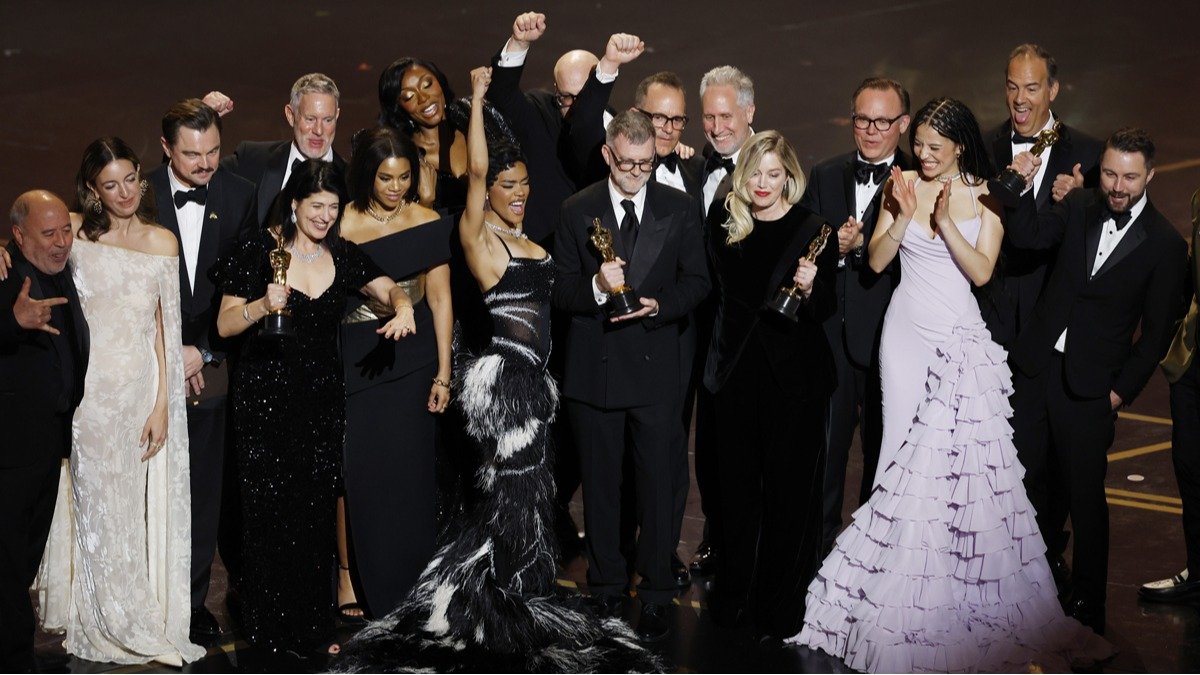
The film's director Paul Thomas Anderson won Best Director
2 months ago
Coverage from both government-aligned and opposition outlets agrees that director Paul Thomas Anderson’s war-themed film won the Academy Award for Best Picture at the most recent Oscars ceremony, and that Anderson also received the prize for Best Director. Both sides state that Michael B. Jordan was awarded Best Actor for his role in "Sinners" and Jessie Buckley won Best Actress for "Hamnet," and they concur that Sean Penn received an acting Oscar connected with Anderson’s film. They also agree that the awards were presented at the 98th Academy Awards ceremony and that Anderson’s film was a central focus of the night’s coverage, alongside recognition for other prominent features.
Both camps describe the event using the familiar institutional framework of the Academy of Motion Picture Arts and Sciences and the long-standing prestige of the Oscars as a global cultural benchmark. They situate the results within the broader tradition of honoring films, directors, and performers whose work has had significant artistic and cultural impact during the year. There is shared acknowledgment that the Best Picture and Best Director awards carry symbolic weight for both the international film industry and domestic audiences, and that the acting awards to Michael B. Jordan and Jessie Buckley reflect the Academy’s recognition of powerful individual performances. Both sides implicitly frame the Oscars as a stage where cinematic narratives intersect with wider social and political conversations, even if they differ on how explicitly to foreground those dimensions.
Film titles and emphasis. Government-aligned outlets refer to Anderson’s winning film as "One Battle After Another" and concentrate on it primarily as an artistic achievement, whereas opposition outlets consistently use the title "Battle for Battle" and highlight that it secured a total of six awards including Best Adapted Screenplay. While both agree that Anderson’s film dominated the night, government coverage keeps the focus on core categories like Best Picture, Director, and Supporting Actor, while opposition coverage uses the broader award haul to underline the film’s prominence and potential political resonance.
Political framing of documentary awards. Government coverage downplays or omits mention of a politically charged documentary, making Anderson’s film and the acting categories the main narrative thread, while opposition sources prominently feature the win for "Mr. Nobody Against Putin" as Best Documentary. Opposition outlets stress the film’s focus on military propaganda in Russian schools and treat its recognition as a pointed international statement, whereas government-aligned reporting appears to treat the documentary category as either secondary or not newsworthy enough to highlight, thereby minimizing its political implications.
Degree of politicization. Government-aligned media largely frame the Oscars as a celebration of cinema and national artistic success, emphasizing craftsmanship, performances, and the honor of international recognition, and presenting the ceremony as an apolitical cultural event. Opposition outlets, by contrast, underscore the political subtext of both the Best Picture winner and the documentary, linking their themes to critiques of militarism and state propaganda. This leads opposition reporting to portray the awards as a forum where global cultural institutions indirectly censure current government policies, while government coverage resists that reading and stresses neutral entertainment value.
Characterization of international perception. Government sources imply that the recognition of Anderson’s film reflects respect for national filmmaking and the universal appeal of its storytelling, suggesting a broadly positive image of the country in global cinema. Opposition sources, however, interpret the combination of honors for the war-themed feature and "Mr. Nobody Against Putin" as evidence that international cultural elites are increasingly critical of the government’s trajectory. As a result, government coverage frames the Oscars as validation of cultural prestige, while opposition coverage presents them as a subtle rebuke woven into the global awards circuit.
In summary, government coverage tends to emphasize the Oscars as a neutral celebration of artistic achievement centered on Paul Thomas Anderson’s Best Picture win and the major acting awards, while opposition coverage tends to cast the ceremony as a politically charged moment in which the success of Anderson’s film and the documentary "Mr. Nobody Against Putin" signal international concern and criticism toward current government policies.