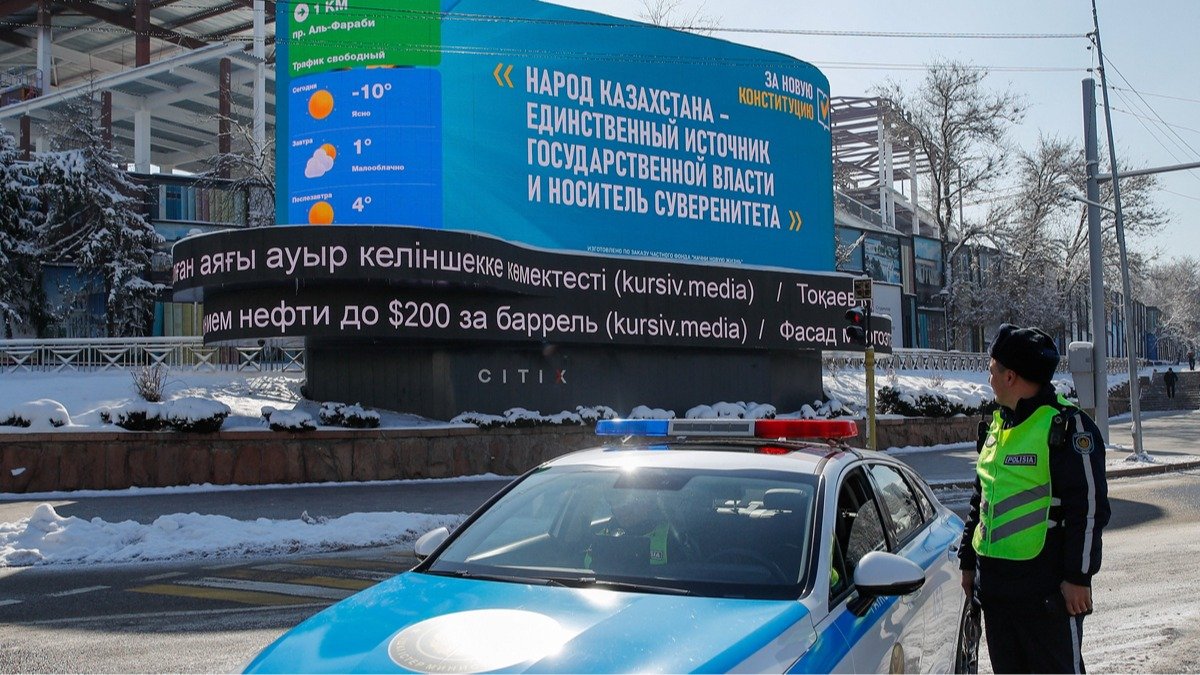
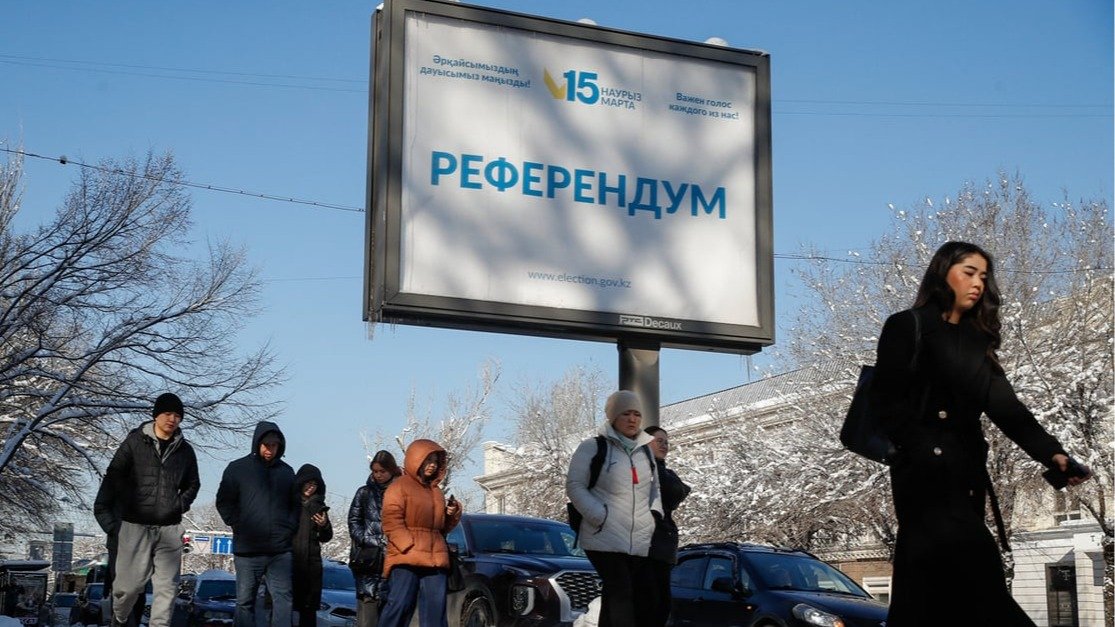
Citizens of Kazakhstan will come to the polling stations on March 15 to – and there is no doubt about it – support the draft of the new Constitution by a majority of votes. The country's Basic Law was changed relatively recently – in June and September 2022. However, the context both within the country and abroad has changed since then. President Kassym-Jomart Tokayev wants to further increase the manageability of the system, and changing the Constitution is a suitable tool for this. It is no accident that loopholes have been left in the text of the new Basic Law, which, if desired, can be used to restrict human rights and freedoms. It is also important that 2029 is already on the horizon, when Tokayev's powers expire. Updating the Constitution may mean both preparation for the transfer of power to his successor (and from this point of view, experts consider the recreation of the post of Vice-President) and a desire to "reset" the term. About what paths Kazakhstan may take – in the material by regional specialist Roman Chernikov. Campaign image of the referendum on the new Constitution on an advertising screen in Almaty, Kazakhstan, March 12, 2026. Photo: Pavel Mikheev / Reuters / Scanpix / LETA. New and Newer It is easy to get confused in the constitutional changes in Kazakhstan. Even the draft Basic Law, which was put to a referendum on March 15, was published in two stages. First, on January 31, one version was made public. Controlled media enthusiastically described the changes: 77 articles were rewritten, which is as much as 84% of the document's text. But then it turned out that the published text was not final. Refinements continued until February 12. Citizens were invited to send their proposals through the eGov and eOtinish portals (although they had done so before – for six months until January 30, and officials even pointed to specific articles written "by the will of the people"). The February refinements turned out to be significant. For example, now the president "has the right to dissolve" (not "dissolves") parliament if it twice refuses to approve his candidates for the posts of Vice-President and Prime Minister, as well as some other officials. Initially, the initiative that led to Sunday's referendum arose as a result of President Kassym-Jomart Tokayev's September proposal to make the bicameral parliament unicameral. At that time, it could still be called a reform, but then there were more changes. When in January the president wanted to reinstate the post of Vice-President (it existed in the country at the dawn of independence, until 1996), it became obvious: this was a complete restructuring of the power system. Tokayev himself spoke about this – even before he called the process of adopting a new Constitution, not reforming the old one. The last time the Constitution was changed loudly and noisily was in 2022 – after the largest protests in the history of independence (these events are often called simply "Kantar" – meaning "January") swept the country in January. At that time, posters promising a "New Kazakhstan" ("Zhana Kazakhstan") hung all over the country, but in reality, the changes turned out to be rather cosmetic. Political strategists focused on the amendment that from now on, "land and its subsoil belong to the people." What this means for the people themselves is not obvious (since the state still manages natural resources), but it sounds nice. There was also a series of amendments that can be called "anti-Nazarbayev." First, the title of First President was removed from the document. Second, relatives of the current head of state were forbidden to hold positions not only in government but also in the "state-owned sector" (e.g., the Samruk-Kazyna Investment Holding). The logic is simple: so that Tokayev does not eventually become – in a bad way – the "new Nursultan Nazarbayev." A resident of the village of Koyandy, Akmola region, votes at the republican referendum on amendments to the Constitution, Kazakhstan, June 5, 2022. Photo: Pavel Mikheev / Reuters / Scanpix / LETA. It would seem that radical changes were enough for that year. But not for Kazakhstan. On September 1, three months after the 2022 referendum, Kassym-Jomart Tokayev announced that he was ready to deprive himself of the opportunity to be re-elected. Instead of two five-year presidential terms, he decided to establish only one – a seven-year term. For the post-Soviet space, and even more so for Central Asia, this is a revolutionary statement – it happened only in Kyrgyzstan, but even there they quickly rolled back (and subsequently became champions of "tightening the screws"). The referendum was not held a second time in a year – the constitutional amendment was approved by parliament. This required two-thirds of the votes in both chambers. At the same time, the capital was renamed from Nur-Sultan back to Astana. This could be considered a truly important sign of getting rid of Nazarbayev's legacy (especially since many other things associated with his name were subsequently renamed). Turbulence Obliges It was believed at the time that the New Kazakhstan had arrived. But, apparently, it hadn't, because four years later, another referendum on amending the Constitution took place. And although many are wondering why the rush, there may be no answer at all. The fact is that the authorities of Kazakhstan are accustomed to playing proactively in order to always keep the agenda in their hands. This is presented as great wisdom of the leaders – they solve problems without waiting for a crisis. The same was true under Nazarbayev. He simply held early elections, and experts from Russian and Western institutions tried to uncover the hidden meaning. Is a transition being prepared? Is the Kazakh leader sick and about to die? Does he know something about Moscow's sinister plans and is trying to preempt them? The authorities themselves usually explained their decision by the abstract concept of "global turbulence." Tokayev successfully borrowed this rhetoric and used it on the eve of the referendum. "Every year of the current decade turns out to be more difficult than the previous ones. This process is reflected in social networks, where truth is closely intertwined with falsehood, conspiracy theories with disinformation, pain and tragedy with holidays and fun," he frightened regional deputies. "This is today's world, which has entered the era of artificial intelligence. The past two weeks have clearly shown the entire world community how dangerous, unpredictable, truly turbulent, i.e., unstable, life on Earth has become." The speech concerned the escalation in the Middle East due to US and Israeli strikes on Iran. Tokayev even made an unexpected hint at events in the Islamic Republic: "Now we are convinced that ultra-conservative political systems based on religious archaism, with a mistaken understanding of national pride and national interests, are not viable and are therefore doomed to failure. To resist the movement forward is to step backward, to go against the laws of being." President of Kazakhstan Kassym-Jomart Tokayev during a meeting with Putin, Astana, Kazakhstan, November 27, 2024. Photo: Mikhail Tereshchenko / Sputnik / Kremlin / EPA. It should be noted that when there were no early elections or rewriting of the Constitution in the country, no less "fateful" development concepts were adopted, such as "Kazakhstan's Path – 2050" or "Mangilik El." They consisted of uninformative phrases about independence, stability, interethnic harmony, and striving for the future, but were discussed as if Kazakhstan would never be the same again. Apparently, in the logic of the authorities, this incitement of anxiety was supposed to make the people rally around the leader. The Latinization of the alphabet – launched under Nazarbayev, reconsidered several times (the first version of the Latin alphabet was extremely inconvenient due to the numerous apostrophes – they denoted special sounds) and almost abandoned under Tokayev – can also be attributed to such "fateful decisions." In any case, all posters calling to vote in the March 15 referendum were written in Cyrillic – as was the ballot itself. And yet, the current changes in Kazakhstan should not be treated ironically – they really affect too much to be decorative. Calculating the Vector At first, the draft of the new Constitution of Kazakhstan puzzled experts. For example, political scientist Ekaterina Shulman did not want to characterize its content in any unambiguous way – whether it was a path to democratization or, conversely, to strengthening Tokayev's personal power. At the same time, the Russian experience suggested: "one should fear that all of Tokayev's rewriting of the Constitution is just a screen to carry out a 'reset' of terms and remain in power after 2029. 'If you don't engage in continuism [extension of power. – Ed.], you are not a true autocrat,' noted Ekaterina Shulman. 'If the current constitutional norm of a single seven-year presidential term remains and the current president observes this norm and does not make an exception for himself personally, we cannot say that the new Constitution is more authoritarian than the previous one.'" Kazakh deputies, who cannot be suspected of disloyalty, also almost unanimously asserted that there would be no extension of Tokayev's powers after 2029. "It is clearly written in our Constitution that the president can be president once for a seven-year term," said deputy Aidoss Sarym. "Therefore, I think that in 2029 we will have a third president, and seven years later, in 2036, we will have a fourth president, and so on." The thesis that "there is nothing about resetting in the Constitution" is encountered everywhere, but here one must object that such things are not written in the Constitution. This is more the prerogative of the Constitutional Court, which will interpret the norms after the adoption of the new Basic Law. Therefore, there will be no absolute certainty that Tokayev will not decide to stay, at least until 2028, when an obvious successor may appear on the horizon. Advertisement for the referendum on the new constitution in Almaty, Kazakhstan, March 12, 2026. Photo: Pavel Mikheev / Reuters / Scanpix / LETA. Given the 28-year rule of Nursultan Nazarbayev, the preparation for the transfer of power is as common a process in Kazakhstan as rewriting the Constitution. As Vladimir Putin put it, they started "looking around" there a long time ago, and people close to power even hinted at specific successors (for example, Nazarbayev's son-in-law Timur Kulibayev or the ex-president's daughter Dariga). There is a potential successor now – former political scientist and then State Advisor of Kazakhstan Yerlan Karin, who headed the constitutional commission. But one can speak of this with any certainty only if he is made Vice-President. The powers of the Vice-President are determined by the head of state himself (in the "draft" of January 30, his functions were described in general terms, but in the "final version" they were removed altogether). It turns out that any potential candidate can be kept in this position for testing without particular risk, and then removed – and for this (unlike appointment), one does not even need to ask for permission from the Kurultai. The powers of the head of state pass to the Vice-President in case of his voluntary resignation, severe illness, death, or impeachment by parliament (this is theoretically possible, but this procedure is very complex and no one has ever seriously considered its implementation). Super-President Tokayev At the same time, many Kazakh human rights activists note that the power system is becoming more authoritarian and "super-presidential" (although it is precisely this characteristic of the Kazakh authorities that they have verbally fought against since 2019). This was stated, in particular, to the BBC by Yevgeny Zhovtis, chief expert consultant of the Kazakhstan International Bureau for Human Rights (KIBHR). The expert meant that under the new Constitution, the president will be able to directly appoint key officials without the consent of the parliament (Kurultai): chairpersons of the Constitutional and Supreme Courts, the National Bank, the Committee for National Security, the Central Election Commission, the Supreme Audit Chamber and the Supreme Judicial Council, the Prosecutor General, the head of the State Security Service, and the human rights ombudsman. Thus, the Kurultai retains control only over the appointment of the Prime Minister and Vice-President. However, given the realities of Kazakhstan, this control will be formal in any case. Under the previous Constitution, when the parliament's involvement was required for the appointment of these officials, no one expected surprises either. It turns out that the real influence on the political landscape remains the innovation of a unicameral Kurultai, elected exclusively on a proportional system, without any quotas. Before that, "their" people in parliament were held by both the president and the Assembly of the People of Kazakhstan – a consultative body composed of representatives of various ethnic groups of the republic. It was assumed that such a quota would allow no one to be offended and elect their deputy from Koreans, and Uyghurs, and, of course, Russians. Tokayev himself advocated for the abolition of such a practice, noting: "Deputies must be elected according to unified rules, without any exceptions and privileges." This idea seems progressive. But in the conditions of Kazakhstan, it will not mean the flourishing of democracy. There are no opposition parties that can participate in elections in the country. And they certainly will not appear by summer, when early elections will be held in the country – after all, the Majilis and the Senate will have to be transformed into the Kurultai. It turns out that the system of selecting deputies will simply become simpler, without unnecessary stages. But they themselves will remain as obedient as they were. President of Kazakhstan Kassym-Jomart Tokayev at the SCO summit in Astana, Kazakhstan, July 4, 2024. Photo: Gavriil Grigorov / Sputnik / Kremlin / EPA. Freedom Within Limits As is often the case when discussing the Constitution, most of the talk revolves around symbolic words and phrases – which "set the tone" but do not have direct legal effect. In Russia, where the referendum on constitutional amendments took place in 2020, these were the words about the "state-forming people" and "belief in God." In Kazakhstan, much attention was paid to the fact that in the "draft," the Russian language was used "on par" with Kazakh, and in the "final version" submitted to the referendum – "alongside." And "alongside" may mean not "on par" at all, but to a much lesser extent. Tokayev himself considers such fears unfounded. "It's amusing to read such articles with numerous stylistic and grammatical errors, their authors advocate for the Russian language, but they themselves do not know it well," he said at a forum of regional deputies. "Meanwhile, the very fact of publishing the text of the new Constitution in Kazakh and Russian, which have equal legal force, as an official document speaks for itself and does not need comments or, even more so, justifications." Many are concerned about this point: "The implementation of human and civil rights and freedoms must not violate the rights and restrict the freedoms of other persons, infringe on the foundations of the constitutional order, public order, public health, and morality of society." This is a classic "rubber" wording that can mean whatever a particular official wants. These words are also alarming: "Information about the movement of funds and assets of non-profit organizations received from foreign states, international and foreign legal entities, foreign citizens and stateless persons must be open and accessible in accordance with the laws of the Republic of Kazakhstan." How laws restricting the activities of NGOs are written, toughened, and used is well illustrated by the example of Russia. At the same time, the authorities are trying to present the situation as if the current Constitution describes human rights better than all previous ones, and now they are reliably protected. Tokayev himself said: "The section on the protection of human and civil rights has become the most voluminous – 30 articles. This is almost a third of the Basic Law, while, incidentally, the section on the president consists of only 10 articles." Other pro-government speakers also emphasized this. "The preamble for the first time in the history of our country declares the strict observance of citizens' rights and freedoms," noted the human rights commissioner in the republic Artur Lastayev. "Now this is enshrined as one of the principles of state activity. Its introduction will embed the priority of human rights in the DNA of all basic social institutions." The preamble was indeed completely rewritten. But it's not difficult: the old one was too short. "Millennial history of the Great Steppe," whose continuity Kazakhstan preserves, "the unitary nature of the state," the aspiration "for peace and friendship with all countries," and "the need for careful attitude towards nature" were added. But the only important thing among these can be considered the unitarity. Almaty, Kazakhstan, March 12, 2026. Photo: Pavel Mikheev / Reuters / Scanpix / LETA. President at a Fork Incidentally, it is in unitary states that unicameral parliaments are most common. A bicameral one, however, is usually needed to represent regions separately. At the same time, states that emphasize stability and prepare for "turbulence" often invent some kind of quasi-parliament. The best example is Lukashenko and his All-Belarusian People's Assembly, which became a constitutional body after the referendum on February 27, 2022. In Kazakhstan, a new body with the right of legislative initiative is also being created – the People's Council (Khalyk Kenesi). It will replace the aforementioned Assembly of the People of Kazakhstan and the National Kurultai created after January 2022 – not a parliament, but a consultative body that included public figures, politicians, representatives of NGOs, businesses, and the expert community. It is difficult to explain the function of the Kurultai (besides the obvious one – to somehow demonstrate changes in the country after the severe crisis). This body met only once a year. Kassym-Jomart Tokayev spoke there, and beautiful but insignificant decisions were made – for example, to reinstate the title "People's Writer of Kazakhstan" and establish similar ones for working professions. Now Kassym-Jomart Tokayev announced that "their [i.e., the Assembly of the People and the National Kurultai. – Ed.] historical missions can be considered successfully completed." The new People's Council has significantly more powers. This body can not only introduce laws itself but also initiate referendums, and its constitutional law (which has not yet been written) may include more serious powers. In peacetime, the People's Council can become a place of honor for retired officials, and in times of crisis, it can be used differently. Kassym-Jomart Tokayev is clearly not a politician of the Western type (like, for example, Armenian and Moldovan leaders Nikol Pashinyan or Maia Sandu), and his policies raise many questions. But, one way or another, so far he has not taken back his promise to leave office in 2029. Now Tokayev stands at a crossroads and could well turn towards greater openness. But for now, he wants to further increase the manageability of the system, and changing the Constitution is a suitable tool for this.