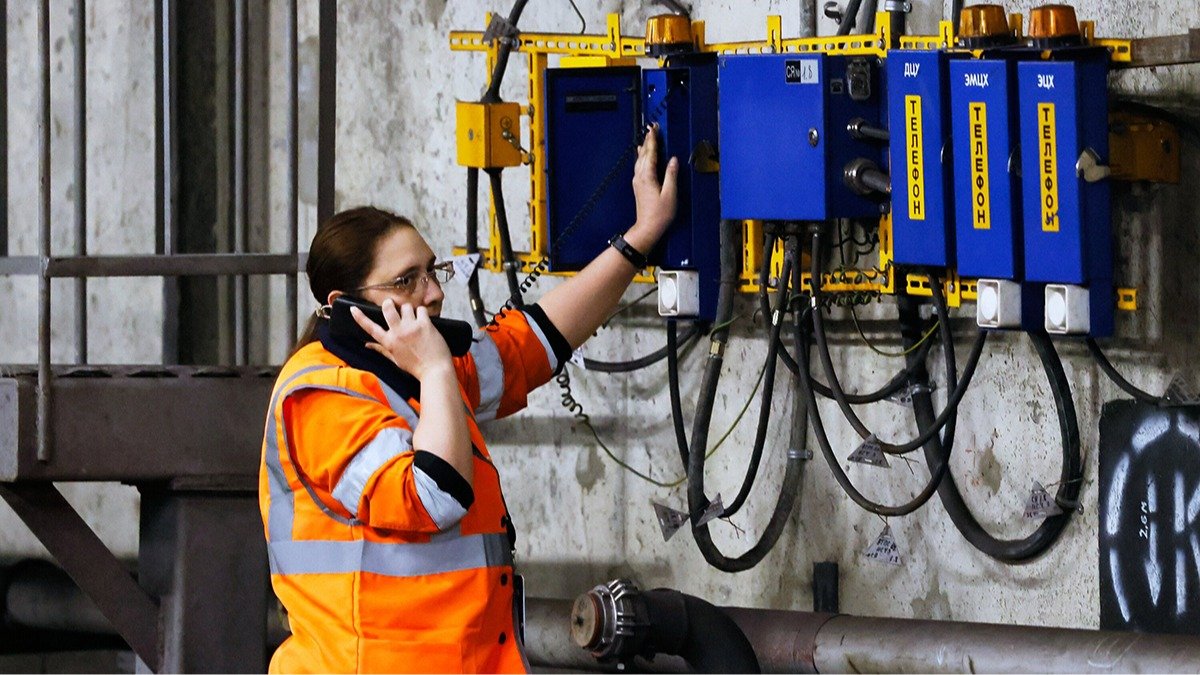
A metro employee talks on the phone in the tunnel of the Big Circle Line. Photo: Yulia Morozova / Moscow Agency. I saw a time machine working at our local library yesterday. In the evening, after eight o'clock, the crowded, hissing, and muffledly giggling silence of the reading room was broken by the loud cry of a young, curly-haired girl from the checkout desk: "Is Angelina Chebotkova in the hall? Angelina, your mother is calling!" Angelina hurries to the phone. Currently, in our district (I live in the center), mobile internet has been down for two days, and mobile communication is also periodically lost. It's good that Angelina Chebotkova's mother knew where to find her. In general, Sobyanin's libraries today are both a window to the past and the future. Polished, bright, immersing visitors in optimistic Scandinavian interiors, they offer Muscovites conversational clubs in the Mordovian language, invite them to the fascinating world of intuitive knitting, and also carefully protect them from the corrupting influence of Akunin and Bykov. And most importantly: Moscow libraries are now becoming the umbilical cord that connects Muscovites to the online world. Cafes and other establishments have long refused to provide Wi-Fi service to guests - probably reasoning that it is a relic. But libraries have preserved this tradition. I sit in the library all day. There is a fairly stable and fast city network here, which does not slow down, even if you turn on a VPN. And all day I observe people who come in from the street and ask at the checkout desk: "Hello, do you have Wi-Fi in the library?" - "Yes!" - the girls at the counter answer triumphantly. - "But it's a city network! You still won't be able to connect without mobile internet!" The city network works exactly like this: the first time you need to go to the verification page from another network, confirm your mobile number linked to mos.ru. But, having recognized you once, the network will no longer request identity verification. In general, I learned that mobile internet was turned off in several districts of Moscow the day before yesterday morning. Coming out of the metro in an unfamiliar district in the east, I launched the car-sharing application. The free car search wheel spun for minutes, but no free cars were found. This was strange, because here they are - lined up in a white and orange strip in the parking lot, waiting for renters. Moscow. Photo: Dmitry Belitsky / Moscow Agency. I reasoned that this was a local application glitch (after all, mobile communication outages are not yet a common occurrence in Moscow, and no one had sent us any notifications at that time). I decided to restart the phone just in case - and in the meantime, buy coffee at the food court of the nearest shopping center. The food court was still deserted. "Cash only," was written at several counters. And on the safety rules stand, which indicates how to behave during shelling and other emergencies, an angry sign hung: "ATMs on the -1 floor!!!!!" Exactly, with five exclamation marks. Going down, I discovered that the phone signal was also gone: a crossed-out circle appeared in the corner of my smartphone screen. Although this development could have been expected, because we were warned! In plain Russian, a few days ago, an announcement was posted in our house chat, reprinted from the Ministry of Emergency Situations website: "On March 4, 2026, at 10:40 local time, a planned comprehensive test of population warning systems will be held in all subjects of the Russian Federation. During the event, sirens and loudspeakers will be activated, and TV and radio broadcasting will be temporarily interrupted to transmit a test signal." The training alarm signal caught me on the way to the metro, in one of the parks in the center of Moscow: bombastic music in the style of early Soviet cinema poured from the speakers. " I would never have guessed that this was the "alarm notification." But in the evening of the same day, Galina Vladimirovna, the chairwoman of our house committee, announced in the general chat that it was. In short, Moscow tries to make even war as pleasant and festive as possible. Yesterday I tried to act as a remote navigator for a taxi driver. Of course, you can call a taxi using home Wi-Fi - but then the adventures begin in the yard. For some reason, the navigator sometimes leads taxi drivers to our Stalin-era building through a neighboring yard, which has long been blocked by a barrier. Running into it, many drivers start to panic, or even cancel the order. Usually, noticing the taxi driver's fuss in front of the neighbor's barrier, I just go up to him there. But now mobile internet is not working, and I don't know from which side the driver will enter. I wrote him a detailed comment that he should enter the yard from the side of the grocery store and the dumpster, and then turn left immediately. It seems we found each other. At the Maryina Roshcha metro station, March 2, 2026. Photo: Dmitry Belitsky / Moscow Agency. By the way, about the dumpster: it was there that the production drama of our new janitor Konstantin unfolded - an unsociable man from some remote Russian region. (His foreign accent, with strangely raised phrase endings, as well as a gray padded jacket, which he wears without any work uniforms from the State Unitary Enterprise "Zhilishnik", allow us to judge this). - Did you completely lose your mind there, Andrey Vladimirovich?! - he shouted into the phone, not paying attention to the fragile morning sleep of the residents of the Central District, nor to their delicate cultural settings. - I'm telling you, the photos are not being sent! Neither through Max, nor through Hiyaks! The requirement for photo confirmation of the quality of work performed is a long-standing know-how of urban utility services. Everyone photographs our courtyards: janitors, garbage truck operators, employees of various utility services that clean the capital after snowfalls. Before Konstantin appeared in our lives, I thought that all this was an absolute whim of Moscow, obsessed with the idea of a digital city. His predecessor Alizhon, whom we all called Alik, kept our yard in exemplary cleanliness, and we chipped in for his bonus for the New Year and on the occasion of heavy snowfalls. But Alik left us in November last year, saying that it had become difficult to live in Moscow. And they sent us Konstantin, who, to all the delicate hints of our housekeeper Galina Vladimirovna that, say, clearing the area near the entrance group is his direct responsibility, answers the same way as his patron. The residents have repeatedly threatened Konstantin with sending a complaint to the "My City" portal, to which Konstantin confidently retorts: "Write to Sportloto if you want!" This morning (mobile internet still hasn't appeared), I witnessed a heartbreaking scene in our supermarket. At the checkout stood a neatly made-up pensioner of the Sobyanin conscription: in a blue frost fox fur coat, with poles for Nordic walking and with a faint, barely perceptible smell of corvalol, hinting at barbiturate dependence. The pensioner could not load the store's application, which automatically calculates the discount. " - You're doing everything to fleece us! - she pressured the meek cashier, although she tried with all her might to explain that the store was not to blame. - They stole and ruined the whole country, and now they're squeezing the last pennies out of us! - Either a lunar eclipse again, or Mercury retrograde, - the girls in the deli section laughed.