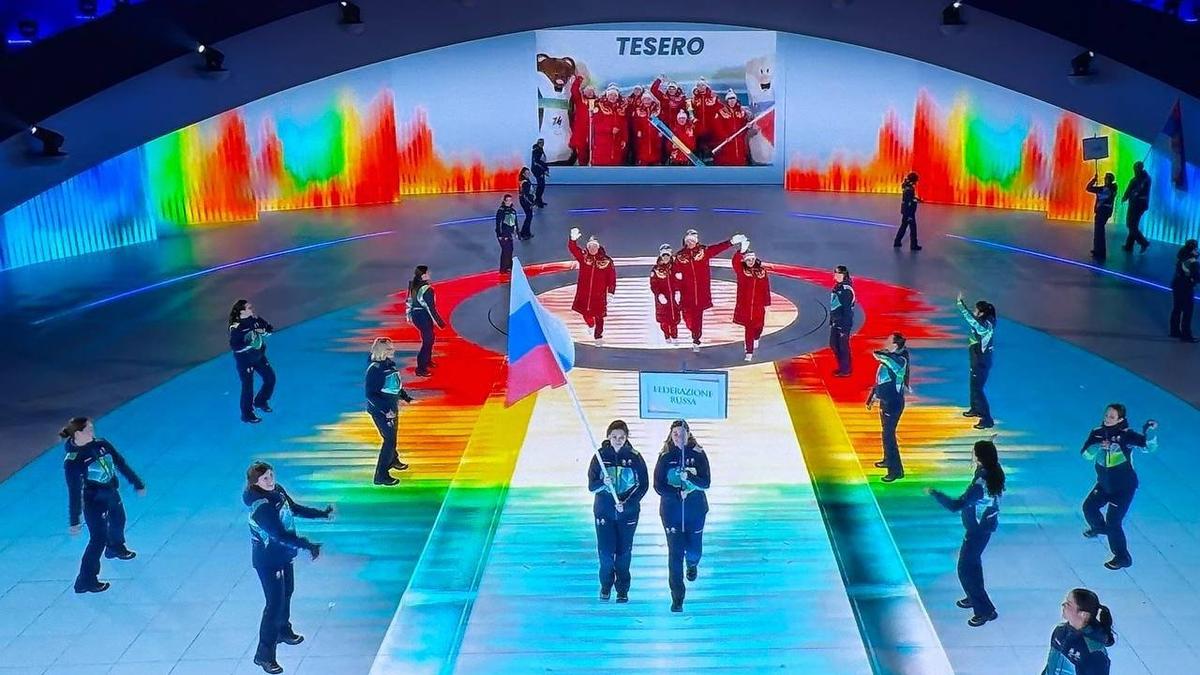
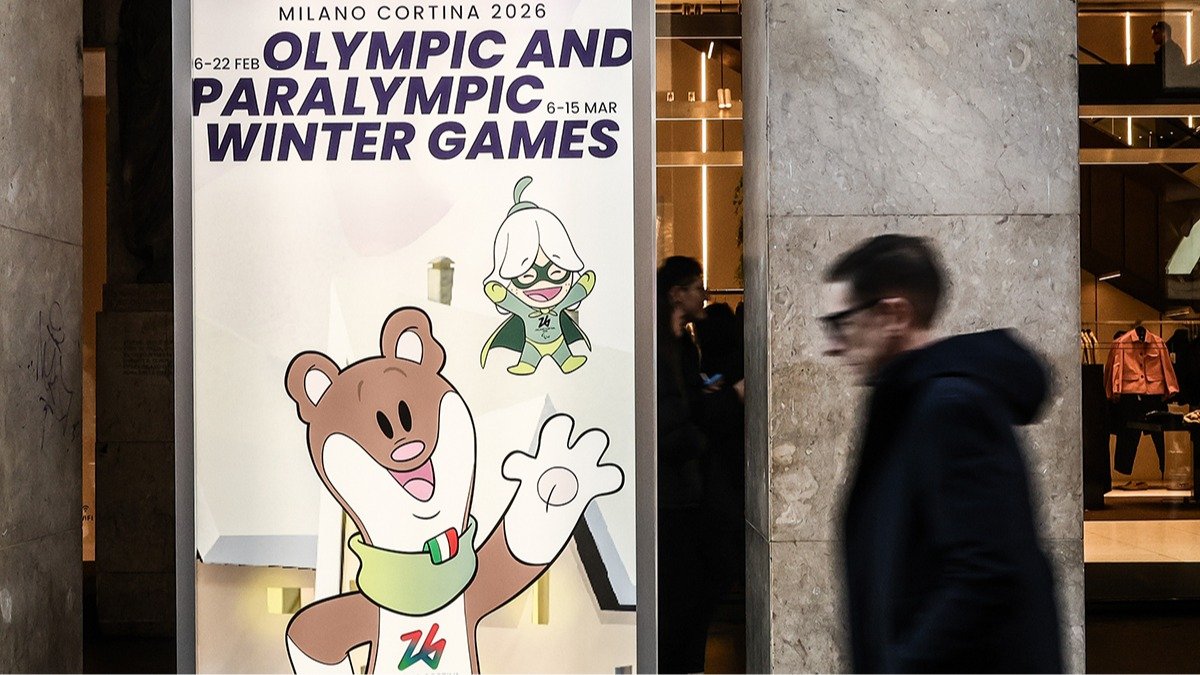
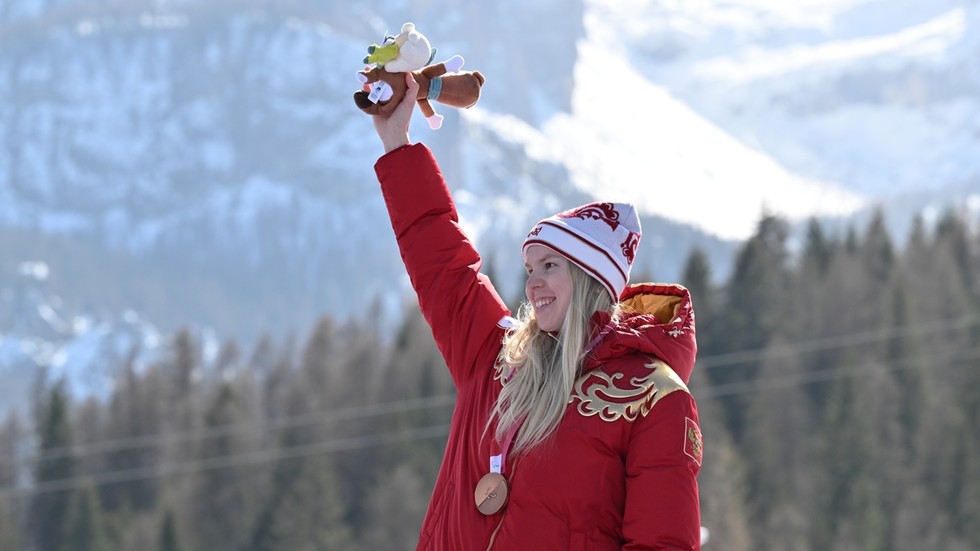
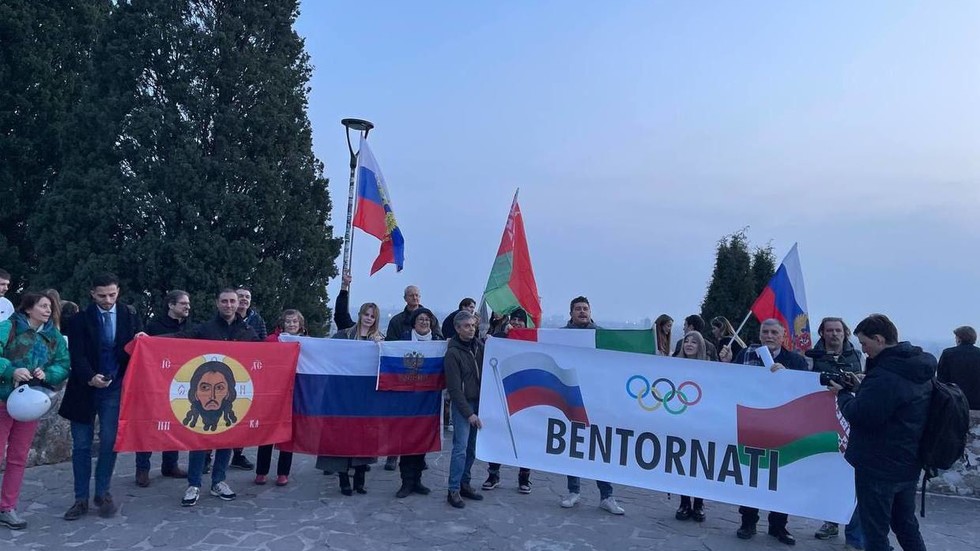
At the opening ceremony of the Paralympics in Verona, Italy, on March 7, the teams of Russia and Belarus marched with their national flags for the first time since 2014. The flag bearers for the Russian team were cross-country skier Anastasia Bagiyan and alpine skier Alexey Bugaev. The International Paralympic Committee's decision to allow athletes from the two countries to compete with their symbols and anthems again caused a sharp reaction: more than ten countries announced a diplomatic boycott of the opening ceremony, reminding that Russia's war against Ukraine continues. Novaya Gazeta Europe provides a detailed account of the political conflict before the Games. A banner for the Milan Cortina 2026 Winter Olympic and Paralympic Games in Milan, Italy, on February 5, 2026. Photo: Teresa Suarez / EPA. "We understand that many countries are unhappy with the decision [to admit Russians], but it was made through a very democratic process," said the International Paralympic Committee (quote from DW). The possibility of lifting sanctions against Russian Paralympic sports was first discussed in the fall of 2025. On September 27, the International Paralympic Committee (IPC) reinstated full membership for the committees of Russia (RPC) and Belarus (PRCB). Two proposals were put to a vote: 1) complete suspension of Russia (111 against, 55 for, 11 abstained); 2) partial suspension (91 against, 77 for, 8 abstained). Similar results were obtained for Belarus: 119 against, 48 for, 9 abstained, and 103 against, 63 for, 10 abstained. Thus, the national Paralympic committees approved the lifting of the current ban by a majority vote. It remained to obtain admission to qualifying events from international sports federations that had suspended Russians and Belarusians. At the Winter Paralympics, athletes compete in 6 disciplines: alpine skiing, cross-country skiing, snowboard, biathlon, sledge hockey, and wheelchair curling. On October 23, the IPC press service stated that Russia and Belarus would not have the opportunity to qualify for Milan-Cortina due to the federations' stance. The International Ski and Snowboard Federation (FIS), the International Biathlon Union (IBU), the World Curling Federation, and the World Para Ice Hockey Federation continued to deny athletes participation in international competitions. Russia filed a lawsuit with the Court of Arbitration for Sport (CAS) to challenge FIS's decision. In early December, CAS ruled FIS's actions unlawful and ordered the lifting of restrictions for Russian and Belarusian athletes. In sledge hockey, the qualifying competitions that determined the Paralympics participants had already concluded. The international federations for biathlon and curling denied Russians and Belarusians admission. From January 14-18, Russian and Belarusian Paralympians participated in a stage of the Cross-Country Skiing World Cup in Germany under their own flags. In Germany, FIS's decision was met with a negative reaction. "We are forced to comply with the CAS decision, but it contradicts our moral and ethical principles, our sporting values, and in our view, is unacceptable, especially for participants from Ukraine," stated the German Paralympic Sports Association. From Finsterau, Russian athletes brought home 8 medals and the necessary ranking points for Milan. On January 20, the IPC announced that Russia could apply for bipartite invitations in skiing and snowboarding – these allow admission in special cases, even if qualifying competitions have already taken place. The Russian Paralympic Committee (RPC) sent a list of 16 candidates to the IPC. On February 17, the head of the RPC, Pavel Rozhkov, announced that bipartite invitations had been issued to 6 athletes. Four participants from Belarus are heading to Milan. How Ukraine Announced Boycott The first official reactions emerged on February 18. In an interview with British journalist Piers Morgan, Volodymyr Zelenskyy called the IPC decision "dirty, absolutely disrespectful, and un-European." He noted that small steps, which concessions begin with, lead to large-scale consequences: "Russian aggression started the same way: Crimea – no one responded, Donbas – no one responded. Then the full-scale invasion. Step by step. This is their modus operandi. The same is happening in sports." Minister of Youth and Sports Matvey Bedny wrote on Facebook that "Russia is using the vulnerabilities of open societies and international organizations to normalize crime." Several hours later, he announced that Ukrainian officials would ignore the official Paralympic events, including the opening and closing ceremonies, and expressed gratitude in advance to foreign colleagues for their support. The President of the National Paralympic Committee of Ukraine, Valeriy Sushkevych, called the IPC decision an "escalation of loyalty to the representatives of a killer country," but emphasized that Ukrainian athletes would definitely participate in the competitions. Regarding the injustice of the situation, Foreign Ministry spokesperson Heorhiy Tsykhiy noted that the Ukrainian team includes individuals who were injured in the war. The following day, the team joined the boycott. The decision on admission was called political in a statement by the National Paralympic Committee, accusing the IPC of systematic loyalty to the aggressor country and demanding that the Ukrainian flag not be used at the opening. On February 20, the broadcaster Suspilne announced its refusal to broadcast the opening ceremony: "We consider it unacceptable to invite representatives of the aggressor state and its satellite, which is waging a full-scale war in Europe, destroying Ukrainian cities, killing Ukrainians, including hundreds of athletes, to the Paralympic Games." A week before the Games, the head of the Ukrainian MFA, Andriy Sybiga, once again urged other countries to support the boycott and not participate in an event where flags "associated with hundreds of thousands of war crimes" would be carried. Vladislav Gerashkevych of Ukraine in a helmet with photos of Ukrainian athletes killed in the war, Milan-Cortina, Cortina d'Ampezzo, Italy, February 11, 2026. Photo: Daniel Dal Zennaro. Who and How Supported the Boycott? By this point, 14 countries are known to have publicly expressed support for Ukraine. Ukraine, the Czech Republic, Poland, Finland, Latvia, Estonia, the Netherlands, Great Britain, Austria, Canada, Germany, Croatia, Romania, and Lithuania refused to participate in the ceremony. The head of the Czech Paralympic Committee emphasized that they are "categorically against the participation of Russians and Belarusians in the Games. Our opinion has remained firm and unchanged from the beginning; we have always been categorically against their return in any form." There will be no delegations, flag bearers, or recorded messages from Czech and Latvian Paralympians in Verona. Finland explained its decision as "the least we can do to show solidarity with Ukraine." Several European officials also reported personal boycotts. The Prime Minister of Lithuania canceled her trip to Italy. The European Commissioner for Intergenerational Justice, Culture, Youth, and Sport, Glenn Micallef, called on like-minded individuals to join him, emphasizing: "Sport unites when it is based on principles. It divides when it compromises." The Italian government expressed its protest against the return of the national symbols. In a joint statement, the Minister of Foreign Affairs and the Minister of Sport noted their categorical disagreement with the IPC's decision: "Italy, along with 33 other countries and the European Commission, reiterates its disagreement with the decision on the full reinstatement of the activities of the Paralympic Committees of Russia and Belarus, adopted by the General Assembly of the International Paralympic Committee on September 27." Meanwhile, the IPC has not yet received official confirmation of the boycotts. This was reported to Match TV by the committee's press service. The organization's head, Andrew Parsons, stated that they would not change the decision: "For various reasons, National Paralympic Committees may decide not to participate in the opening ceremony. We strongly urge them to attend. In our opinion, the opening ceremony should not be politicized, but we respect and understand different views." Parsons also noted that the IPC would not impose sanctions for non-participation. However, the Ukrainian team had to yield to the IPC on another "political" issue. The committee raised objections to the parade uniform because it depicted the full map of Ukraine within its 1991 borders. As Valeriy Sushkevych explained, the uniform was a political manifesto intended to remind the world of the inviolability of state borders. The IPC interpreted this as a manifestation of "radicalism" and demanded that the uniform be replaced. New sets had to be hastily made and sent to the delegation members in Milan. A similar situation occurred before the Paris Paralympics, but the team managed to defend its choice then. "This is Where Our Return Begins" In Russia, news of the flag's return and the boycott caused a stir. Officials and journalists spoke of the possible complete lifting of sanctions on sports, rejoiced at the victory, and were outraged by the "provocations." Vladimir Putin's press secretary, Dmitry Peskov, stated that the Kremlin categorically disagrees with Ukraine's characterization of Russian Paralympians as war propagandists. Foreign Ministry spokesperson Maria Zakharova commented on the decision to ignore the opening with the phrase: "The air will become cleaner." Dmitry Guberniev praised the brilliant joint work of Rozhkov and Degtyarev. Olympic champion and State Duma deputy Svetlana Zhurova called the IPC decision "humanly correct" and the boycott an "attempt at weak pressure." There were calls to revoke accreditations, and accusations of political orders and radicalism were made. What is Allowed for Russia at the Paralympics? Athletes compete with the country's symbols and under their flag, attend official events, including the opening and closing ceremonies, and will hear the Russian anthem in case of victory. In early February, the IPC approved the delegation's equipment. Paralympians will wear red and white clothing with gold inscriptions "Russia." The last time the country participated with its national flag and anthem was at the Sochi Paralympics in 2014. Back then, the Russian team of 69 people won a record 80 medals. In Milan, according to Pavel Rozhkov's estimates, athletes are vying for 18 awards. Varese, Italy. The Canadian ice hockey team played a friendly match against Italy as part of the Milan Cortina 2026 Winter Paralympic Games in Milan at the "Akinike" ice arena, which Canada won 4-0, on February 28, 2026. Photo: Nick Zonna / IPA / Scanpix / LETA. Who Will Compete for Russia? The Russian team includes Alexey Bugaev, Varvara Voronchikhina (alpine skiing), Ivan Golubkov and Anastasia Bagiyan (skiing), Dmitry Fadeev, Philipp Shebbo (snowboard). Two alpine skiers and officials will participate in the opening ceremony, which will take place in Verona on March 6. The remaining athletes will be preparing for the competitions at that time. A volunteer will serve as the team's flag bearer. For Alexey Bugaev, this is his third Paralympics. He is one of the most experienced and certainly the most decorated member of the team. After the Sochi Games, where he won 5 individual medals (3 gold, 2 silver, 1 bronze), the 16-year-old Russian athlete was hailed as a new world star. Bugaev has a congenital deformation of his right hand. He skis without poles. In Milan, Bugaev, the main Russian medal contender, is entered in 5 disciplines. Alpine skier Varvara Voronchikhina has been a multiple champion and medalist in major international competitions, but this is her first Paralympics. Voronchikhina is 23 years old and has a congenital left arm injury. Like Bugaev, she is expected to win medals in the super-combined and slalom. Alpine skiing events will begin on March 7. Anastasia Bagiyan and Sergey Sinyakin will compete together. Bagiyan is a visually impaired skier, and Sinyakin is the guide skier in this pair. The athlete relies on his voice and signals. They have won medals at Russian competitions and a World Cup stage in January. After each start, they analyze their performance in detail. In Milan, the skiers will compete in the sprint and 10 km. Cross-country skier Ivan Golubkov has been a six-time world champion (bringing all his medals from Lillehammer in January 2022) and a nine-time cup winner. The 30-year-old athlete has a congenital lower limb abnormality. He failed to qualify for Sochi and Pyeongchang, and did not go to Beijing. In 2022, he intended to retire from sports. Golubkov prefers long-distance races but is also entered in the sprint. He has high chances for medals. In para-snowboard, where 2 athletes also compete, medal predictions are more cautious. Dmitry Fadeev suffered a serious injury on the track in 2020 and had his leg amputated. After adapting to his new life, Fadeev returned to sports. He posted videos of his training sessions online, was noticed by the federation, and then invited to the national team. The snowboarder has rarely competed in international events. It is expected that his results at the Paralympics (he competes in 3 para-snowboard disciplines) will allow Fadeev to enter the top ten. The sports prosthesis used by Fadeev was created in the Russian bionic laboratory "Anatomiks." Its general director, Philipp Shebbo, grandson of actress Galina Polskikh, is the team's second snowboarder. He was 19 when he lost his leg in a motorcycle accident. Shebbo received an engineering degree in the UK. Upon returning to Russia, he founded a small company that developed sports modules for prosthetic legs. Shebbo personally made the first prototypes for himself. *** The Russian Olympic Committee remains under sanctions. Individual athletes are admitted as neutral athletes. Sports Minister Degtyarev hopes that the IOC Executive Board will consider the issue of restoring the status in April-May. According to him, the legal commission, to which the current committee head Kirsty Coventry handed over Russia's dossier immediately after taking office, found no obstacles to a favorable decision for the ROC.