

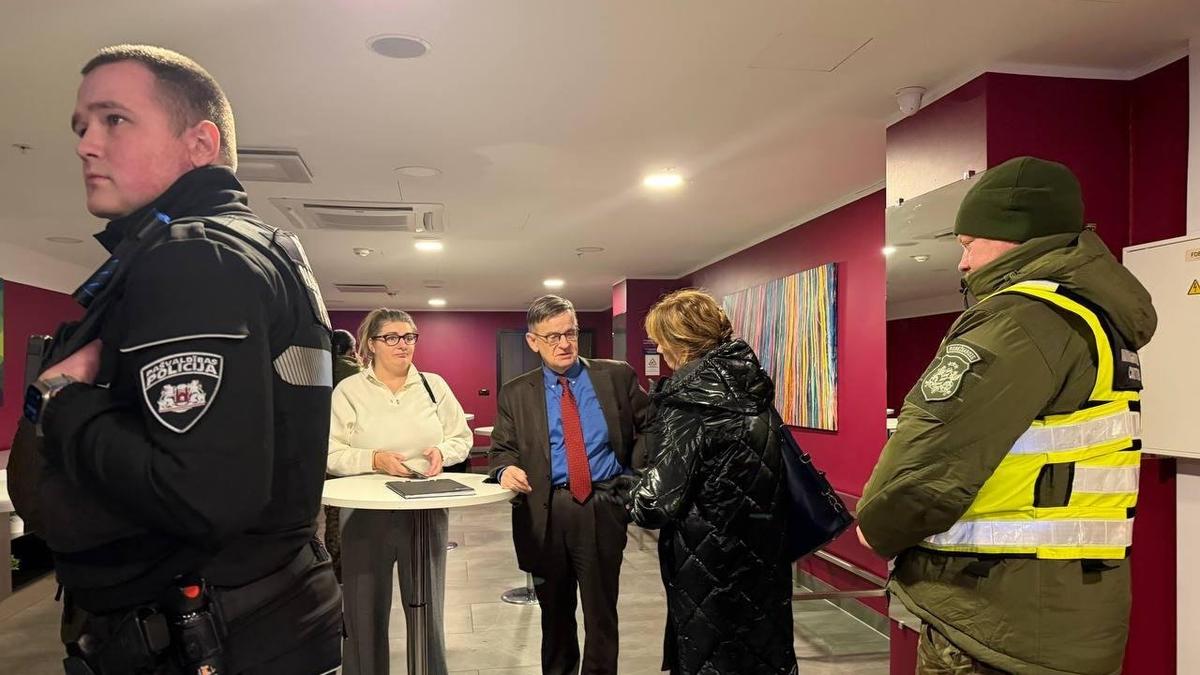
Russian scholar and Korea expert Andrey Lankov was detained by Latvian authorities in Riga while preparing to deliver a public lecture on North Korea, scheduled to begin at 17:00 GMT. Both government-aligned and opposition outlets agree that he was taken away from the venue by officials and brought to an immigration service office, interrupting the planned event and surprising attendees who had gathered for the lecture.
Across sources, there is agreement that Lankov had legally entered Latvia prior to the incident and that his detention was carried out by state authorities in the context of immigration or border control procedures. Coverage from both sides notes his status as a well-known academic specializing in Korean studies, and that his case involves cross-border movement within the Baltic region, with Estonia mentioned as the neighboring state to which he was eventually transferred.
Areas of disagreement
Nature and severity of the incident. Government-aligned outlets frame the episode mainly as a routine immigration or administrative matter, emphasizing the procedural aspect of bringing Lankov to an immigration office and avoiding loaded terms. Opposition sources, however, characterize the incident as more serious, highlighting that he was officially declared persona non grata and physically escorted out of Latvia, presenting it as an expulsion rather than a simple check. While the government side downplays drama, the opposition side underscores the punitive and exceptional nature of the action.
Transparency and justification. Government-aligned coverage tends to focus narrowly on the fact of detention without delving into reasons, implicitly normalizing the lack of public explanation as standard practice for immigration procedures. Opposition media, by contrast, repeatedly stress that the authorities offered no clear grounds for declaring Lankov persona non grata, treating the absence of stated justification as a central problem in itself. For the government side, the lack of detail is a neutral omission, whereas for the opposition it becomes evidence of opacity and potential arbitrariness.
Political and symbolic implications. Government-oriented reporting largely avoids speculating about political motives, treating Lankov as an individual traveler subject to immigration rules and leaving his academic work on North Korea as background. Opposition outlets, however, implicitly or explicitly suggest that targeting a well-known scholar at a public lecture has broader symbolic meaning, hinting at political sensitivity around his expertise or contacts. Thus, the government side presents a depoliticized incident, while the opposition frames it as part of a pattern of politically charged state behavior.
Characterization of state behavior. Government-aligned narratives depict Latvian authorities as acting within their legal remit, focusing on actions like detention and transfer in dry, institutional language. Opposition sources, on the other hand, describe the same steps as heavy-handed and disproportionate, pointing to the timing during an academic event and the cross-border escort as signs of overreach. In this way, the government accounts normalize official conduct, while the opposition questions its legitimacy and proportionality.
In summary, government coverage tends to portray Lankov’s detention as a low-key, procedural immigration incident with minimal detail, while opposition coverage tends to depict it as an opaque, politically tinged expulsion of a prominent scholar and a troubling example of state overreach.
