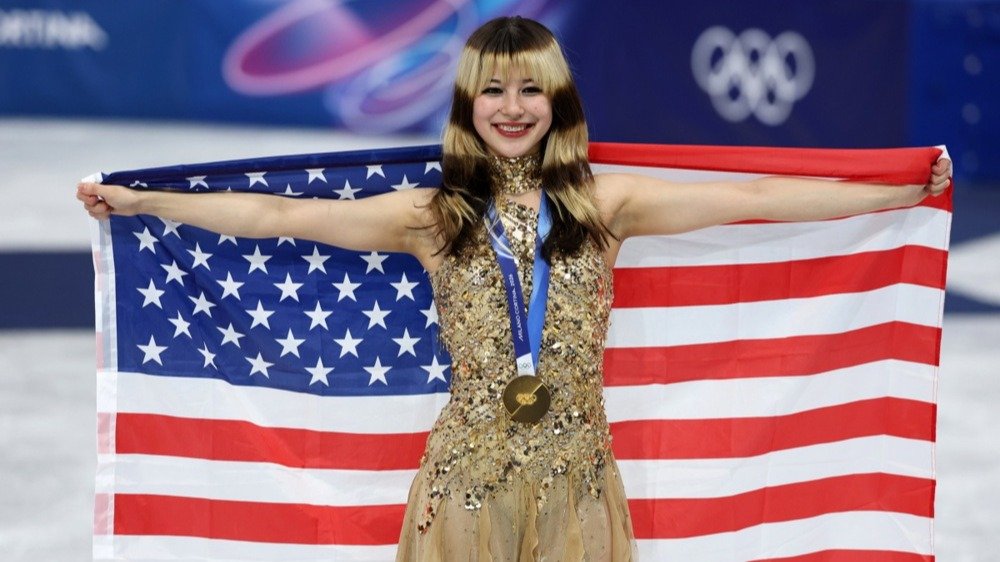
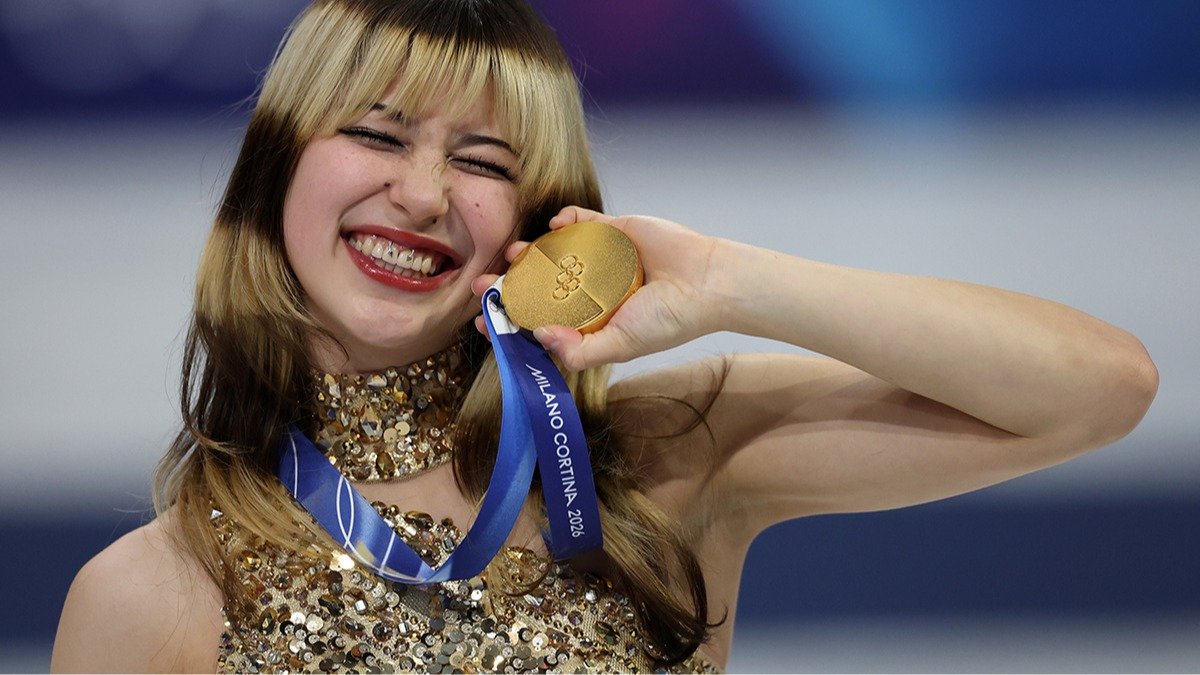
At the Milan and Cortina Olympics, 20-year-old American Alisa Liu became the champion in women's singles figure skating. She returned to the sport after a break and on her own terms. In Russia, where victory is often pursued at any cost, such a story seems impossible. Moreover, the system of harsh training, from which Adelia Petrosyan, who took sixth place, emerged, is becoming obsolete. More details on the different approaches are in the material from "Novaya Gazeta Europe." Gold medalist Alisa Liu from the USA after the free skate in the women's singles competition at the 2026 Milan-Cortina Winter Olympics, Milan, Italy, February 19, 2026. Photo: Wu Hao / EPA. When the women's singles competition concluded, many took notice: Adelia Petrosyan became the oldest student of Eteri Tutberidze to ever compete in the Olympics. Lipnitskaya, Medvedeva, Zagitova, Shcherbakova, Trusova, Valieva – all were under 18 at the time of their Olympic participation. With Adelia, the era of unconditional victories for Russian single skaters essentially ended. Tutberidze's protégées have always been distinguished by phenomenal technique. Young figure skaters performed the most complex elements and consistently took podium places in all international competitions. In both 2018 and 2022, Russian single skaters entered the Olympic ice as absolute favorites. Bookmakers took bets on their triumph, and the press paid them unprecedented attention. It was a time when the Russian national championship competition was compared to the Olympic Games in terms of passion and skill level. The popularity of figure skating in the country was incredible, and parents went to great lengths to get their child into Tutberidze's group. On the eve of the Milan Olympics, the documentary series "The Tutberidze Method" was released. In short interviews, coaches and skaters talked about the colossal amount of work they performed on and off the ice. Much was said about discipline and overcoming challenges, about the inevitable pain of high-achievement sports. However, in women's singles skating, athletes have to wage another, invisible battle: with their own changing bodies and age-related transformations. The Champion Factory The first bright star of the Tutberidze school was Yulia Lipnitskaya. Possessing amazing natural flexibility, she mastered an arsenal of triple jumps in a short time and conquered the world by winning gold in the team event at Sochi-2014. However, her triumph was short-lived: just a year after the Olympics, Yulia left the group. Behind the external success lay a personal drama: the figure skater struggled with an eating disorder (ED) for a long time, was treated for anorexia, and suffered from online harassment. She no longer wanted or could continue her career on the ice, especially under colossal pressure. Before the 2017-2018 Olympic season, Tutberidze's student Evgenia Medvedeva remained undefeated for two years, winning two World Championships and two European Championships consecutively. She amazed the sports world not only with her incredible consistency but also with her deep artistry. Medvedeva headed to Pyeongchang-2018 as the main contender for gold. The second skater in the team was 15-year-old Alina Zagitova. Her arsenal included a more complex technical set, and in her achievements, she had a recent victory at the European Championships, where Alina surpassed Medvedeva. At the Olympics, Zagitova triumphantly took the gold medal, setting a world record in the short program. Medvedeva took second place. After the defeat, she asked Tutberidze: "Couldn't you have kept Alina in juniors for another year?" This was the first sign. Later, Medvedeva admitted that she understood the decision of the Federation and the coach, but when Olympic gold is made a cult from childhood, any place other than first feels like a failure. This deals a heavy blow to the psyche. Evgenia Medvedeva during a mass training session with figure skaters at the Luzhniki Olympic Complex South Sports Center. Photo: Moskva Agency. A few months after the Olympics, Evgenia Medvedeva moved to Canada and began training with Brian Orser. The change of coach was sensational. It essentially meant choosing a different philosophy: instead of a despotic coach, grueling work, and quick results, Medvedeva found a mentor who emphasized the importance of health, proper nutrition, and a long sports career. Relations with Tutberidze remained strained for a long time. And although Medvedeva later returned to the ice of the "Khrustalny" sports school, where Tutberidze's group trains, the former closeness between them was gone. In 2023, she announced the end of her career. And three years prior, Alina Zagitova had effectively left the sport. Meanwhile, Eteri Tutberidze's coaching staff had already developed new champions. While Zagitova surpassed Medvedeva in endurance, performing all jumps in the second half of the program for bonus points, future stars performing quads were already training on the same ice: Trusova, Shcherbakova, and Valieva. Tutberidze brought them to Beijing in 2022. In this generation, the emphasis was on extreme technicality: ultra-C elements became a mandatory part of each of their programs. "Age was the decisive factor here. Mastering quadruple jumps and complex cascades is physically and mentally easier before puberty, when the body and psyche are maximally adaptable. Aesthetics and "mature female" skating inevitably took a back seat in this approach. Zagitova was criticized at the time for the predictable structure of her programs: first "waiting out the time," and then a jump combination. After her performance at the Beijing Olympics, Alexandra Trusova had a nervous breakdown. In the under-the-stands area, the skater cried and shouted, "I hate this. I hate this sport. I will never step on the ice again. This cannot be done." Trusova won the silver medal. Kamila Valieva also cried there after falling in the free skate. This was the second and very loud signal. The video of Trusova became a reason for public discussion of the Tutberidze system. Journalists discussed the cold detachment with which the coach reacted to the girls' tears. She was criticized for her conveyor-belt approach, the premature depletion of female bodies' resources, and the creation of a harsh competitive environment. One athlete falls out of the lineup, and a new, more perfect one takes her place. Eteri Tutberidze at the 2026 Winter Olympics in Milan Cortina, Milan, Italy, February 13, 2026. Photo: Wu Hao / EPA.The competitive careers of Eteri Tutberidze's figure skaters were short, and her team's training relied on mathematical calculations. This allowed them to perfect jump technique to an automatic level: the body begins to twist before takeoff while still on the ice. Flawless execution requires repeated practice and strict coach control. Including over athletes' weight. Pyeongchang silver medalist Shoma Uno suffered exhaustion during his training stint with Tutberidze. Figure skater Vladimir Samoilov, now competing for Poland, recalled that training at "Khrustalny" was psychologically difficult: "Either you train, or if your back hurts, stay home and don't come back." In Russian sports, such an attitude is considered the norm. In the Western system, it's an anomaly. In 2024, after lengthy discussions, the age limit was finally changed: figure skaters now compete in juniors until the age of 17. This was a direct blow to the Tutberidze system. Now, athletes need to maintain quadruple jumps while accounting for physiological changes, and performing ultra-C elements at 18 is clearly more difficult than at 14. Furthermore, in the updated judging system, a balanced program is valued more highly than one oversaturated with technique. In Milan, Adelia Petrosyan had an advantage over her rivals: she was the only one to attempt quadruple jumps, but she performed them inconsistently. Adelia arrived at the Games as the only representative of Russia in a neutral status. The world arbitration panel knew her little, but it was clear what burden of responsibility she carried. "On the ice, Petrosyan fought, but mistakes pushed her to an overall sixth place. After the final in the mixed zone, Adelia Petrosyan, controlling her emotions, spoke to journalists: "...it will be psychologically difficult for me to return to Russia after such a performance. I feel a little ashamed in front of myself, the federation, the coaches, and the audience. I understand it's my own fault." And when asked about an injury, the 18-year-old Petrosyan replied: "I'd better ask the coaches first. I don't know if we're talking about this. I don't know what I might get in trouble for." Russian Adelia Petrosyan performs in the free skate in the women's singles competition at the 2026 Milan-Cortina Winter Olympics, Milan, Italy, February 19, 2026. Photo: Wu Hao / EPA.Gold was won by American Alisa Liu. Her path to this medal was not easy. She walked away from the strict control and pressure of coaches because she didn't see herself in such a sport. Alisa Liu's figure skating is a world where comfort and joy come first. And she proved that success doesn't have to be accompanied only by pain and suffering. "How is that possible!" The American, daughter of a Chinese immigrant, left the ice with the phrase "That's what I'm f***ing talking about!" She enjoyed the program, the gold dress, the audience's attention. And she was happy. Liu didn't need to fight because she didn't return to the sport for that, and her confident skating reminded the audience what victory should look like. In the under-the-stands area, Liu jumped and shouted, "How is that possible!" This was her second Olympics. In Beijing, Liu placed seventh. Before that, at 10 years old, she won the US Championship, at 13 she won the senior US Championship, and at the Junior World Championships, she took bronze, losing to Kamila Valieva. However, at 16, Alisa Liu decided to leave figure skating. She spoke with her father, who was her sports manager and had spent a significant amount on her daughter's career by then. "Liu explained that she was choosing to live the life of an ordinary teenage girl, rather than spending all her time on the ice, adhering to a strict schedule and diet. "I will never starve myself," the figure skater repeatedly stated. Liu first began to consider how much she valued freedom in sports during the quarantine period of the pandemic. She recalled that during training, she would lie on the ice, put on music, and feel a sense of peaceful calm. The demanding daily routine left the athlete no time to stop and think. After Beijing, the decision to leave figure skating solidified. Liu wasn't aiming to become a champion, to win every competition. Her main dream at that moment was to live at home. She maintained her physical fitness, did stretching, got a piercing, enrolled at the University of California, and went on vacation with friends. Alisa Liu of the USA in the free skate in the women's singles competition at the 2026 Milan-Cortina Winter Olympics, Milan, Italy, February 19, 2026. Photo: Wu Hao / EPA.But two years later, Liu consciously decided to return. She wanted to skate not for medals, but for enjoyment. She simply enjoyed doing it again. To prepare for the Milan Olympics, Alisa Liu assembled an international team of coaches, setting one condition: she would choose her own costumes and music. For her, these people were primarily like-minded individuals. Liu's coach, Italian Massimo Scali, told journalists after the performance: "Alisa's free skate is very dance-like, and I kept repeating, 'Imagine we went to a club!' Relax, make us feel like we're on the dance floor. And she did it!" Liu took to the Olympic ice in Italy as an adult (by figure skating standards), free, and strong. Commentators noted how much she reveled in her skating. Alisa Liu's programs were not distinguished by increased difficulty, but they had the harmony for which the sport is valued. Jumps, combinations, spins, footwork – everything together formed a cohesive whole, a well-thought-out composition, a story that Alisa Liu wanted to tell the world. "It doesn't look like a memorized program. It's improvisation," Tatyana Tarasova said during the broadcast. Alisa Liu has always stood out for her emotionality and openness. She also supports her rivals. It's nothing for her to write a comment under another skater's performance video saying how great she skated, or to leave enthusiastic emojis. When the scores were posted, she bowed to her coaches. In Milan, it seemed that Liu was as happy for others as she was for herself. She hugged and congratulated 17-year-old Ami Nakai on her sensational bronze medal. She called the silver medalist Kaori Sakamoto of Japan "incredible and great." The first thing Liu said after her free skate was: "I can't believe I did it."