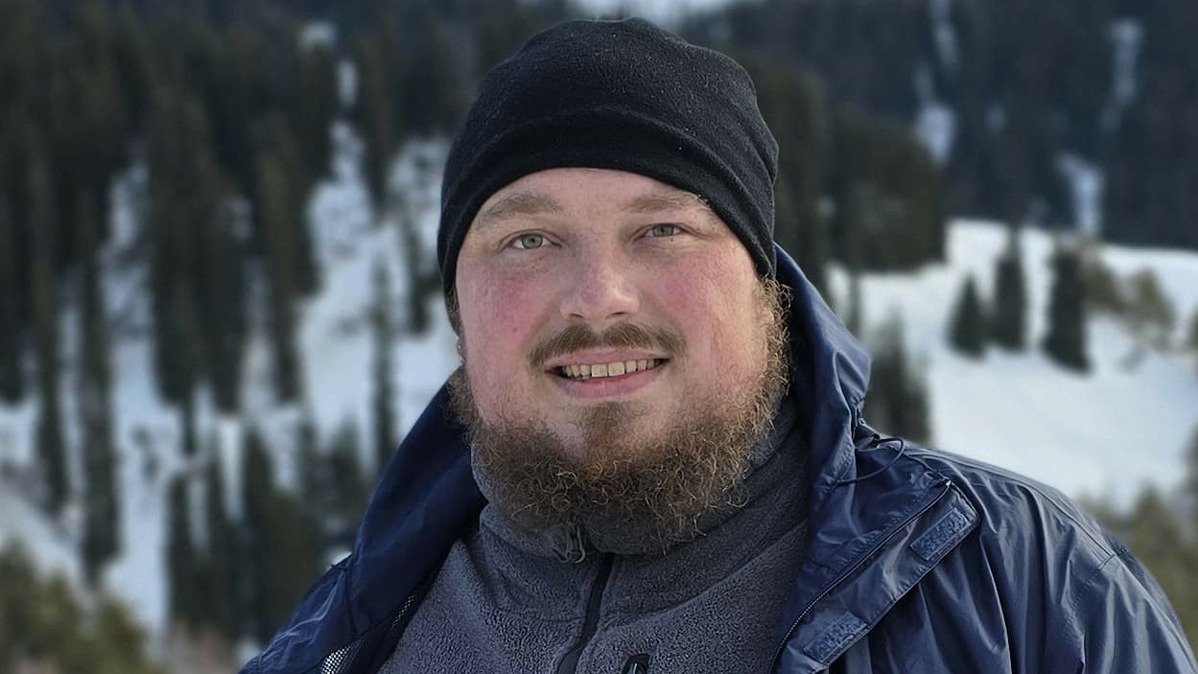
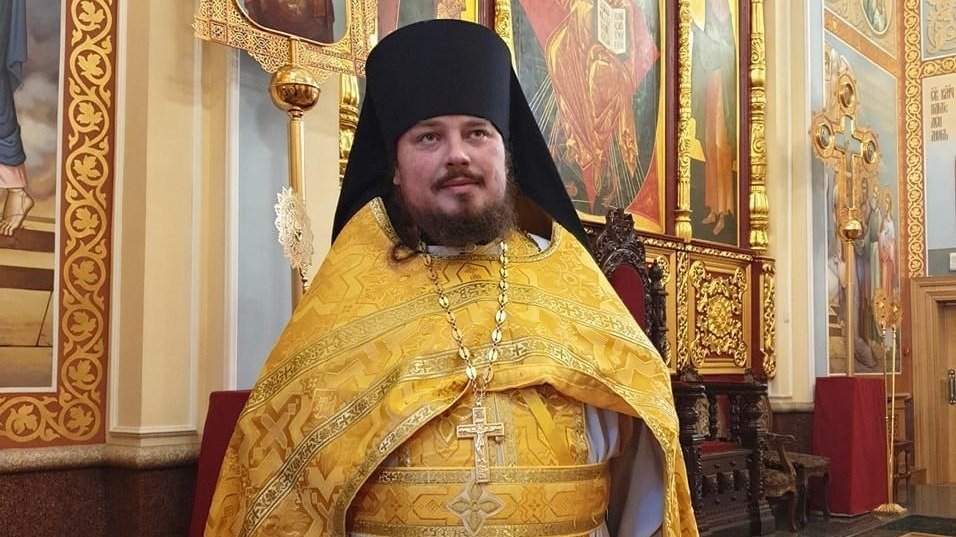
Iakov Vorontsov. Photo from Vorontsov's Facebook page. Hieromonk Iakov (Vorontsov), 'deprived of his clerical rank' by the ROC for his anti-war stance, was arrested in Almaty early on Friday the 13th. Three days earlier, on February 10, a session of the Specialized Administrative Court of Kazakhstan in Almaty was to take place concerning the lawsuit filed by Fr. Iakov, demanding to annul the decision of the local Department of Justice to refuse registration of an Orthodox community not affiliated with the ROC. The hieromonk came up with this initiative in 2023, when he distanced himself from the pro-war position of the Moscow Patriarchate and its structures in Kazakhstan. To date, the ROC maintains a monopoly on Orthodoxy in Kazakhstan, and Fr. Iakov's idea is that Kazakhstani Orthodox Christians should have a peaceful alternative: not everyone wants or can pray for the 'victory of Russian weapons' over Ukraine. The Patriarchate of Constantinople is considered as an alternative, which readily accepts into its jurisdiction clerics of the ROC expelled, like Fr. Iakov, for their anti-war stance. However, the court session on February 10 did not take place without explanation. Instead, early on the 13th, masked OMON officers burst into the hieromonk's apartment, conducted a search as part of a criminal case for 'organizing a drug den,' and, of course, found 'a white powdery substance.' An analogy with the case of another anti-war cleric of the ROC, reported by 'Novaya Gazeta Europe' – Archimandrite Feognost (Pushkov), who did not hide his sympathy for Ukraine while remaining in the Russian-controlled Luhansk region – involuntarily comes to mind. Ultimately, he too was imprisoned not 'for politics,' but for allegedly growing cannabis in the bushes near a toilet. Fr. Iakov's like-minded followers, his friends, lawyers, and journalists he was in contact with unanimously reject the version that the hieromonk could have used drugs. In any case, it would have affected his behavior, appearance, lifestyle, etc. Fr. Iakov released video clips almost every day, often gave sermons on the 'Novaya Gazeta' channel, pestered officials to register the community, visited the Greek Catholic Church in Almaty – in short, he lived openly, in plain sight. The status assigned to him by the investigation – 'witness with the right to defense' – sounds more like a warning. According to Fr. Iakov's lawyer, Galym Nurpeisov, shortly before his detention, his client took a sleeping pill, traces of which were likely found in his blood by a medical examination organized by the police. Based on the conclusions of this examination, the legality of which the lawyer questions, the hieromonk was sentenced to ten days of administrative arrest. This arrest will undoubtedly be appealed. Iakov Vorontsov. Photo from Vorontsov's Facebook page. Hieromonk Iakov was already attempted to be brought to criminal responsibility: in late December 2023, the investigative department of the Almaty police department recognized him as a 'witness with the right to defense' in a criminal case of 'incitement to hatred' (Article 174 of the Criminal Code of the Republic of Kazakhstan). The case was initiated based on a denunciation by a parishioner of the Ascension Cathedral in Almaty, where Fr. Iakov once served, Anna Shcherbakova, supported by the secretary of the Astana-Almaty Diocese of the ROC, Archpriest Alexander Suvorov. The parishioner was outraged by the hieromonk's Facebook post, where he called the ROC's teaching on the 'sacred special military operation' 'the most abominable of all earthly religions.' Later, Fr. Iakov admitted that he expressed himself too harshly, being in shock from another missile strike on civilian cities, and deleted the post. However, the persecution machine had been set in motion. The specific Kazakh status of 'witness with the right to defense' is little different from that of a suspect, except that it deprives the defendant of the right to refuse to testify. An examination conducted in the case in early 2024 did not reveal any signs of incitement to hatred in the hieromonk's statements, but the case was only closed in May 2025 after Fr. Iakov's open letter to President Kassym-Jomart Tokayev. The fault line with the ROC emerged back in February 2022, when Fr. Iakov signed an open letter against the invasion of Ukraine. Already in early March, the all-powerful diocesan secretary, Fr. Alexander Suvorov, removed him from service at the Ascension Cathedral, and the disciplinary commission accused the hieromonk of 'violating the principle of separation of church and state.' Iakov Vorontsov. Photo from Vorontsov's Facebook page. The pro-war stance of the head of the Kazakhstan Metropolitanate of the ROC, Metropolitan Alexander (Mogilev), a member of the Council of the All-Russian People's Council, is likely not such a violation. The mandate of the council, headed by Patriarch Kirill, states, in particular: 'The special military operation is a Holy War in which Russia and its people, defending the unified spiritual space of Holy Rus', are fulfilling the mission of the 'Holder,' protecting the world from the onslaught of globalism and the victory of the West, which has fallen into Satanism. After the completion of the SMO, the entire territory of modern Ukraine should enter the zone of exclusive Russian influence.' The involvement of the head of the Kazakhstan Metropolitanate of the ROC should have alerted the authorities of a sovereign state, as Russian politicians increasingly make statements in the spirit of: 'Kazakhstan is next!' Gradually, Fr. Iakov concluded that the Christian faith was absolutely incompatible with the new aggressive doctrine of the ROC and urged Orthodox Christians in Kazakhstan: 'For the sake of the truth of the Gospel, for the sake of the good of the Church, to turn away from Patriarch Kirill, who is destroying the Church. 'If we do not do this, we become accomplices in building a church without Christ.'' In August 2023, the diocesan court of the Astana-Almaty Diocese 'deprived' him of his rank, and Patriarch Kirill approved this decision. Thus, Fr. Iakov and his like-minded lay followers came up with the idea of creating an independent community of Orthodox Christians in Almaty in honor of the Transfiguration of the Lord, which held its founding meeting last year in accordance with the requirements of the Kazakh law on religion and submitted documents for state registration. After registration, the community planned to officially appeal to the Patriarchate of Constantinople with a request for canonical acceptance. The response was a massive propaganda campaign by the ROC (first at the diocesan level, and then at the Moscow level, with the help of the 'Spas' TV channel) accusing the hieromonk of personal and political sins and demanding his criminal prosecution. Iakov Vorontsov. Photo from Vorontsov's Facebook page. On January 20, the Russian federal television show 'Evening on Spas' aired, titled 'Attack on the Orthodox Church in Kazakhstan.' For an hour, its participants, including the aforementioned Archpriest Alexander Suvorov, competed in insulting Fr. Iakov, not refraining from criticizing the Kazakh regime. The talk show claimed that the case against Fr. Iakov was closed last year on the orders of 'the very top,' which is perceived as the official position of the metropolitanate of the ROC in Kazakhstan, as Fr. Alexander was presented as the head of the public relations department of this district. At the same time, other Russian propaganda resources have also issued warnings about 'Istanbul church expansion' in Kazakhstan. Unfortunately, Kazakhstan is in no hurry to shed its reputation as a country unsafe for opponents of the expansion of the 'Russian world.' On the contrary, it is strengthening it. The other day, the country's authorities extradited 25-year-old programmer Alexander Kachurkin to Russia, whom the FSB accuses of treason. The young man was detained under the pretext of crossing the street in the wrong place. Kazakhstan refuses asylum to Chechen oppositionists Mansur Movlaev and Zalimkhan Murtazov. Deserter Semen Bazhukov from the 'SMO' was handed over to Russian military police directly on the territory of Kazakhstan. Against this backdrop, confrontation with the 'Russian world' and being under the fire of Russian propaganda in Kazakhstan requires considerable fortitude. Fr. Iakov, as a specialist in the martyrs of the 20th century, was aware of what awaited him: 'It is better to be in prison than for a priest to live without serving the liturgy. The feat of the new martyrs and confessors of the 20th century has always been my role model.'