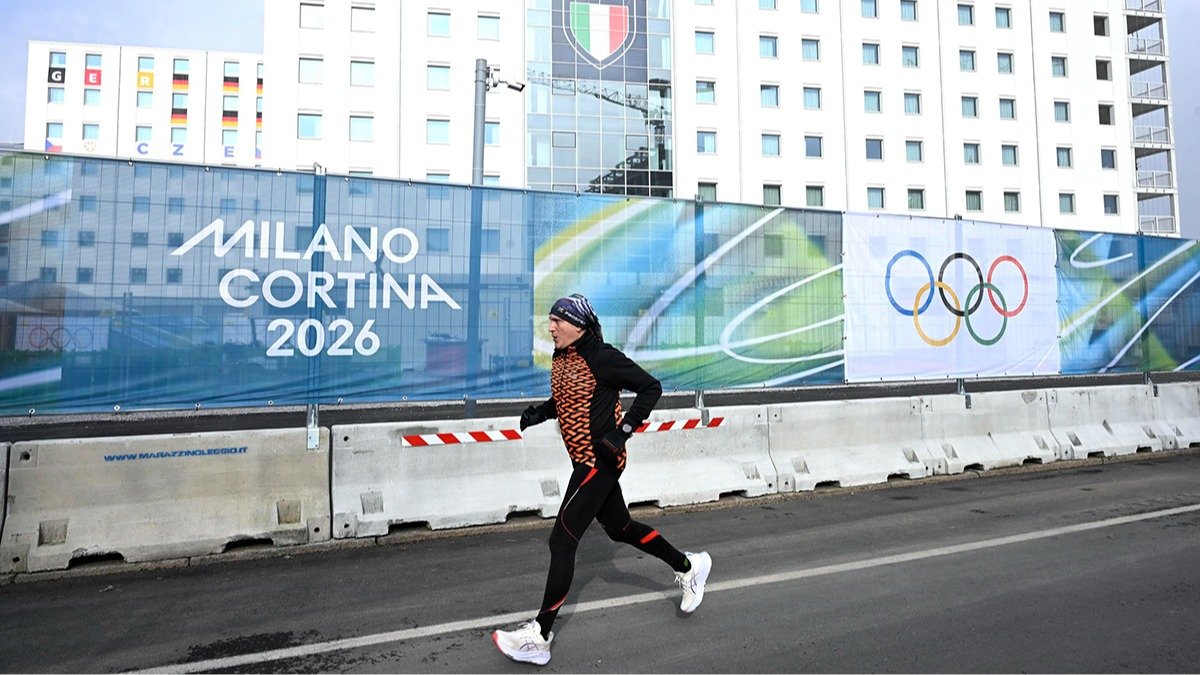
On Friday, February 6, the opening ceremony of the юбилейные, 25th Winter Olympic Games will be held in Milan. The Russian delegation will not appear at the opening: due to the war in Ukraine and doping sanctions, Russians are allowed to compete only in a neutral status, and the number of Russian athletes admitted to the Games is approaching the anti-records of tsarist times, despite ambitious statements by Moscow officials about the speedy restoration of rights. Meanwhile, the Games themselves have become the center of several corruption and political scandals at once - and the Italian mafia has not been left out. The main expectations for the XXV Winter Olympic Games - in the material "Novaya Europa". The Olympic village in Milan, Italy, January 30, 2026. Photo: Daniel Dal Zennaro / EPA. The 2026 Winter Olympic Games will be held in northern Italy, in Milan and Cortina d'Ampezzo from February 6 to February 22. These will be the fourth Olympics in Italy (Cortina d'Ampezzo previously hosted competitions in 1956) and the first to be held in Milan. Nearly 3500 athletes from 93 countries will take part in the competitions, competing for 116 sets of medals in 16 disciplines. There were fewer only in 1908: Russians set an anti-record from the times of Nicholas II. At the 2026 Winter Olympics in Milan and Cortina d'Ampezzo, 13 Russian athletes will compete in a neutral status. The list includes Petr Gumennyk and Adelia Petrosyan (figure skating), Saveliy Korostelev and Daria Nepryaeva (cross-country skiing), Nikita Filippov (ski mountaineering), Ivan Posashkov and Alena Krylova (short track), Ksenia Korzhova and Anastasia Semenova (speed skating), Pavel Repilov and Daria Olesik (luge), Semen Efimov and Yulia Pleskova (alpine skiing). Only athletes competing in individual events were admitted to the tournament in Italy; hockey players, biathletes, and representatives of other team sports are still suspended from international competitions. Figure skater Adelia Petrosyan trains in anticipation of the ISU Figure Skating qualifying tournament 2025 at the National Indoor Stadium in Beijing, China, September 18, 2025. Photo: Wu Hao / EPA. 13 participants of the Winter Olympics is an anti-record for Russia. Even fewer participated in the era of tsarist Russia and Nicholas II - six people at the 1908 Summer Olympics in London. For comparison, at the 2022 Olympics in Beijing, held shortly before the full-scale war, 212 Russian athletes won 32 medals and took second place in the overall standings, second only to Norway (37). Even then, due to sanctions after the doping scandal, they officially competed not as the Russian national team, but as the team of the Russian Olympic Committee (ROC) - without a flag and anthem. Belarusian neutral athletes in Italy will also be the smallest delegation in the country's history. Seven representatives will go to the Olympics: Anna Guskova, Anna Derugo, Anastasia Andrianova (aerial skiing), Marina Zueva (speed skating), Victoria Safonova (figure skating), Anna Koroleva (cross-country skiing), and Maria Shkanova (alpine skiing). Neutral status means that athletes will compete without a flag and anthem. By decision of the IOC, they will not be able to participate in the parade of athletes at the opening and closing ceremonies of the tournament. However, athletes are allowed to communicate with the media. There is no talk of a full return of Russian athletes yet, despite the words of the Minister of Sport Mikhail Degtyarev that he expects the ROC status to be restored by March 2026 - after or during the Olympics. Speaking in late December at the "Knowledge. State" marathon, the minister said that the participants of the 2026 Olympics are "pioneers, and in 2028 [for the Summer Games] the entire team will go." "In 2024, the Ministry of Sport of Russia significantly revised its development course. Without international competitions and the Olympics, the level of our sport would inevitably begin to decline. Therefore, we decided to participate at all costs wherever possible," explained Degtyarev. The new policy is also linked to the rhetoric regarding neutral athletes. If earlier they were condemned and accused of almost betrayal, now even the State Duma calls for supporting them. "These are our athletes, we will support them in any case, worry about them and fight for them, we wish them luck," said deputy Dmitry Svishchev. Will there be gold? Figure skaters Adelia Petrosyan and Petr Gumennyk are considered the most realistic medal contenders among Russians. In women's singles, athletes from the Russian Federation have won gold three times in a row. It all started with Adelina Sotnikova's victory in Sochi-2014, continued with Alina Zagitova's gold in Pyeongchang, and Anna Shcherbakova's first place in Beijing. In September, Petrosyan, an 18-year-old student of Eteri Tutberidze, took first place at the Olympic qualifiers in Milan, and in December, she won her third consecutive Russian championship gold. She will be the youngest participant of the 2026 Games from the ROC. "Potentially, in her best form, she performs a quadruple jump and a triple axel. This needs to be restored - I haven't seen such ideal programs from Adelia this season. But we believe: with a perfect performance, she is an Olympic champion," says Ilya Averbukh, silver medalist of the 2002 Olympics in ice dancing. 23-year-old Petr Gumennyk set a Russian record for total points at the last tournament before Milan - 326.49 and became the national champion for the first time. He has one of the most difficult men's programs with five quadruple jumps in the free skate. Gumennyk is also considered a medal contender. The absolute favorite of the men's event is considered to be 21-year-old Ilya Malinin, who competes for the USA. He was born in Virginia to Russian figure skaters Tatiana Malinin and Roman Skorniakov, who competed in the USSR and Russian championships. Figure skater Petr Gumennyk, November 16, 2025. Photo: Vasily Kuzmicheonok / Moscow Agency. "I think Malinin is here to stay. He is our figure skating genius, he cannot be compared to anyone. He is unlike anyone else. It is very pleasant that he is coached by his father and mother, Russian people who previously worked in St. Petersburg," said USSR Honored Coach Tatiana Tarasova. Nikita Filippov's chances of winning a medal in ski mountaineering, a new sport for the Olympics, are also highly rated. This is a mountain race where participants alternate ski ascents, walking sections, and downhill descents. The 23-year-old Filippov approaches the Games in excellent form: a few weeks ago, he took third place in the sprint at the World Cup stage in Courchevel. "A medal is realistic if I approach the Olympics in good shape. If everything works out, it will be gold. I will do everything to get it because it is my dream. I have been working towards this for a long time, and I don't want to miss my chance," says the athlete himself. Another medal contender is 22-year-old skier Saveliy Korostelev. He is the current winner of the Russian Cup, and recently took fourth place in the 10 km freestyle race as part of the "Tour de Ski". In Russia, Korostelev has recently tried to compete with the country's top skier, three-time Beijing champion Alexander Bolshunov, who was not admitted to the Olympics. On January 29, the special department of the Court of Arbitration for Sport (CAS) refused to consider Bolshunov's appeal against this decision. Korostelev will compete in Milan in skiathlon (a cross-country ski race with a change of style during the distance), sprint, marathon, and individual start race. "Legionnaires": dozens of Russians will compete in the Olympics for other countries In addition to the 13 ROC representatives, several dozen naturalized Russians and athletes with Russian roots will compete in Italy. For example, Sofya Samodelkina (figure skating), Kristina Silaeva and Elizaveta Golubeva (speed skating), and Alexandra Skorokhodova (alpine skiing) are included in the Kazakhstan team. All of them changed their sports citizenship after the start of the war in Ukraine and have repeatedly won tournaments in the Russian Federation. Silaeva is even the current winner of the Russian Speed Skating Championship at 500 meters. The Uzbekistan team's application for the Olympics consists of three people, two of whom are a pair of naturalized figure skaters: Ekaterina Geinish and Dmitry Chigirev. Former Russian figure skaters Karina Akopova and Nikita Rakhmanin, who received permission to transfer from Russia only in May 2025, will compete for Armenia in Milan. Figure skaters Ekaterina Geinish and Dmitry Chigirev, February 14, 2024. Photo: Yaroslav Chingayev / Moscow Agency. Georgia will be represented in ice dancing by the pair of Diana Davis (daughter of Eteri Tutberidze) and Gleb Smolkin, and in women's singles by Anastasia Gubanova. Another Russian, Anastasia Metelkina, will compete in pair skating with Luka Berulava. In addition to the aforementioned Ilya Malinin, two more figure skaters with Russian roots will represent the USA at the Olympics. These are 25-year-old Maxim Naumov, son of famous Soviet and Russian figure skaters Eugenia Shishkova and Vadim Naumov (they died in a plane crash in Washington in January 2025). And also 24-year-old Andrew Torgashev, son of figure skaters Ilona Melnichenko and Artem Torgashev, who competed for the USSR in ice dancing and pair skating, respectively. Malinin, Naumov, and Torgashev took the entire podium at the 2026 US Championship. This is far from a complete list of Russians who will compete in Italy for other countries. "Trained at European bases": almost 50 athletes will represent Ukraine at the Olympics The final application for the Games has also been published by the NOC of Ukraine. 46 athletes in 11 sports will compete in Italy - the same as in Beijing. Sports officials place the greatest medal hopes on freestylers. Ukrainians have reached the World Cup podium three times this season, and Dmitry Kotovsky and Alexander Okipnyuk have won stages. President of the NOC Vadym Guttsait emphasized that "recommendations for dealing with Russians" will be in effect for the Olympians during the competition. Vadym Guttsait. Photo: Wikimedia. "So that they don't pay attention to any provocations, because they will use any situation against us. And then they will show the world that we are the provocateurs," he said. According to Guttsait, the athletes "prepared calmly, were at European bases where we were given the opportunity to train," as there are no necessary conditions in the country due to hostilities. (As early as 2023, the IOC allocated $7.5 million for the training of Ukrainians for the Olympics in Paris and Milan.) "Some sports held specific training camps within the country. Then they went to winter terraces, because during air raids, according to recommendations, all our sports facilities must be closed. Therefore, almost everyone trained abroad," explained Guttsait. The Minister of Youth and Sports of Ukraine, Matvey Biedny, spoke about the problems of ice arenas resulting from the war. Equipment requires a lot of electricity, and the infrastructure leaves much to be desired, which limits training opportunities for figure skaters, hockey players, and other athletes. However, even in such conditions, some athletes still train at home. 26-year-old biathlete Kristina Dmitrenko trains at an Olympic training base in Chernihiv, partially destroyed as a result of Russian shelling. "Sport can show that Ukraine is strong. We represent our country in the international arena, allowing other nations to see our unity, strength, and determination," she states. Star biathlete Dmitry Pidruchny, after the start of the invasion in 2022, served in a National Guard unit in Ternopil, carrying out combat missions, and thought about ending his career. Many Ukrainian Olympians participate in various programs to help the army and residents affected by hostilities. For example, skeleton racer Vladislav Geraskevich and others are known for their volunteer activities. "In ancient times, during the Olympics, all wars either ceased or ended. I think everyone has great hope that this will be the case at this Olympics too," hopes Pidruchny. Similar views are held by the UN. On January 30, General Assembly President Annalena Baerbock called on all warring parties to agree on a "mutual ceasefire" during the sports competitions in accordance with the ancient principle of the Olympic truce. At the same time, after protests by the Ukrainian junior team at the European Cup stage, the IOC warned the NOC about the prohibition of anti-war actions at the Olympics, admitted skeleton racer and national team flag bearer Vladislav Geraskevich. A young biathlete trains near a destroyed ski base in Chernihiv, Ukraine, October 30, 2025. Photo: Julia Demaree Nikhinson / AP / Scanpix / LETA. Mafia, corruption, and ICE: scandals surrounding the Olympics In Italy, preparations for the 2026 Olympics, as before Turin-2006, are accompanied by problems. One of the most significant issues was the delay in the construction of the new "Santa Giulia" hockey arena in Milan. As a result, the arena will not be fully ready by the start of the 2026 Olympics, and the number of spectator seats has been reduced from the announced 14 to 12 thousand people. ESPN journalist Emily Kaplan previously reported that "the locker rooms will be mobile trailers, and players will have to walk on mats to get to the ice." IOC Executive Director Christophe Dubi acknowledged the construction problems but stated they would not hinder the tournament. "Are all the premises at the stadium ready? No. Does the arena have everything necessary for matches? No. But everything open to the public will be top-notch. Work is ongoing, but it is aimed at making this place excellent," said Dubi. Loud corruption scandals have also not been avoided. In May 2024, searches were conducted at the Olympic headquarters. The accusation was related to the selection of sponsors and suppliers in the field of technological services for the Olympics. Test hockey match, at the Milano Santa Giulia arena, Milan, Italy, January 9, 2026. Photo: Matteo Bazzi / EPA. In the summer of 2025, the Italian prosecutor's office launched an investigation into possible corruption schemes in tenders for the construction of Olympic facilities. 74 people are under suspicion, including the mayor of Milan, Giuseppe Sala. The Italian mafia has not stood aside from the Games either. In October 2025, the prosecutor's office announced the arrest of brothers Leopoldo and Alvise Cobianchi from Rome, associated with the Lazio ultras group Irriducibili ("The Unbending"). They gained control of drug trafficking and entertainment venues in Cortina d'Ampezzo and attempted to infiltrate the contract awarding process for Olympic facilities. "Standard methods were used to advance illegal interests - verbal intimidation, and if that didn't work, real actions began: kidnapping, beatings, threats with weapons," the prosecutor's office reported. Mayor of Milan Giuseppe Sala, January 28, 2026. Photo: IPA / Scanpix / LETA. According to data from the Italian Ministry of Internal Affairs, a total of 169 workers, 57 companies, and 70 construction machines linked to mafia structures were identified in construction work for the Olympics in Trentino. In December 2025, the IOC, after a series of scandals, announced the creation of a special body to combat corruption and manipulation at the Olympics. "Ethical violations can take various forms: from competitor manipulation to bribery or unethical behavior by accredited individuals. We will cooperate with Italian authorities, police, and judicial bodies in case of violations," said Giuseppe Deleonardi, IOC Chief Ethics and Compliance Officer. The most resonant event surrounding the Olympics in recent days is the announced arrival of US Immigration and Customs Enforcement (ICE) officers, who are to ensure the security of US representatives in Milan. In recent weeks, events in Minneapolis, where ICE agents shot two US citizens under the guise of self-defense, have been widely discussed. The Americans' decision outraged Italian politicians and sparked a wave of criticism against Prime Minister Giorgia Meloni. Milan Mayor Giuseppe Sala stated that ICE agents "have no place" in the city. "They kill people. Can we say 'no' to Trump? They shouldn't come to Italy," he exclaimed. "ICE as such will never operate on Italian territory," replied Italian Interior Minister Matteo Piantedosi. According to him, American law enforcement officers will arrive in Milan to escort the visit of US Vice President JD Vance and Secretary of State Marco Rubio to the opening ceremony. Where to watch the Olympics For the first time in the history of the country, the official broadcast of the Olympic Games in Russia will not be carried by a federal channel. Exclusive rights were obtained by the online cinema Okko. The platform will show the opening and closing ceremonies of the Olympics, as well as all sporting events. They can be watched both live and recorded. They will be available to residents of Russia for free.