government
‘Enough of Washington’s orders’
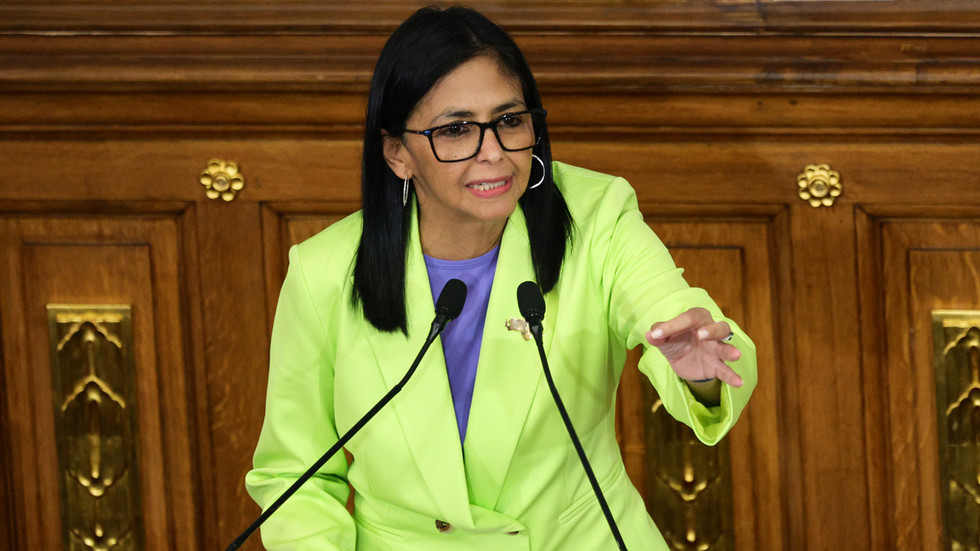
Venezuela’s interim president, Delcy Rodriguez, has expressed frustration with US orders, calling for an end to interference
3 months ago
Venezuelan and international reporting agree that interim president Delcy Rodriguez has publicly rejected what she characterizes as orders from Washington and specifically from US officials regarding Venezuela’s internal and economic policies. Across accounts, Rodriguez’s remarks follow a major escalation in US–Venezuela tensions, including US criminal charges against Nicolas Maduro, a declared state of emergency in Venezuela, and strong US statements about shaping events in the country. Coverage converges on the fact that while denouncing US interference, Rodriguez has simultaneously signaled a willingness to partially accommodate some US economic interests by opening segments of Venezuela’s oil sector to American companies, which has been met with positive signals from US leaders, including discussion of possible sanctions relief.
Reports also align in describing core institutional and geopolitical context: Venezuela is under heavy US sanctions, facing economic crisis, and subject to intense diplomatic and legal pressure from Washington, including drug trafficking indictments and rhetoric framed as military or coercive in nature. They concur that Rodriguez presents her interim presidency as constitutionally grounded and accountable to the Venezuelan people, against a backdrop of long-running disputes over sovereignty, regime legitimacy, and control of the oil industry. Both sides acknowledge the broader pattern of US involvement in Venezuelan affairs, the centrality of the oil sector to any negotiation, and the existence of parallel narratives around who legitimately governs, even if they differ sharply on the meaning and legality of US actions and the Maduro–Rodriguez leadership.
Framing of US actions. Government-aligned sources portray Washington’s behavior as outright interference and aggression, emphasizing talk of abduction, military pressure, and criminal charges as tools to dominate Venezuela’s sovereignty, while opposition sources more often characterize US measures as legal or diplomatic pressure designed to curb authoritarian abuses. Government outlets stress a narrative of imperial overreach and external management of the country, whereas opposition coverage tends to downplay or dispute the notion of US “orders,” casting them instead as conditions tied to democracy, human rights, or anti-narcotics enforcement.
Legitimacy of leadership. Government-linked media present Delcy Rodriguez’s role as interim president as a constitutionally valid response to extraordinary circumstances, rooted in popular sovereignty and institutional continuity after the targeting of Maduro. Opposition outlets, by contrast, question or reject that legitimacy, treating the interim presidency as a continuation of an illegitimate regime or as a maneuver to preserve the existing power structure rather than a genuine transfer or sharing of authority. While government coverage emphasizes obedience to the Venezuelan people alone, opposition reporting often highlights contested elections, repression, and institutional capture as reasons to doubt that claim.
Economic concessions and oil policy. Government narratives frame the partial opening of the oil sector to US companies as a pragmatic, sovereign decision made on Venezuelan terms to alleviate sanctions and stabilize the economy, presenting US praise and hints of sanctions relief as reluctant recognition of Caracas’s resilience. Opposition coverage, when present, tends to interpret the same moves as evidence of regime vulnerability or opportunism, suggesting that the government uses resource access as a bargaining chip to maintain power rather than to pursue structural reforms. This leads government media to stress strategic flexibility and national benefit, while opposition media question whether ordinary Venezuelans, rather than elites, will gain from such deals.
Responsibility for the crisis. Government-aligned outlets largely attribute Venezuela’s emergency and economic collapse to US sanctions, judicial persecution of leaders, and threats of military aggression, arguing that external coercion has forced harsh internal measures and emergency governance. Opposition sources generally shift responsibility inward, citing years of mismanagement, corruption, and repression by the Maduro–Rodriguez leadership as the root causes, with US actions seen as a reaction rather than the origin of the crisis. As a result, government media present defiance of US directives as a defense of national dignity, while opposition voices view that same defiance as an excuse to evade accountability for domestic policy failures.
In summary, government coverage tends to depict Delcy Rodriguez’s defiance as a sovereign stand against US domination and as part of a legitimate, people-centered leadership navigating sanctions and emergency, while opposition coverage tends to frame it as rhetoric from an embattled, illegitimate regime that selectively cooperates with Washington to preserve its own power rather than to resolve Venezuela’s underlying crises.