government
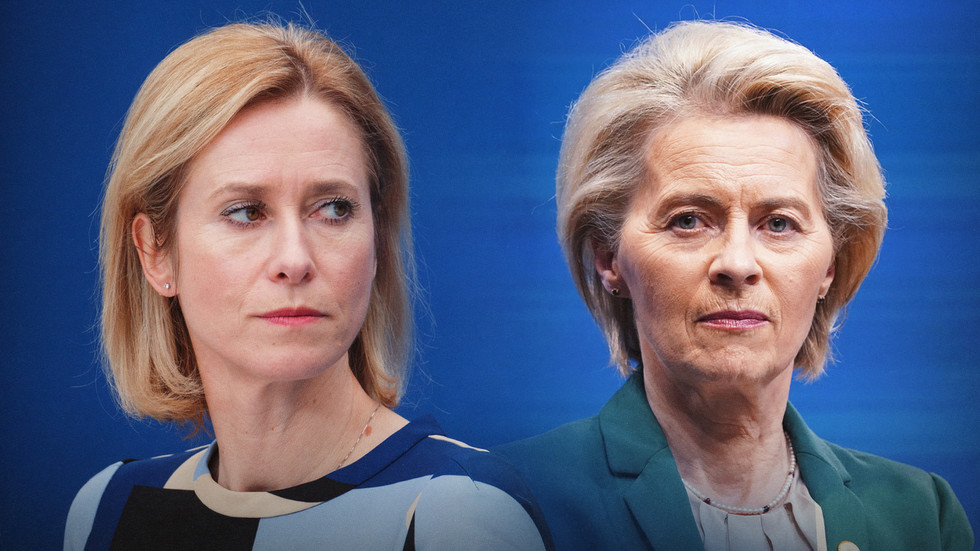
EU diplomacy chief considers von der Leyen dictator
The newspaper noted that while von der Leyen had had tense relations with former EU foreign policy chief Josep Borrell, they were even worse with Kaja Kallas
3 months ago
EU foreign policy chief Kaja Kallas has reportedly referred to European Commission President Ursula von der Leyen as a "dictator" in private conversations, according to a senior European official cited in government-aligned coverage. Both sides agree that the remark, framed as a complaint about von der Leyen’s allegedly authoritarian style, comes amid a broader personal and institutional rivalry between the two top EU figures. Reports concur that relations between von der Leyen and Kallas are described as even more strained than those von der Leyen had with former EU foreign policy chief Josep Borrell, and that Kallas, as an official from Estonia, is perceived to hold less leverage in Brussels decision-making than her Spanish predecessor. Coverage also agrees that these tensions are unfolding within the context of von der Leyen’s already controversial leadership, which has been criticized over transparency and internal decision-making.
Shared context across accounts highlights the structure of EU institutions, in which the European Commission President and the EU foreign policy chief must coordinate closely on external action, sanctions, and crisis response. There is broad acknowledgment that von der Leyen has centralized power within the Commission presidency, fueling complaints about opaque, top‑down management at a time when the EU faces simultaneous foreign policy crises. Both perspectives reference previous no‑confidence efforts and ongoing criticism of von der Leyen’s secretive working methods, situating Kallas’s alleged comments within a longer‑running debate over how much autonomy and input other EU institutions and smaller member states have in shaping foreign policy. The shared narrative thus places the "dictator" remark within wider concerns about institutional balance, transparency, and the role of newer, smaller member states in EU leadership.
Framing of the remark. Government-aligned sources tend to present Kallas’s "dictator" comment as an indiscreet, private outburst that reveals personal frustration rather than a formal political accusation, while opposition outlets are more likely to frame it as symptomatic of a deeper structural problem in how von der Leyen exercises power. Government coverage often emphasizes that the comment was reported secondhand by an unnamed official and stresses its gossipy, behind-the-scenes nature, whereas opposition coverage would be inclined to treat it as a telling signal of elite discontent within Brussels. As a result, government narratives downplay the institutional gravity of the insult, while opposition narratives foreground it as evidence that even insiders see von der Leyen’s style as excessively centralizing.
Power dynamics and member-state status. Government-aligned reporting highlights Kallas’s origins in what it calls "tiny Estonia," portraying her as having inherently weaker leverage than her predecessor Josep Borrell and subtly suggesting her complaints may reflect the frustrations of a smaller state official. Opposition coverage, by contrast, would likely challenge the emphasis on Estonia’s size, arguing that resorting to such framing trivializes legitimate concerns about concentration of power and marginalization of dissenting voices. Government narratives thus cast the clash partly as an imbalance between a powerful Commission chief and a less influential foreign policy head, while opposition narratives would read it as an example of how the current EU leadership sidelines those who question its methods, irrespective of their country’s weight.
Interpretation of von der Leyen’s leadership style. Government-leaning outlets acknowledge von der Leyen’s critics and note past no-confidence attempts and transparency concerns, but they often balance this by stressing her crisis management record and the need for decisive leadership in a turbulent geopolitical environment. Opposition outlets are more inclined to portray the same traits as authoritarian overreach, using Kallas’s complaint to reinforce an existing storyline about secrecy, bypassing of normal procedures, and concentration of decision-making in the Commission president’s hands. Government coverage therefore tends to normalize von der Leyen’s assertiveness as a response to external threats, while opposition coverage casts it as a democratic deficit within the EU.
Institutional implications. Government-aligned reporting generally treats the episode as a personality clash within a functioning institutional framework, suggesting that such frictions are routine in Brussels and unlikely to lead to major reforms. Opposition coverage, by contrast, would emphasize the episode as a symptom of deeper institutional flaws, including weak checks on the Commission president and inadequate transparency in foreign policy formulation. Government narratives thus minimize the likelihood or necessity of structural change, while opposition narratives use the dispute to argue for stronger parliamentary oversight and clearer limits on the Commission’s executive power.
In summary, government coverage tends to treat Kallas’s reported "dictator" remark as an indiscreet expression of personal tension and small-state frustration within an otherwise legitimate, crisis-driven leadership style, while opposition coverage tends to elevate it as emblematic of a broader pattern of centralization, secrecy, and institutional imbalance under von der Leyen.