February 23, 2026
Leader of the Largest Drug Cartel Killed in Mexico. Riots and Clashes Erupt in the Country. This Threatens a Bloody Redistribution of Spheres of Influence Between Cartels
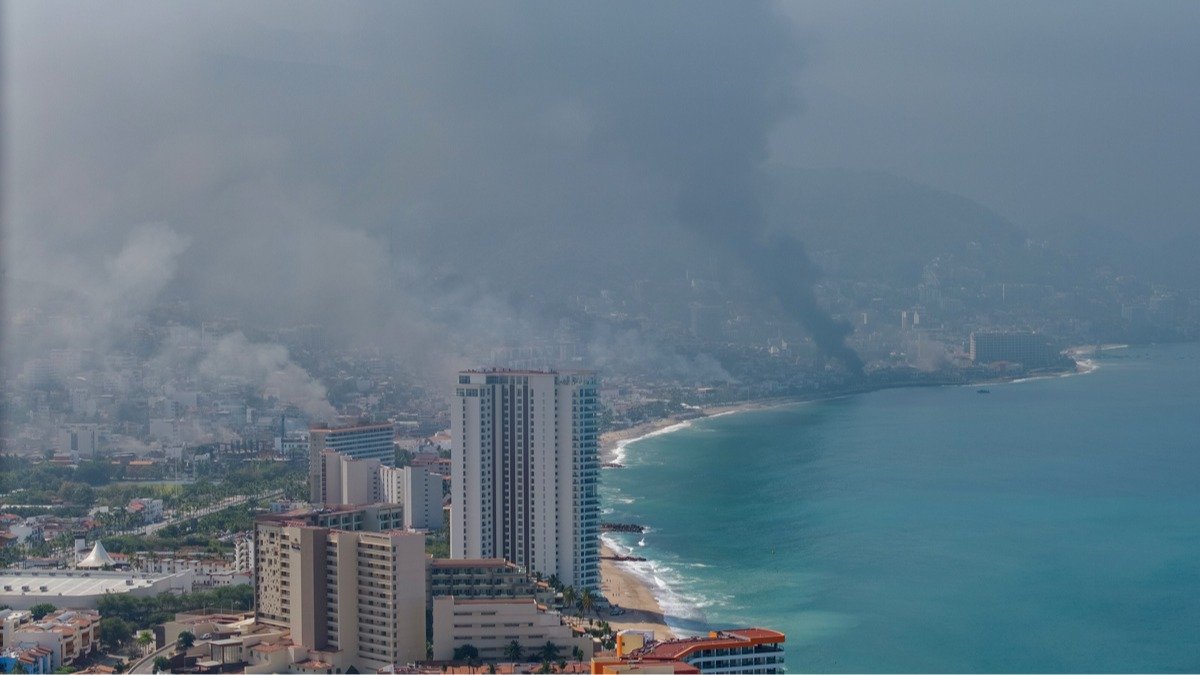
Mexico was hit by a wave of violence on February 22. The situation escalated in at least 20 out of 32 states. The epicenter was the state of Jalisco, home to the popular tourist cities of Puerto Vallarta and Guadalajara. The cause of the arson, attacks, and murders was the elimination of the leader of the Jalisco New Generation Cartel (CJNG), Nemesio Rubén Oseguera Cervantes, nicknamed El Mencho. Washington considered him "one of the most bloody and ruthless drug lords," stating that CJNG's activities extended not only to Mexico and the US but also to about forty other countries. The elimination of El Mencho is the most serious blow to the drug business in recent years and an achievement for Mexican President Claudia Sheinbaum, who abandoned the previous authorities' policy known as "hugs instead of bullets." However, new challenges will now arise: due to the decapitation of the CJNG, a redistribution of territories and spheres of influence among drug cartels is to be expected. Fires and plumes of smoke over Puerto Vallarta, resulting from riots after the elimination of El Mencho, Mexico, February 22, 2026. Photo: EPA. Did not live to stand trial The operation to capture El Mencho (short for Nemesio) took place on February 22 in the town of Tapalpa (Jalisco state). It was carried out by special forces of the Mexican army with the participation of the Air Force and an immediate response group of the National Guard. Initially, they planned to capture Nemesio Rubén Oseguera Cervantes alive. But a shootout began, four cartel members were killed on the spot, and three more died later from their wounds. Among the latter was the leader of the CJNG. The future founder of the most powerful Mexican cartel was born in 1966 into a poor peasant family in the state of Michoacan, a land of poppies and marijuana. At 14, he began guarding marijuana plantations. A few years later, in the 1980s, he illegally emigrated to the United States. The late 1980s and early 1990s date almost all known photographs of El Mencho: these are images from the files of the US Drug Enforcement Administration (DEA). Initially, he was arrested for possession of stolen property and carrying a loaded weapon, then twice for drug dealing. After serving three years in an American prison, he was released on parole and deported to Mexico at the age of 30. Photographs of El Mencho and seized methamphetamine at a press conference at the DEA office in San Diego, USA, March 11, 2020. Photo: K.C. Alfred / San Diego Union-Tribune / TNS / Abaca / ddp / Vida Press. Back in his homeland, El Mencho joined the municipal police, but later left and joined the "Mileniо Cartel." In 2009-10, this structure began to disintegrate, which allowed El Mencho to emerge and begin forming the Jalisco New Generation Cartel (CJNG) – now Mexico's most powerful criminal organization. El Mencho built his reputation by betraying some and entering into strategic alliances with others. He also actively learned from other cartels. "From the old Pacific gangsters - the ability to negotiate and build networks of patronage among politicians. From "Los Zetas," founders of drug terrorism - extreme cruelty as a tool for negotiation. From neighbors in Michoacan - methods of drug propaganda and expansion into the sphere of new synthetic drugs, especially methamphetamine," noted the newspaper El Pais, calling El Mencho's main invention "a new formula for a modern, decentralized mafia operating as a kind of franchise." Indeed, the CJNG became a new type of cartel, more like a multinational corporation with a developed management apparatus and a variety of spheres of activity. The cartel, with tens of thousands of fighters, has gone far beyond the production and transportation of drugs (cocaine and methamphetamine): it is also involved in extortion, robbery, migrant trafficking, and other illegal activities. The CJNG's international connections extend to the USA, Latin America, Europe, Asia, and Africa. According to the DEA, the cartel operates to varying degrees in about forty countries. In 2024, when the leader of the Sinaloa Cartel, Ismael Zambada, was arrested, El Mencho became Mexico's most wanted drug lord. In December of that year, the US increased the reward for information leading to his capture to $15 million. Mexican National Guard officers provide security in the area where El Mencho's body was delivered, Mexico, February 22, 2026. Photo: Mario Guzman / EPA. Response from the Mafia As soon as news of El Mencho's death spread across the country, chaos ensued. Riots broke out in at least 20 of Mexico's 32 states. According to local media, at least 30 people, including law enforcement officers, suspected cartel members, and bystanders, became victims of the wave of violence. Local media and social networks were flooded with videos showing CJNG members and supporters setting fire to cars, shops, and banks, blocking roads, and attacking law enforcement officers. It was reported that the drug cartel had offered a reward of $1,200 for every killed police officer or soldier. Schools in eight states canceled in-person classes on February 23. The National Autonomous University of Mexico (UNAM), located in the capital, did not suspend classes but decided not to penalize students who could not attend. The situation was particularly severe in Jalisco, the CJNG's home state, specifically in its capital Guadalajara and the resort city of Puerto Vallarta. Although sometimes it was difficult to distinguish truth from fakes. "Burning cars, buses, and shops, gunfire, blocked roads, panic, and something resembling a stampede among passengers at the international airport. An airport, for God's sake. Social media is full of videos: people running, hiding behind counters, leaving the terminal via the runways. Many are sharing photos of a burning plane - it later turns out to be a montage," described the atmosphere of Sunday, journalist Antonio Ortuño, who lives in Guadalajara. "An audio message is circulating, in which someone's voice assures that El Mencho's people will start mass killings at one in the afternoon. Another audio message claims: no, actually at two. Both audio messages came from a neighborhood chat group where any lie is believed. The chat participants fall into a panic. They want to flee... but how, if, according to them, going outside means becoming a living target?" A car set on fire by suspected organized crime members near a shopping center in Guadalajara, Mexico, February 22, 2026. Photo: Francisco Guasco / EPA. In any case, Guadalajara was deserted on Sunday: no one went out into the streets. However, some were caught off guard by the sharp escalation of violence. For instance, it was reported that over 1,200 people were stranded at the city zoo. People who found themselves there before the riots began were afraid to leave amid the chaos in the city. State police sent patrol cars to the zoo to protect visitors. People were also stranded at the state's airports: many international and domestic flights were canceled or delayed. Authorities feared that cartels would use drones: the CJNG had previously attacked security forces' aircraft in this manner. No requests for help According to the Telegram channel Baza, Russian citizens were among those stranded in Guadalajara. According to the Association of Tour Operators of Russia (ATOR), there are currently "less than 3,000 Russian citizens in Mexico, and most of them did not arrive for tourism purposes." ATOR recalled that Russia has not had direct flights to Mexico since 2022, and "the few classic tourists reach this country with layovers, and the most convenient option - through Cuba - has been excluded from the range of Russian tour operators due to the cessation of direct flights to this country." ATOR also noted that "the main object of interest for 95% of organized travelers choosing Mexican resorts in the current conditions is the beach resorts of the Caribbean Sea in Quintana Roo state - Cancun, Riviera Maya, and others." However, arson of cars and shops, as well as road blockades, were also reported there (though on a smaller scale than in Jalisco). Meanwhile, the Russian Union of Travel Industry (RST) reported that there are currently about 3,500–5,000 Russian citizens in Mexico - both tourists and relocators. The Russian Embassy in Mexico noted that no one had requested assistance. At the same time, diplomats urged Russian citizens to postpone trips to Jalisco, and those who are there were advised to "take personal safety measures." Many other countries issued similar warnings. For example, the US Embassy in Mexico urged Americans to take shelter in safe places and not to go outside unless absolutely necessary. Initially, the embassy issued a warning about the situation in five states. About eight hours later, a new warning was issued with a more alarming wording: "Applies to extensive territories, including the state of Jalisco (including Puerto Vallarta, Chapala, and Guadalajara), the state of Baja California (including Tijuana, Tecate, and Ensenada), the state of Quintana Roo (including Cancun, Cozumel, Playa del Carmen, and Tulum), as well as areas of the states of Guanajuato, Guerrero, Michoacan, Oaxaca, Nuevo Leon, and Tamaulipas." People inspect a bus burned by suspected organized crime members in the resort city of Acapulco, Mexico, February 22, 2026. Photo: David Guzmán / EPA. Awaiting Redistribution Meanwhile, US authorities expressed their full support to their Mexican counterparts. For example, US Deputy Secretary of State and former ambassador to Mexico, Christopher Landau, wrote on social media X that he observes the scenes of violence in Mexico "with great sadness and concern." "It's not surprising that criminals respond with terror. But we must not lose our composure under any circumstances. Hold on, Mexico!" he added, writing the last phrase in Spanish. The diplomat called the CJNG leader "one of the most bloody and ruthless drug lords" and his elimination "a great achievement for Mexico, the United States, Latin America, and the whole world." The US role was not limited to encouraging words. The Secretariat of National Defense of Mexico announced that US authorities had provided their Mexican colleagues with "additional intelligence information." The fact that "the United States provided intelligence support" was confirmed by White House press secretary Karine Jean-Pierre. It should be recalled that US President Donald Trump, since taking office in January 2025, has pressured the Mexican authorities to strengthen the fight against drug cartels. The head of the White House claimed that Mexico is now ruled by cartels, not President Claudia Sheinbaum, and "something must be done" about it. Among other things, he threatened several times to strike at the positions of Mexican drug cartels. In recent weeks, President Sheinbaum has done everything possible to avoid such a development of events - for example, a number of criminals, whom Washington had long sought, were extradited from Mexico to the United States. In addition, law enforcement agencies have sharply intensified operations against drug cartels. The "hugs instead of bullets" policy, used during the administration of former President Andrés Manuel López Obrador, was deemed completely ineffective. The elimination of El Mencho is the most serious blow to the drug business in recent years and a significant achievement for Sheinbaum. However, it should be understood that there may now be even more problems, as noted by Donald Trump's allies. "The Mexican government needs to make the right decision in the interest of its people and seek military support from the US to end the threat of drug terrorists before it's too late," wrote US Republican Senator and long-time Trumpist Bernie Moreno on social media X, commenting on the latest news. This is not so much about the spontaneous reaction seen on the streets of Mexican cities immediately after the elimination of the CJNG leader (according to the latest reports, life is gradually returning to normal). Now, a long-term escalation of violence can be expected in Mexico, as other cartels will begin to claim the resources and territories of the cartel that has lost its leader with doubled intensity. Conflicts within the CJNG itself are also not excluded. This is what happened with the Jalisco Cartel - once Mexico's most powerful group. After one of the world's most famous drug lords, Ismael Zambada, was arrested in 2024, a bloody internal struggle began within the cartel he led. Since then, the state of Sinaloa has been in a state of continuous war, with hundreds killed and missing. A repeat of this scenario is now possible in the CJNG territories, primarily in Jalisco, which will affect all local residents and potential tourists. And many were expected among the latter in Guadalajara this summer: the capital of Jalisco is among the cities that are scheduled to host the FIFA World Cup in June-July.
TL;DR
- The killing of Nemesio Rubén Oseguera Cervantes, 'El Mencho,' leader of the Jalisco New Generation Cartel (CJNG), led to widespread violence in Mexico.
- Riots, including arson and attacks on security forces, occurred in at least 20 out of 32 states, particularly in Jalisco.
- The elimination of El Mencho is seen as a major blow to the drug trade but is anticipated to result in a power struggle and redistribution of territories among cartels.
- International authorities, including the US, provided intelligence support and issued travel warnings for affected regions.
- The violence has disrupted daily life, canceled school classes, and caused airport delays, raising concerns about long-term instability and potential impact on upcoming events like the World Cup.
Continue reading the original article