March 2, 2026
Under the Ax. The Law Allowing Logging Near Lake Baikal Comes into Force. The Damage to the Lake and Ecosystem May Be Irreversible
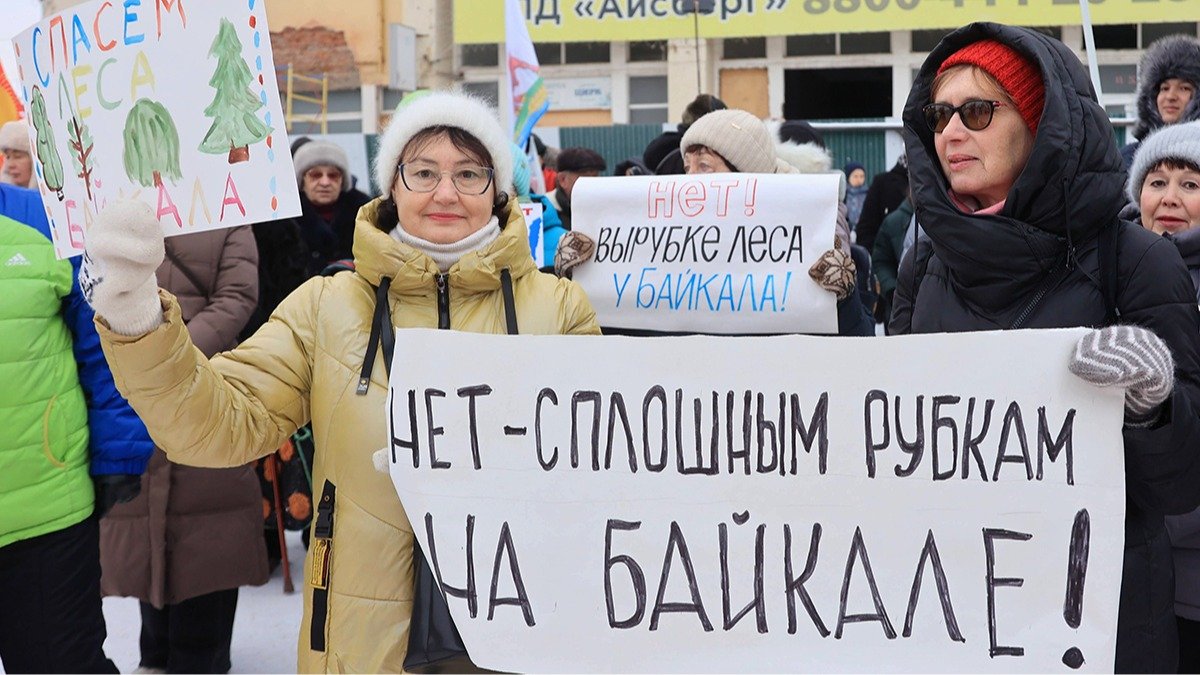
Amendments to the law "On the Protection of Lake Baikal" came into force on March 1, 2026. The document allows for clear-cutting of dead forest stands in the central ecological zone of the Baikal natural territory. The law also permits the transfer of forest fund lands to other categories for the construction of infrastructure. Decisions on these issues will be made by a departmental commission based on scientific conclusions. Critics of the law suggest that the amendments allow for the development of tourist facilities on the Baikal territory, significantly weakening the lake's protection, and that Baikal may be classified as "in danger" at the next UNESCO session. "Novaya Gazeta Europe" recalls what is wrong with the Baikal law. Activists with placards during a rally against logging around Lake Baikal in Irkutsk, Russia, December 27, 2025. Photo: Kirill Shipitsyn / IMAGO / SNA / Scanpix / LETA. Unlimited Logging Despite formal restrictions, experts believe it will not be difficult to obtain the necessary approvals for logging. This could lead to uncontrolled logging that will disrupt the lake's ecosystem balance. Scientists and activists fear that timber may be removed from the territory, even though the law intends for it to remain at the logging site. Furthermore, even small-scale logging will lead to the fragmentation of forest areas and reduce ecosystem resilience. The Scientific Council of the Russian Academy of Sciences on Forests opposed the amendments (the council's comments are available to the publication). According to specialists, they create high risks of unjustified logging and the loss of Baikal's unique ecosystems due to the absence of scientific criteria for assessing the "loss of forest functions." "The legislation only considers the recreational value of forests, ignoring their crucial role in forming water flow (73% of water for Baikal), regulating climate, and preserving biodiversity. Artificial restoration after logging using heavy machinery destroys soil and pollutes the lake, while permission to expand economic zones and settlements leads to a direct reduction in forest areas. Scientists insist that economic activities on Baikal are permissible only after a comprehensive scientific assessment of all forest ecosystem functions. However, the opinion of other scientists who are not involved with forests but are also part of the Russian Academy of Sciences prevailed. In July 2025, at hearings in the Public Chamber of the Russian Federation, the head of the Siberian Branch of the Russian Academy of Sciences, academician Valentin Parmon (a specialist in catalysis and photocatalysis), noted that "modern technologies" should be used in forest restoration, such as planting seedlings in pots. According to the scientist, if done carefully, the ecosystem will not be destroyed. In December, the Russian Academy of Sciences agreed on a coordination mechanism that would be mandatory when making decisions about logging. Details about this structure are still unavailable. Why Will Trees Be Logged? According to two governor-lobbyists of the law - Igor Kobzev in the Irkutsk region and Alexander Tsydenov from Buryatia - before the amendments, the law did not allow for the development of local infrastructure, construction of roads, repair of bridges, laying of new power lines, or the implementation of territorial development projects. For example, Igor Kobzev emphasized that the lack of modern infrastructure (piers, roads) hinders the region's development. He pointed to problems with existing piers (queues for the ferry to Port Baikal) and the need to create winter parking for large vessels. These difficulties prevent the implementation of the federal tourism development project "Magical Baikal." The construction and reconstruction of piers are estimated to cost 15.5 billion rubles. Igor Kobzev during the solemn oath-taking ceremony of cadets at the Academy of the State Fire Service of the Ministry of Emergency Situations of Russia, Moscow, September 15, 2018. Photo: Sergey Vedyashkin / Moscow Agency. In 2025, three new investors received resident status in the "Baikal Gate" special economic zone. They plan to implement hotel projects worth 1.7 billion rubles by 2028. Projects include guesthouses, restaurants, bath complexes, apartment hotels, and spa complexes. Within the framework of the federal project "Five Seas and Lake Baikal" and the national project "Tourism and Hospitality," apartment buildings, townhouses, and hotels will be built on the former territory of the Baikal Pulp and Paper Mill (BPPM). However, work on cleaning up the former enterprise's land has not even been completed yet. Buryatia also has many plans for developing the lake. In 2025, a new resident of the "Baikal Harbor" Special Economic Zone (SEZ) will invest over 940 million rubles in the "Green Flow Baikal Residence" project and 40 billion in a ski resort on Bychya Mountain. In Goryachinsk, a five-star hotel complex with 654 rooms and a multifunctional cluster "Lotus" are under construction. It will include an ethno-village, a spa center with a thermal zone, a sports complex, a training center for athletes and artists, and a multifunctional arena for 5,000 spectators. The investment volume is 40 billion rubles. Why the Lake Is Unlikely to Avoid Pollution Every news item about development on Baikal is accompanied by a mantra of preserving the lake's ecosystem. The state of Russia's water bodies, complex development plans, and ineffective monitoring systems cast doubt on these assurances. Thus, despite UNESCO's requirements - Baikal is still a World Natural Heritage site - the Ministry of Natural Resources has not provided the organization with a comprehensive territorial development plan with an environmental impact assessment. According to Mikhail Kreindlin, a specialist in specially protected natural areas, if such a plan is not developed, Baikal may receive "heritage in danger" status in 2027, when a UNESCO mission is scheduled to visit the site. The absence of a continuous and high-quality lake monitoring system is also alarming. This was mentioned in 2019 by Natalia Tumureeva, Deputy Minister of Natural Resources of Buryatia. Later, it was remembered less and less, although no monitoring system for the lake has appeared. "The "Point No. 1" project remains the flagship for assessing Baikal's purity. Water samples have been taken at one point in the lake, 2.7 km from the village of Bolshiye Koty, for over 80 years. The construction of wastewater treatment facilities in several villages on Baikal was not completed in 2024, with a projected delay in commissioning of 700 days. After a revealing inspection by the State Duma, which revealed these facts, no reports on the launch of the treatment plants were found. Pollution incidents in the lake occasionally appear online. For example, in 2025, in the village of Turka in Buryatia, the elite complex "AMAR" was accused of possibly discharging wastewater into the lake. Experts identify the lack of new and the low efficiency of existing wastewater treatment plants as the main cause of Baikal's pollution: many do not meet technical standards. As explained by Andrey Fedotov, director of the Limnological Institute, the common practice is to use septic tanks and filters outside closed containers. Since there is nowhere to take the waste, the effluents seep through the soil directly into the lake. Amidst the development of the shores and the increase in tourist flow, the situation is becoming critical. Scientists insist that tourism development must be strictly linked to the capacity of wastewater treatment plants (WWTPs): "No WWTPs - no tourism; WWTPs - tourism within their capacity." But currently, the law has been passed, development has begun, and WWTPs are absent. The lack of treatment plants contributes to the pollution of shallow waters and the proliferation of algae along the shore. Logging in the Severobaikalsky district of Buryatia. Photo: Investigative Committee of Buryatia. Meanwhile, there are generally no special places in the country where wastewater treatment has been successfully established. As early as 2017, the Ministry of Natural Resources noted that 80% of Russia's rivers were polluted to varying degrees. The main reason is inadequately treated wastewater. Judging by the fact that the large-scale reconstruction of treatment facilities on the Volga did not yield results, there have been no improvements since then. " According to Roshydromet, in 2023, 162 rivers and lakes with extremely high pollution levels were recorded in the country, a 33% increase from 2022 (122 sites). 306 water bodies with high pollution levels were also identified. As of February 2025, according to the information-analytical platform "Greenium," in 2024, the number of cases of water body pollution in Russia increased by 12% compared to 2023. The largest number of pollution incidents were recorded in the Sverdlovsk, Murmansk, and Smolensk regions, Krasnoyarsk Krai, and the Moscow region - the most densely populated regions. Baikal is currently protected from severe pollution by its remoteness and relative lack of population. However, what happened to Lake Manzherok in the Republic of Altai could happen here. By 2021, the water level in it had dropped, likely due to logging for development and an increase in beach area. As a result, the water lily population was completely destroyed. The population of the unique water plant water chestnut is on the verge of complete extinction. It is annual; the rosette of leaves is attached to a long, cord-like stem rising from the bottom. If the plant is torn off, it dies. In 2023, it was decided to allocate 800 million rubles for the restoration of Manzherok after unsuccessful cleaning. So, even future problems with the lake could become a reason for new budget injections. Distrustful Development When officials, deputies, and businesses tried to push through amendments to the Baikal law that allowed clear-cutting, they organized expeditions to the lake and held meetings with people, calling for a relaxation of the conservation regime. They argued that it was impossible to build cemeteries, erect protective forest belts, repair roads, and lay power lines. Those who opposed were more numerous in Moscow than in Buryatia or the Irkutsk region. Sana Bezmenova, a political activist who left Russia in 2022, told "Novaya-Europe" why this is happening. Sana volunteered for a campaign against laying an oil pipeline along the shore of Baikal in 2006. According to her, even then, people were afraid to speak out against the construction, but many could be persuaded. "People are still unhappy now, but no one will speak out. Any projects that cast even the slightest shadow on the regional governments have been stopped. Activists have left, and those remaining are silently observing. The investment mainly comes from people from Moscow and other regions of Russia. And if for locals Baikal is a sacred lake, for newcomers it is a way to make money," says Bezmenova. She believes that the development of Baikal is unlikely to improve the situation of the local population. Over the years, people have stopped believing the authorities. "When I lived in the Irkutsk region, I watched trains loaded with timber pass by my house. At the same time, news reports mentioned minimal logging. But when you see with your own eyes that this is not true, you stop believing any statements. And there are plenty of such examples. No matter what officials want to do, people will object because trust has been lost," Bezmenova believes.
TL;DR
- Amendments to the "On the Protection of Lake Baikal" law, effective March 1, 2026, allow clear-cutting of dead forests and land transfers for infrastructure within the Baikal natural territory's central ecological zone.
- Critics fear the amendments will lead to unchecked development, especially for tourism, potentially weakening Baikal's protection and leading to its classification as "in danger" by UNESCO.
- Experts and scientists warn that the new laws could disrupt the ecosystem balance, cause uncontrolled logging, fragment forests, and ignore the vital ecological roles of forests beyond recreation.
- Proponents, including regional governors, argue the law is necessary for developing essential infrastructure like roads, bridges, and power lines, and for advancing tourism projects.
- Concerns are raised about the lack of comprehensive environmental impact assessments, effective monitoring systems, and adequate wastewater treatment facilities, despite ongoing development and increased tourism.
- A history of pollution incidents and ineffective environmental management in Russia casts doubt on assurances of ecosystem protection for Baikal.
- Local activists express a lack of trust in authorities due to past experiences and fear that development may primarily benefit external investors rather than local communities.
Continue reading the original article