March 9, 2026
"It's a good life." European politicians who publicly support Putin earn money on Channel One talk shows. Among them is former Austrian Foreign Minister Karin Kneissl
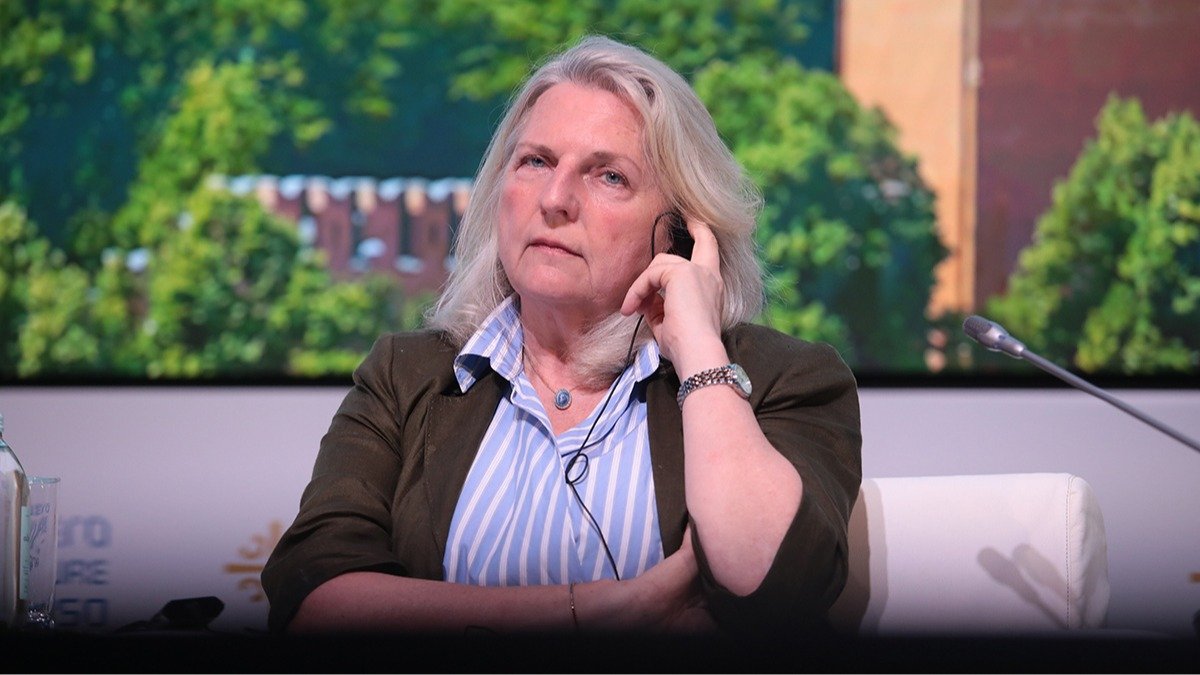
"It is clear to me that the warmongers are the politicians in Brussels, not anyone else. Something broke there, something went wrong – and this is happening throughout the EU," the former Austrian Foreign Minister described the situation in Europe in April 2025 on the political talk show "Big Game." This was not her first appearance there and, as "Novaya Gazeta Europe" found out, not a free one. For each participation in the talk show, the former European official received 200,000 rubles and earned over a million in six months. Political scientists, bloggers, and foreigners who come to "Channel One" to talk about how happy they are to move to Russia also receive fees for their comments. "Novaya-Europe" has obtained bank statements from one of the producers of programs for "Channel One" – the company "Teleprofil." We tell you who gets how much for their statements on "Channel One." Head of the "G.O.R.K.I." (Geopolitical Observatory for Key Issues of Russia) Center at St. Petersburg State University, Karin Kneissl. "Forum of the Future 2050" in the Lomonosov educational cluster, June 9, 2025. Photo: Artur Novosiltsev / Moscow Agency. From the editors The investigation is published jointly with the Austrian publication Der Standard. After the start of the war with Ukraine in 2022, Russian TV channels reduced entertainment broadcasting and increased the number of propaganda political talk shows. In March 2022, "Channel One" launched the talk show "Antifake" – as a response to programs by independent journalists exposing state television. This program has since been repeatedly caught promoting false information. With the start of the "special military operation," special episodes of the political talk show "Big Game" began to air up to three times a day. Before the war, the program aired less frequently – once a day from Monday to Thursday. – "Big Game" presents itself as something calmer and more thoughtful compared to other programs like "60 Minutes" or "Vremya Pokazhet" (Time Will Tell), says journalist Maria Borzunova, who has been analyzing state propaganda on television for the past ten years. – However, in terms of content, there is nothing there that we wouldn't hear in other programs on "Channel One": about the villains in the West who want to destroy Russia, about decaying Europe, about how Russia brings justice to the world, including through the war in Ukraine. Among recent statements that raise questions, at least, Borzunova recalls how, in an episode about the political situation in Iran, it was claimed that more people came out for rallies in support of the Ayatollah than for protest actions. "Novaya Gazeta Europe" has obtained bank statements on the movement of funds of "Channel One's" contractor – the company "Teleprofil," which produces the political programs "Big Game" and "Antifake." The statements cover the period from the beginning of 2024 to September 2025. Along with employee salaries – operators, editors, producers, and other personnel – experts commenting on political events also receive fees, but not all of them. For example, the head of "Mosfilm," Karen Shakhnazarov, who often appears on the programs, is not mentioned in the statements, while political scientists like Yevgeny Buzhinsky, who regularly receive small fees, are present in "Big Game." The Practice of Paying Experts on Television The payment of fees to experts for participating in programs is a practice that exists in both Russian and foreign media, journalists with television experience told "Novaya-Europe." But there are a number of important nuances. British journalist and television producer Peter Pomerantsev says that this fee is usually small and is needed, for example, to cover travel expenses to and from the studio. A BBC employee, who works in news broadcasting, told "Novaya-Europe" that their newsroom is forbidden from paying eyewitnesses to events to avoid tempting them to embellish what they saw. And under no circumstances can the newsroom pay politicians. „ – It's important to distinguish between one-off payments, for example, in cases of sensational journalism where a person is paid for participation due to a scandal, and regular fees for permanent speakers, says Sergei Polikarpov, a disinformation researcher from the University of Amsterdam. – The latter looks more like an anomaly. Mathias Karmasin, who studies media and communication at the Austrian Academy of Sciences, believes that in the case of "Channel One," the entire context must be taken into account: it is not an ordinary journalistic program, but a talk show that is part of the state propaganda machine. – The main task of journalism is to find answers to complex questions, – emphasizes the expert. – "Channel One" does not provide any new answers; it serves a specific political task. Therefore, according to Karmasin, fees from "Channel One" should be considered payment for participation in propaganda. Vladimir Putin dances with Karin Kneissl at her wedding to Austrian businessman Wolfgang Meilinger in Gamlitz, Austria, August 18, 2018. Photo: Alexei Druzhinin / Sputnik / EPA. A House in Giblits A frequent guest of "Big Game" is former Austrian Foreign Minister Karin Kneissl. She is one of the highest-ranking European politicians who currently publicly supports Vladimir Putin. Back in 2018, she invited him to her wedding, and he came and danced a celebratory waltz with her. At that time, Kneissl was still the head of the Ministry of Foreign Affairs from the far-right Austrian Freedom Party (FPÖ), known for its pro-Russian views. Kneissl held this position only until 2019. In 2020, the former minister became a columnist for RT, and in 2021, she joined the board of directors of the state-owned company "Rosneft" as an independent director, but soon resigned due to sanctions imposed against "Rosneft." In 2020, according to her own words, Kneissl was "hounded" in Austria, and she began to "constantly receive threats." She left the country and settled on a small farm in France, and then moved to northern Lebanon with her pets – horses, dogs, and cats. In 2023, Karin Kneissl announced that she had moved to Russia and would live in the Ryazan region. The former Austrian minister rented a small house in the village of Petrushovo, which has a permanent population of about 40 people. „ – I like life here... Grandmothers, apples, summer, swimming in the river. It's a good life. I don't need the Maldives or Seychelles, – she said in Russian in an interview with TASS. Now, as "Novaya-Europe" found out, Kneissl owns her own home nearby – in the village of Giblits. It is a two-story, 350-square-meter house built in 2023. After acquiring her own home, Kneissl brought her ponies to Russia – a special Russian Ministry of Defense aircraft was allocated for this. Kneissl has not spoken publicly about the source of her income in Russia. In the summer of 2025, The Guardian wrote that after losing her ministerial post and during the pandemic, Kneissl found herself in such difficult financial straits that she even sought help from an Austrian fund for people with financial difficulties, which refused her. As "Novaya-Europe" discovered while studying "Teleprofil's" activities, at least one of Kneissl's sources of income has become "Channel One" – a Russian TV channel whose broadcasting has been suspended in the EU and the US for "propaganda and disinformation." Karin Kneissl on the TV show Big Game. Photo: Channel One website. How to Become a Millionaire From August 2024 to April 2025, Kneissl appeared on "Channel One's" "Big Game" six times and received 1.2 million rubles for it. Her longest appearance was an in-studio interview for a special episode with Dmitry Simes about the situation in Lebanon. Another time, she also gave a comment lasting approximately 30 minutes, but via video link. In August 2024, she commented on the arrest of Telegram owner Pavel Durov in France; a month later, in September, she spoke about the situation in Lebanon; and in January, she gave a short comment on the Austrian elections – all these comments were recorded via video link and lasted no more than seven minutes. According to Sergei Polikarpov, a disinformation researcher from the University of Amsterdam, the mere fact of payment does not mean that participants are directly dictated what to say: often, it is enough for people to understand the expectations and reproduce the desired narratives themselves. – There are people with pro-Russian views in the West, and what they sincerely think coincides with what propaganda needs, and the Russian authorities do not mind paying for it, – Polikarpov concludes. As a rule, Kneissl supports Russia's position and criticizes European policy quite cautiously. "When I left Austria in 2020, I realized that in five years it might be too late," she said in one episode of "Big Game," where she participated with deputy Babakov. – It became clear to me that it would only get worse. And it is clear to me that the warmongers are the politicians in Brussels, not anyone else. Something broke there, something went wrong – and this is happening throughout the EU. And this poisoned part, the hatred of Russia, is becoming stronger: you can no longer ask smart questions, you can't discuss anything." Kneissl's interlocutors respond to her much more sharply. For example, at the end of the same program, after discussing European politics, the host Dmitry Simes suddenly stated that he was not against violence in "states hostile to Russia." "Of course, I am not for Russia interfering in the affairs of other states, let alone persuading someone to use violence. But if it happens as a result of Russophobic governments and if these countries are enemies of Russia, then I would not be bothered if they faced certain problems at home," he said. – I think I should have been a humanist, but, as they say, not to such an extent. We must know how to control our humanism and sympathy for our enemies." "Forum of the Future 2050" in the Lomonosov educational cluster, June 9, 2025. Photo: Artur Novosiltsev / Moscow Agency. G.O.R.K.I. in St. Petersburg Kneissl has another source of income related to the Russian state. Since 2023, she has headed the G.O.R.K.I. research center (Geopolitical Observatory for Key Issues of Russia) at St. Petersburg State University, which was founded shortly before for "finding solutions to global problems and developing proposals for Russian policy." This research center, like the entire St. Petersburg University, is funded by the state, and Kneissl has received over 22 million rubles for 29 months of work there – about 750,000 rubles per month. – This looks like an attempt to legitimize people who are important for the propaganda system, of which they become a part, – says Sergei Polikarpov. – The forms of payment for their participation can be very different, including indirect ones, as in the case of Kneissl's employment at St. Petersburg State University. And such indirect mechanisms are especially convenient, as direct agreements on remuneration for a certain position could raise questions. To the question of how this practice differs from grants awarded by Western quasi-governmental structures to researchers and journalists from Russia, Polikarpov explains that there are differences, although these phenomena look very similar externally. „ – The Russian model quite consciously reproduces the system of grants or foreign funding. Propaganda mechanisms often copy external institutional forms but fill them with different content, acting as a kind of "distorted mirror" of global practices, – believes the expert. Therefore, it is important to look at the broader picture, Polikarpov believes. In his opinion, the grant system in the West has internal mechanisms that prevent the state from influencing the results of scientific research, even when it provides funding. For the Russian authorities, however, any financial support looks like a package that already contains both the question and the desired answer. – All major European grant programs involve a peer review procedure – anonymous expert review by specialists in the relevant field, – explains Polikarpov. – The experts do not know my name, and I do not know theirs. The process usually involves several rounds of evaluation, and the more complex the grant scheme, the more rounds the application goes through. Final decisions are also made based on the evaluations of independent anonymous experts. This means it is a system based on meritocracy and professional expertise: funding in the scientific field is allocated for a research question and the applicant's competencies. There are also resume competitions, where victory also depends on professional achievements and qualifications. And this is precisely why, as an academic researcher, it remains a question for me how Karin Kneissl obtained such a large laboratory and significant funding from St. Petersburg State University, given that she is, after all, a former minister, not a scientist with recognized international academic reputation. St. Petersburg State University did not respond to "Novaya-Europe's" request about how Karin Kneissl got the job in the laboratory and whether a competitive selection process was conducted. Kneissl herself also did not answer questions about fees from "Channel One," but commented on her life in Russia in general terms. "Unlike in Austria, in Russia I can teach and speak much more freely – I have never encountered [state] interference here. Because of my teaching contract, the Austrian authorities are planning to deprive me of my citizenship and make me an apatride. That's human rights for you," she said. Yuri Podolyaka via video link on the show Big Game. Photo: Channel One website. European Politicians in the Service of "Channel One" Not all commentators on "Big Game" or "Antifake" receive large fees for their participation in the shows. For example, Americans Mira Terada and Peter Chevozerov, as well as Finn Erkki Beckman, occasionally appear on "Antifake." When they moved to Russia is not precisely known, but before moving, all of them became defendants in criminal cases in their home countries. Moreover, these cases were not related to their statements or support for Russia. Mira Terada was accused of money laundering and drug trafficking offenses. Peter Chevozerov (real name Chad Hover) was accused of child abduction: according to the US investigation, after a conflict and divorce from his wife, he illegally took the child out of the United States and kept him outside the country. And Finn Erkki Beckman was conditionally convicted in 2018 for harassing a Finnish journalist: he spread false information about her and sent abusive messages, and as a result of his publications, she and her colleagues began to receive threats. „ Now, for their appearances on "Channel One" episodes, they receive from 15,000 to 20,000 rubles. And each of them talks about how much better and safer Russia is compared to European countries and the US. However, the most generous payment from "Big Game" went to former Ukrainian blogger Yuri Podolyaka, who, after the annexation of Crimea, effectively became a pro-Kremlin military commentator. His Telegram channel "Mir segodnya s Yuriyem Podolyakoy" (The World Today with Yuri Podolyaka) is one of the most popular resources for Russian war correspondents, with 2.9 million subscribers. Since 2022, the blogger has actively covered the "special operation" on his social media and on Russian television. For this, among other things, in February 2025, a Ukrainian court sentenced Podolyaka in absentia to 15 years for justifying Russian aggression. Since the beginning of the invasion, Podolyaka has been hosting regular reviews of the front-line situation for the program "Big Game" – his comments did not last more than five minutes. Leaks indicate that Podolyaka was paid 18 million rubles for these reviews in 2022. The blogger received and even opened a letter requesting comments from a "Novaya-Europe" correspondent but did not respond. Olga Petersen on the air of the program Antifake. Photo: Rutube. Fees from "Channel One" are also received by other former European politicians. For example, Olga Petersen often appears on the talk show "Antifake." In 2020, she was elected as a member of the Hamburg city parliament for the right-wing party "Alternative for Germany" (AfD). She openly sympathized with Russia, and in 2024, she came as an "independent" observer to the presidential elections and called the voting "open, democratic, and free." After that, she was expelled from the AfD, officially explained by misleading the party leadership and saying she was traveling to Russia as a private individual. In December 2025, Petersen was also expelled from the Hamburg parliament for systematic absenteeism. By that time, she had apparently already moved to Russia. According to her own words, she decided to move because of the fear that state authorities in Germany would take her children away from her due to her pro-Russian stance. After moving to Russia, she began to actively visit the occupied territories. "God arranged it so that, without even settling in my new place, I was able to visit Donbas," she said in an interview. – This truth will never be shown on German television, but today I have the opportunity to convey it to those who want to hear something other than the lying German press." On "Channel One's" talk shows, Petersen most often talks about the discrimination of Russian-speakers in European countries, as well as the persecution of dissenters in Germany. "In Russia, we have freedom," Petersen said in an "Antifake" episode. „ – Here we don't have to walk around with rainbow flags, here no one forces us to have a certain opinion, you can simply rely on facts." Olga received not much from "Teleprofil" for participating in two programs – only 70,000 rubles. However, according to leaks, she also receives money from the RT TV channel. By 2025, Petersen had earned almost a million rubles there. What exactly she does at the TV channel is unknown; "Novaya-Europe" could not find any materials or expert comments by Petersen on the Russian-language website of RT. Another European politician invited to "Antifake" as an expert was former Member of the European Parliament and Latvian journalist Andrey Mamyskin. In May 2025, the ex-deputy said that Russia pays pensions to its citizens living in the Baltic countries and claimed that due to the requirement to pass a Latvian language exam, residents of the Baltic countries are massively moving to Russia and Belarus. For his comment, he received 50,000 rubles. "Novaya-Europe" sent inquiries to politicians who participated in "Antifake" and "Big Game." Only Andrey Mamyskin responded to the correspondent's messages. He claims he does not remember participating in "Antifake" and has never received fees for his participation in any programs on Russian television. "In short, send me this money, I am ready to take it and transfer it to the SMO. This money will help the front and the Russian guys fighting Nazism. Ukraine must be liberated from filth," he added in response to a message specifying the date of his contract with "Teleprofil" and the amount of the fee.
TL;DR
- Former European politicians, including ex-Austrian Foreign Minister Karin Kneissl, are being paid for appearances on Russian state TV talk shows.
- Kneissl reportedly received 1.2 million rubles for six appearances on "Big Game" and also earns a significant salary from a state-funded research center in Russia.
- These talk shows, such as "Big Game" and "Antifake," are characterized as propaganda outlets by media analysts and researchers.
- Payments are reportedly made through a production company called "Teleprofil," with fees varying based on the guest's prominence and the show.
- Other foreign participants, including former politicians and individuals with past legal issues in their home countries, also receive payments for their appearances.
Continue reading the original article