March 2, 2026
Iran Attacks Persian Gulf Countries. What Is It Trying to Achieve? In response to Israeli and US strikes, Tehran is hitting both military bases and civilian objects.
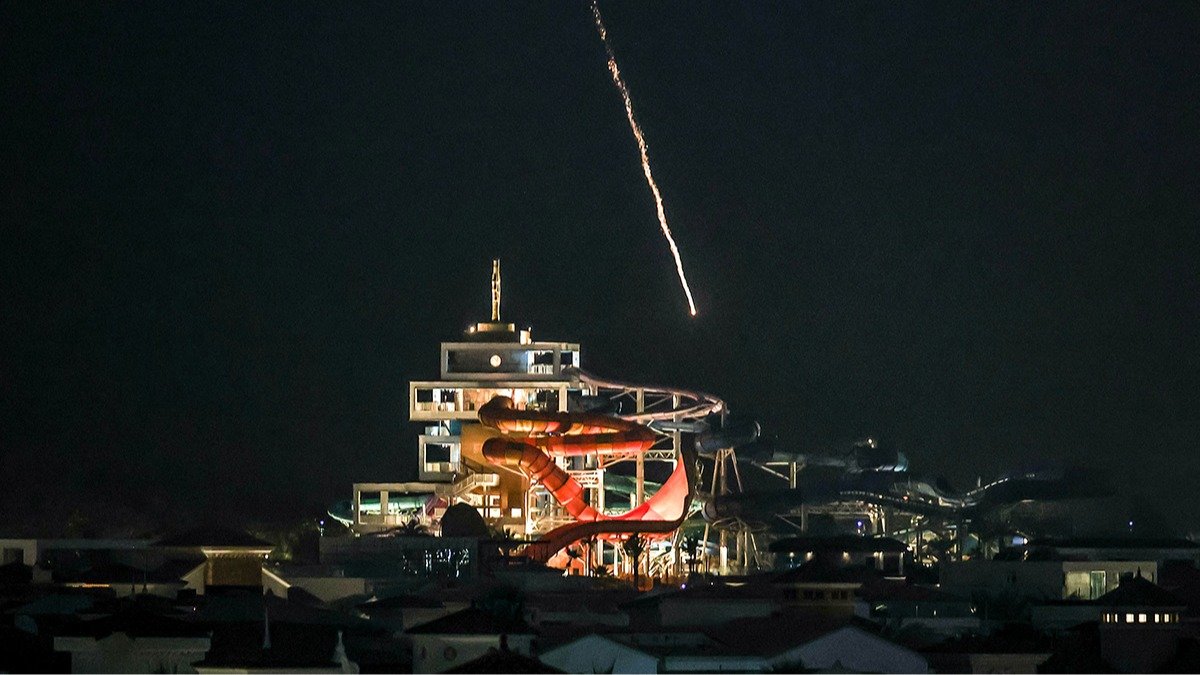
The geography of Iran's response to the American-Israeli military operation turned out to be unprecedentedly broad: not only Israel but all the Persian Gulf countries came under fire from ballistic missiles and kamikaze drones. Tehran claims that Iranian forces are not attacking the Gulf countries as such, but the American military bases located there, which are de jure US territory. However, numerous civilian objects have actually been hit: airports, hotels, residential buildings. What Iran is trying to achieve with such strikes is in the material from "Novaya Gazeta Europe". A downed missile falls into the sea near the Dubai Palm Jumeirah archipelago, March 1, 2026. Photo: Fadel Senna / AFP / Scanpix / LETA. Destruction of a fragile balance. Persian Gulf states have long held a dual position regarding Iran. On the one hand, for the most part, they viewed it as a threat to regional security, particularly due to Tehran's support for various proxy forces, its nuclear program development, and its missile arsenal build-up. On the other hand, in recent years, countries in the region have tried to influence the Iranians by establishing interaction with the ruling regime. Thus, in 2022, after a six-year crisis, the UAE returned its ambassador to Tehran (and subsequently the Iranian ambassador returned to the Emirates). Additionally, in March 2023, Saudi Arabia agreed to resume embassy operations with Iran. After Donald Trump came to power in the US, the Persian Gulf countries, where most American military facilities are located, continued to attempt to maintain a fragile balance. They did everything possible to avoid being drawn into open confrontation with Iran, for example, by refusing to provide their airspace or territory for any military actions against the ayatollah regime. Simultaneously, some Gulf states assisted in diplomatic settlement attempts. The first sign that this tactic might ultimately prove ineffective came during the so-called "Twelve-Day War" between Israel and the US with Iran in June 2025. At that time, Tehran, among other things, struck the American airbase Al-Udeid in Qatar. However, serious consequences were avoided. The Gulf countries limited themselves to statements condemning the Iranian strike and calls for de-escalation, after which they seemed to forget about the incident. " Before the current escalation, far more massive than last summer, countries in the region also made it clear that they wished to remain on the sidelines. For instance, in January, media outlets, citing sources, reported that Gulf states had notified Washington that they would not allow their airspace or military bases to be used for strikes against Iran. Oman was directly involved as a mediator in American-Iranian indirect negotiations regarding Tehran's nuclear program. After a round held in Geneva on February 18, the head of the Omani Foreign Ministry, Badr Al-Busaidi, announced "substantial progress" and that a nuclear deal was "within reach." After the start of the American-Israeli operation, he wrote: "I am deeply disappointed. Active and serious negotiations have once again been undermined. This serves neither the interests of the United States nor the cause of global peace." Containers with US humanitarian aid are loaded onto an Air Force aircraft at Al Udeid Air Base, Qatar, Friday, March 29, 2024, before being dropped over the Gaza Strip. Photo: Hussein Malla / AP Photo / Scanpix / LETA. Reaching the Bases Peace – at least regionally – has indeed been undermined. Immediately after the attacks on Iranian territory, Tehran promised an unprecedentedly powerful response to its enemies. At the same time, the Secretary of Iran's Supreme National Security Council, Ali Larjani, addressed the Persian Gulf countries with these words: "We do not intend to attack you. But if bases located on your territory are used against us during US operations in the region, we will strike these bases." De jure, as Larjani noted, these bases are US territory, so there is no question of attacking the Gulf countries themselves. By the evening of February 28, Iranian media affiliated with the Islamic Revolutionary Guard Corps reported: "Tehran attacked 14 American facilities in the region." A military source from the Iranian Tasnim agency assured that in some countries, missiles and drones hit multiple enemy targets simultaneously. According to a July 2024 Congressional Research Service (CRS) report, the Pentagon manages or operates at least 128 overseas bases in at least 51 countries. Bases in the Middle East operate under the command of the US Central Command (CENTCOM). CRS identified eight permanent bases and 11 additional military facilities in the region to which the Pentagon has access. It is possible that the claim of 14 attacked facilities is an exaggeration. But, one way or another, Bahraini authorities confirmed that a command center at the headquarters of the US Fifth Fleet was hit by a missile strike. The Ministry of Defense of Kuwait reported three servicemen lightly wounded by shrapnel during an attack on Ali Al-Salem Air Base. The Washington Post verified video of a drone attack on another Kuwaiti base, Camp Buehring. The Iranian Fars agency claimed on February 28 that strikes had hit Al-Udeid Air Base in Qatar (the same one from the 2025 war) and Al-Dhafra Air Base in the UAE. The next day, the same agency reported, among other things, an attack on a US ammunition depot in Erbil, the capital of Iraqi Kurdistan. On Saturday evening, the US Central Command reported successfully repelling "hundreds of Iranian missile and drone attacks." "There were no reports of casualties or injuries among American military personnel. Damage to American facilities was minimal and did not affect the course of operations," the military stated. Meanwhile, the next day it was officially announced: three American soldiers were killed, and five more were seriously injured. Where exactly this happened and under what circumstances was not specified. According to The Washington Post, the deceased were part of a logistics unit in Kuwait. A building damaged by an Iranian drone attack in Manama, Bahrain, March 1, 2026. Photo: Hamad I Mohammed / REUTERS. Removing All Safeguards In 2025, commenting on the attacks on the base in Qatar, Donald Trump openly thanked the Iranians for warning them in advance of their attack. "This saved lives and avoided injuries. Perhaps now Iran can move towards peace and harmony in the region, and I enthusiastically urge Israel to do the same," he wrote at the time on his social network Truth Social. If Trump's statement is to be believed, one can conclude that Tehran could not but respond then, wanting to save face, but at the same time was not inclined to escalate. This time, there was no warning intended to minimize the threat. Military expert David Gendelman, in an interview with "Novaya-Europe," pointed out that "Arab countries hosting US military bases have not previously given the US Air Force permission to fly over their territory for attacks on Iran." "Perhaps the authorities of these countries hoped that such a ban on the use of airspace would grant them immunity from Iranian attacks. But the plan did not work," the expert stated. Another interlocutor of "Novaya-Europe," former Israeli intelligence and police officer Sergey Migdal, noted that with a simultaneous attack on the region's countries, "the ayatollah regime decided to remove practically all safeguards." The security specialist noted that not only Israel, UAE, Saudi Arabia, Qatar, Bahrain, and Kuwait were attacked, but also Oman, which does not even have an American military base (though it does have a British one). Furthermore, there is a British base in Cyprus, and on Monday, Cypriot President Nikos Christodoulides confirmed that an Iranian drone had attacked it. "We are in a region of particular geopolitical instability, facing many challenges and problems, experiencing an unprecedented crisis. Our homeland is in no way participating and does not intend to participate in any military operations," he said. Sergey Migdal, meanwhile, pointed out that Iran is not attacking Turkey, which hosts several large US military bases. For example, reconnaissance aircraft equipped with AWACS systems (which gather data on Iran) take off from there. The expert is confident that Tehran "is not touching Turkey yet because it fears getting involved with a NATO country." Regarding Hotels and Airports Iranian authorities claim their targets are exclusively military facilities. However, from the very beginning of the escalation, news of damage to civilian infrastructure and accidental casualties began to arrive from various Persian Gulf countries. For instance, attacks on airports were reported in at least four countries: Iraq (specifically, Iraqi Kurdistan), Bahrain, Kuwait, and the UAE (in Dubai and Abu Dhabi). Among other things, after a missile fell, a large fire broke out at the Fairmont Hotel in the Palm Jumeirah area of Dubai, popular with tourists. Explosions were also heard in the vicinity of the prestigious Dubai Marina development. Meanwhile, in Abu Dhabi on February 28, debris from a downed Iranian missile fell on a residential area, killing one person. On March 1, debris from a drone shot down by air defense systems hit the facade of one of the Etihad Towers skyscrapers. Among other things, the Estonian embassy is located there. Smoke is visible in Kuwait after reports of an Iranian strike on an area where the US embassy is located, March 2, 2026. Photo: AFP / Scanpix / LETA. In total, as of Sunday evening, three people were killed and about 60 were injured in the UAE. The Ministry of Defense stated that since the beginning of the Iranian attack, more than 540 drones, 165 ballistic missiles, and two cruise missiles had been targeted at the UAE. Most of these projectiles were intercepted, but 21 drones, as the ministry noted, hit civilian objects. In Kuwait, one person died as a result of Iranian attacks, and another 32 were injured. Among other things, Tehran, according to the Iranian Tasnim agency, struck the US embassy located there. The Ministry of Defense also reported the crash of "several American military aircraft" on the country's territory, with no pilots injured. In the capital of Bahrain, a five-star hotel building was damaged; the Ministry of Interior reported no casualties. Qatar also reported repelling Iranian attacks involving drones and missiles. Several explosions were heard in Riyadh, the capital of Saudi Arabia. In Oman, the port of Duqm was attacked by two drones: one drone hit a residential module, and a foreign worker was injured. A significant portion of the casualties are victims of falling debris resulting from air defense system operations. Meanwhile, military observer David Sharp, in a conversation with "Novaya-Europe," indicated that not all Iranian missiles and drones were initially aimed at military targets. "The first type of strike is against American bases. The second is against peaceful and civilian objects: airports, hotels, residential buildings. Apparently, Iran is acting on the principle of 'making life unbearable' and trying to spoil the prosperous and comfortable existence that the citizens of the Persian Gulf countries have cultivated for many years," the expert said. Failed Pressure Apparently, it is not just about targeting errors. It is also, let's say, targeted blackmail. The economic model of the Gulf Cooperation Council (GCC) countries is based on three pillars: security, global logistics, and foreign investment. "The status of Dubai or Doha as "safe havens" in the Middle East translates into billions of dollars. And Iranian missiles began to hit the very brand of these states as calm financial and tourist centers. The emergency closure of airspace and the cancellation of thousands of flights instantly paralyzed transcontinental routes. Market shocks are also expected (given this, the Abu Dhabi and Dubai stock exchanges will be closed until at least Wednesday). Qatari political analyst Ali Al-Hail notes that the Persian Gulf countries can be seen as "scapegoats" in the current conflict, as they represent a weaker side in the regional geopolitical scheme. Iran understands perfectly well that a full-scale war with the US at sea threatens it with swift defeat, so it is hitting vulnerable points. This is both a message to the US (demonstrating the ability to threaten American interests through Washington's allies) and an attempt to pressure the Gulf states to panic and urge Trump to terminate the military operation prematurely. However, Iran has made a colossal diplomatic miscalculation. The Gulf monarchies, torn by internal contradictions and economic rivalry for decades, have put aside their disputes. Not a single Persian Gulf state has condemned the US and Israeli strikes, expressed solidarity with the attacked Islamic Republic, called for a ceasefire, or recalled its ambassadors from Washington or Jerusalem. Instead, they have unanimously condemned Tehran. The Arleigh Burke-class guided-missile destroyer USS Spruance (DDG 111) launches a Tomahawk (TLAM) land-attack missile during operations in support of Operation Epic Fury from an undisclosed location, February 28, 2026. Photo: US Central Command (CENTCOM) / EPA. The Saudi Ministry of Foreign Affairs criticized "blatant Iranian aggression and gross violation of the sovereignty" of the region's countries. Bahrain's National Communication Center stated its "full right to respond and take all necessary measures to protect national security" in coordination with "allies and partners" (recall that the US Fifth Fleet is based in the kingdom). The UAE announced the closure of its embassy in Tehran and the recall of its ambassador. The Diplomatic Advisor to the UAE President, Anwar Gargash, stated that this escalation "has isolated Tehran at a critical moment" and confirmed the correctness of those who consider the Islamic Republic and its missile program "the main source of danger and a permanent cause of instability in the region." "For 40 years, the Islamic Republic has built a narrative of the 'axis of resistance,' seeking to present itself as the main defender of the Muslim world against Western and Israeli power. But in just one morning, Iranian ballistic missiles have destroyed this image more convincingly than any American or Israeli bombs could have," summarized Gregg Roman, Executive Director of the Middle East Forum (USA). A Test of Unity The conflict has become a test of strength for the GCC, whose members signed a defense treaty in 2000. It includes a clause similar to the well-known Article 5 of the North Atlantic Treaty: an attack on one member is considered an attack on all. In 2013, the creation of a unified GCC military command was approved to enhance operational coordination among the region's countries. However, regional security experts describe the command as merely a "theoretical framework for coordination" rather than an operational body with immediate executive powers. Citing internal disagreements and differences in national security priorities, they expect Persian Gulf states to act independently or within narrow coalitions. David Gendelman tells "Novaya-Europe" that "on paper, many Arab states possess very serious military potential." For example, Saudi Arabia and the UAE have modern air forces (for instance, Saudi Arabia ranks second in the world in terms of F-15 aircraft). And the UAE, according to the expert, has "one of the most modern air defense systems on the planet, including two THAAD batteries, 12 Patriot batteries, and even Israeli Spyder systems." Sergey Migdal also notes that "nominally, the armies of Saudi Arabia and the UAE have a wide range of expensive modern armaments, aviation equipment, and air defense systems." However, the words "on paper" and "nominally" are not accidental. "Real combat readiness is questionable," notes Sergey Migdal. "- Saudi Arabia, for example, has been fighting the Houthis for many years but has not been able to achieve significant results. The combat effectiveness of these armed forces – their equipment multiplied by training and motivation – leaves much to be desired." David Gendelman suggests that Arab states are unlikely to take an active part in combat operations in the near future. "It can be assumed that in such a case, Iran will begin to select targets among government buildings and decision-making centers, and they [the Persian Gulf countries. - Ed.] will like this even less," he explains. However, at the political level, the region's states have shown rare unity. On March 2, Kuwait, Saudi Arabia, Bahrain, Qatar, Jordan, the UAE, and the US issued a joint statement "resolutely condemning the indiscriminate and reckless missile and drone attacks" by Iran, which "endangered civilians and damaged civilian infrastructure." At the same time, the signatory countries pointed to their "right to self-defense in response to these attacks." In Conditions of Shortage Military experts interviewed by "Novaya-Europe" note that Iran's air defense is "practically suppressed" (meaning it is running out of resources for effective defense), but at the same time, the Islamic Republic still has the capability to strike Israel and neighboring countries. "Tehran still has a very large number of missiles with a range of 300-900 km, which it can use to shell neighboring countries. According to some estimates, there could be 12-14 thousand units. For example, before the war, Iranians apparently had 1.5-2 thousand missiles that could reach Israel," said Sergey Migdal. Thus, Iran can continue to launch high-intensity attacks with short-range missiles, cruise missiles, and drones on nearby targets in the Persian Gulf, while saving its remaining medium-range missiles for a narrow range of targets in Israel. Consequences of strikes on aircraft shelters at Konarak naval base in southern Iran, in the Persian Gulf, February 28, 2026. Photo: Satellite image Vantor / AFP / Scanpix / LETA. And here, an important question arises, which Western media pondered in the days before the start of the American-Israeli operation: "How many drones, missiles, and rockets can the United States afford to intercept?" Modern air defense systems are both extremely effective and extremely expensive. As the Defense Security Asia portal noted, the cost of one THAAD interceptor missile reaches $11 million, and one Patriot missile costs about $4 million. Spending these unique and incredibly expensive items to intercept cheap Iranian kamikaze drones or old short-range ballistic missiles means dooming oneself to ruin in such a war of attrition. The American military-industrial complex lacks the capacity for rapid replenishment of stocks on the required scale. As early as July 2025, The Guardian reported that the US had "about 25%" of its Patriot interceptors remaining from the volume stipulated in the Pentagon's military plans. The reason for the partial depletion of stocks is supplies to Ukraine. And a week ago, The Washington Post reported that the Chairman of the Joint Chiefs of Staff, US General Dan Kane, mentioned a shortage of critically important ammunition among the significant risks within a then-hypothetical military operation against Iran. On Saturday, Bloomberg, citing sources, reported that if Iran maintained its current launch rate, American military stocks of interceptor missiles might last only a few days. And it is unclear how this relates to Donald Trump's assertion that the war could ultimately last "about four weeks."
TL;DR
- Iran's response to US-Israeli military operations was broad, hitting Israel and Persian Gulf countries with missiles and drones.
- Tehran claims to be targeting US military bases in Gulf states, asserting they are de facto US territory.
- Civilian objects, including airports, hotels, and residential buildings, were hit, causing casualties and damage.
- Persian Gulf states, historically navigating a complex relationship with Iran, have condemned the attacks.
- The attacks have economic implications, disrupting global logistics and potentially impacting financial markets.
- Experts suggest Iran aims to pressure Gulf states and the US by hitting vulnerable economic and logistical points.
- The conflict tests the unity of the Gulf Cooperation Council (GCC), though military effectiveness of some states is questioned.
- The high cost of air defense systems and limited interceptor missile stocks pose a challenge for the US in a prolonged conflict.
- Despite Iran's claims of targeting military sites, evidence suggests intentional strikes on civilian infrastructure.
- The incident highlights Iran's strategic calculations and its attempts to leverage regional instability.
Continue reading the original article