March 5, 2026
Russia Returns to Venice Biennale After Invasion Hiatus; Pussy Riot Plans Protest
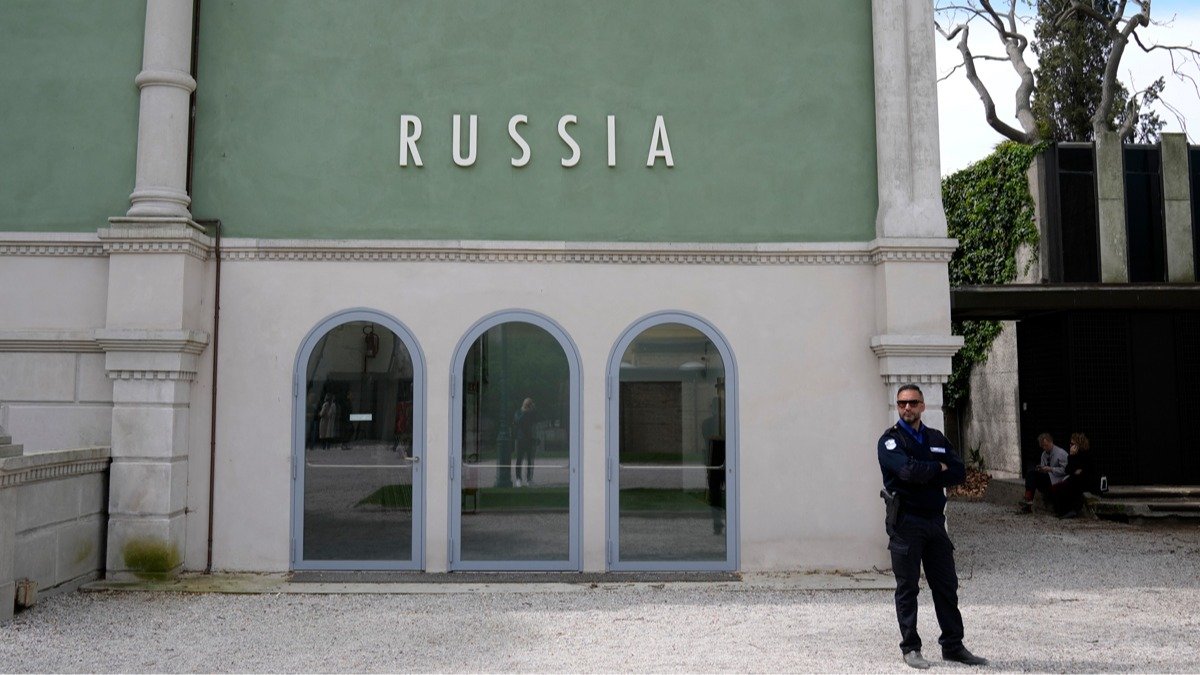
Russia will open its national pavilion at the 61st Venice Biennale of Contemporary Art. This marks the country's first participation since the full-scale invasion of Ukraine began; Russian artists withdrew from the project in 2022, and the pavilion remained closed. Russia's return has already drawn criticism, with Pussy Riot activists announcing a protest action. More details in "Novaya-Europe." Russian Pavilion, Venice, Italy, April 19, 2022. Photo: Antonio Calanni / AP Photo / Scanpix / LETA. Russian Pavilion Russia will open its pavilion at the 61st Venice Biennale of Contemporary Art. The exhibition itself will take place from May 9 to November 22 this year, under the theme 'Foreigners Everywhere.' Russia is participating for the first time since the full-scale invasion of Ukraine. In February 2022, Russian artists Kirill Savchenkov and Alexandra Sukhareva, along with Lithuanian curator Raimundas Malašauskas, withdrew from that biennale. They described the war as 'politically and emotionally unbearable,' emphasizing that 'in the context of conflict, there is no place for art,' and left the project. 'The Russian Pavilion team believes that the final word in the work on the project belongs to the artists and the curator. Kirill Savchenkov, Alexandra Sukhareva, and Raimundas Malašauskas have just announced that they will not be able to participate in the Russian Pavilion project at the 59th Venice Biennale of Contemporary Art. The Russian Pavilion will not participate in the 2022 Venice Biennale of Contemporary Art,' the pavilion's Instagram post stated. At the 2024 Venice Biennale, Russia handed over its pavilion to Bolivia and made no public comments. This year, Putin's special representative for international cooperation, Mikhail Shvydkoy, confirmed Russia's participation in the biennale, ARTnews reports. 'I would like to note that Russia has never left the Venice Biennale. The very presence of our pavilion—regardless of what happens there, whether it's exhibitions by our Latin American friends or the placement of an educational center for the entire Biennale—means the presence of our country in the cultural space of Venice. Therefore, since we never left, we are not 'returning.' We are simply seeking new forms of creative activity under the current circumstances,' he wrote in an email. He also stated that over 50 young musicians, poets, and philosophers from Russia and other countries would participate in the new pavilion project. Shvydkoy considers this proof that 'Russian culture is not in isolation and that attempts to 'cancel' it, undertaken by Western political elites over the past four years, have not succeeded': — This is precisely why we decided to create a project that features a multilingual polyphony of cultures—cultures that do not consider themselves peripheral to the West. 'The Tree Rooted in the Sky' The new Russian project at the biennale is titled 'The Tree Rooted in the Sky.' The Russian pavilion's Instagram page describes the project as a 'large-scale cultural initiative.' Organizers plan to host a 'real music festival with musicians from various regions of Russia,' as well as from Argentina, Brazil, Mali, and Mexico, inside the pavilion. The event aims to highlight the 'creative potential of peripheral territories and practices, presenting traditions, musical languages, and experimental approaches that arise far from major cultural centers,' yet precisely because of this, they retain 'authentic and innovative expressive power.' 'Through the encounter of different cultures, the project seeks to create a space for dialogue and exchange, where local roots can intertwine with global perspectives, shaping new artistic horizons and strengthening a sense of international community,' the post reads. Mikhail Shvydkoy. Photo: Dmitry Belitsky / AGN "Moscow". Shvydkoy also explained that the project's idea is dedicated to the notion that 'politics exists in temporal dimensions, while cultures communicate in eternity.' According to his description, in 'The Tree Rooted in the Sky,' 'eternity prevails over ephemeral concerns, and culture over politics.' However, as Shvydkoy emphasizes, 'not everyone can grasp this.' 'Various sanctions can be developed, and official Western institutions may be forbidden from cooperating with us, but no one can deprive Russia of its right to artistic self-expression,' he added. The biennale organizers themselves emphasized that they do not decide which countries participate in the exhibition. Shvydkoy believes they are 'ready to seek a compromise [so that the pavilion remains open], naturally, without wishing to jeopardize the work of the entire Venice Biennale.' Curator from Rostec In July 2021, Anastasia Karneeva was appointed commissioner of the Russian pavilion at the Venice Biennale for eight years. Her father, Nikolai Volobuev, has held the position of Deputy General Director of the state corporation Rostec since 2007. Until 2004, he served in the KGB and FSB, then worked as deputy head of the Russian customs service and director of special assignments at Rosoboronexport. Additionally, Volobuev is on the board of directors of the Kalashnikov concern. Anastasia is married to Moscow businessman Dmitry Karneev. According to "Proekt," from 2010 to 2017, he was the chairman of the board of the commercial bank "Khovansky," which "has been used for financial operations of the Izmaylovskaya organized crime group since the nineties." He then worked for the state company "Rossirtprom," whose enterprises "are under the influence of structures controlled by Arkady Rotenberg." Currently, Karneev owns pizza restaurants under the "Papa John's Pizza" brand. Anastasia herself is involved in business in the art sphere and beyond. She studied at Moscow State University, then at University College London. She developed Christie's auction house in Russia and promoted contemporary art with Ekaterina Vinokurova, daughter of Foreign Minister Sergey Lavrov. Together, they own the company Smart Art, which has represented the Russian pavilion at the Venice Biennale since 2019. It was after the change of organizer that Leonid Mikhelson, the owner of Novatek, promised to become the main sponsor of the project. "Taking over the pavilion was our initiative. But before we went to the auction, we approached Leonid Viktorovich [Mikhelson] and secured his support. He has known us for a long time; there is a certain degree of trust," Karneeva herself said. Anastasia Karneeva. Photo: Kirill Zykov / AGN "Moscow." Reactions After news broke of Russia's participation in the Venice Biennale, the group Pussy Riot announced a protest action. The statement claims that the biennale organizers are lying when they say the decision to admit Russia did not depend on them. It emphasizes that although the pavilion building belongs to Russia, it is located in the Italian Giardini. "The Russian Pavilion is not an embassy: it is not sovereign territory and has no diplomatic status. This means that the Italian government, the authorities of Venice, and the biennale itself can say 'no' to Russia if they wish. If Russia participates in the Biennale, it means it is a political decision by Italy," activists believe. They also note that Russia's participation in the biennale is a "serious blow to European security," as since the beginning of the full-scale invasion of Ukraine, "cultural 'soft power' has become part of Russia's military doctrine and a tool of hybrid warfare." "This is a cultural expansion of imperial Russia into the heart of Europe. Pussy Riot is coming to the biennale with an artistic intervention. We want to express unconditional support for Ukraine, the victims of Russian war crimes, Russian political prisoners, and Ukrainian prisoners of war. The best citizens of Russia are either in prison for anti-war gestures or have been killed—while Europe opens its doors to Putin's officials and propagandists," the statement reads. Russian film critic Zinaida Pronchenko also spoke out against Russia's participation in the biennale. According to her, critic Dmitry Renansky has been appointed to "conduct folk singing." Pronchenko believes he will "curate a corner for the Russia channel under an anti-colonial agenda: we are showing 'indigenous peoples,' as befits a celebration of left-wing ideas." "Hand in hand, Rostec and the Ministry of Foreign Affairs will roughly tell the West a couple of Soviet jokes about ethnic minorities. It would be very embarrassing if it weren't so funny, and there will certainly be intelligent people like Renansky himself who will defend this initiative in the name of tolerance and world peace," she wrote on her Telegram channel.
TL;DR
- Russia will participate in the 61st Venice Biennale of Contemporary Art, its first since withdrawing in 2022 due to the invasion of Ukraine.
- The Russian pavilion's project is titled 'The Tree Rooted in the Sky' and aims to showcase diverse cultural expressions from Russia and other countries.
- Mikhail Shvydkoy, Putin's special representative, confirmed Russia's participation, stating Russian culture is not isolated and the pavilion's presence signifies cultural engagement.
- The pavilion's commissioner, Anastasia Karneeva, has connections to state corporations through her father and husband, raising concerns.
- The activist group Pussy Riot announced a protest against Russia's participation, calling it a political decision and a form of 'cultural expansion.'
- Critics like Zinaida Pronchenko have expressed embarrassment and concern over the curatorial choices and the pavilion's narrative.
Continue reading the original article