March 21, 2026
Unrepentant and Unyielding. Patriarch Filaret (Denisenko) of Kyiv Dies at 98, Anathemaized by Moscow, Justified by Constantinople, and Heroized by Ukraine
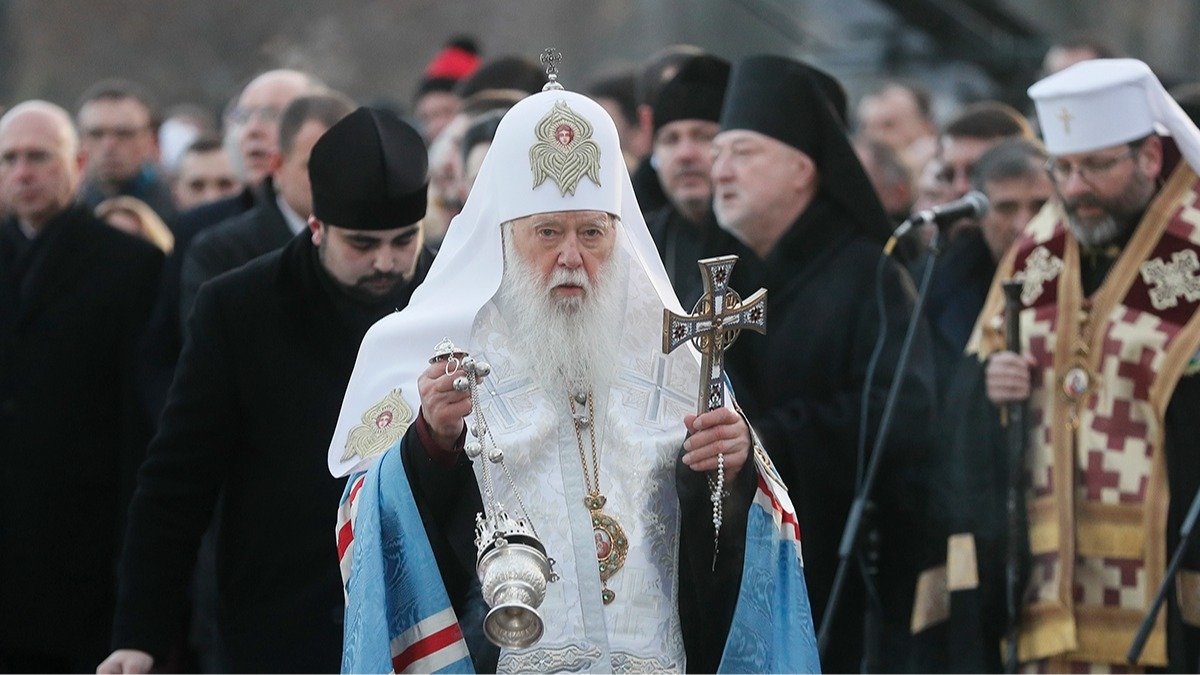
Filaret, Patriarch of the Ukrainian Orthodox Church of the Kyiv Patriarchate, prays during a memorial ceremony near the monument to the victims of the Holodomor in Kyiv, Ukraine, November 24, 2018. Photo: Sergey Dolzhenko / EPA. The biography of Patriarch Filaret (Denisenko) is a veritable textbook, or rather, a detective novel on the history of the church in the eras of the USSR and independent Ukraine. He came to faith during the time of the first Stalinist Patriarch Sergius, made a rapid church career under Alexy I, temporarily headed the Russian Orthodox Church after Pimen's death, 'went into schism' under Alexy II, and obtained the Tomos of autocephaly for the Ukrainian Church from the Patriarchate of Constantinople under Kirill. He tirelessly predicted Ukraine's victory, repeating in every sermon when battles were fought near Kyiv: 'The truth is on our side, and therefore? God is with us. And if God is with us, we will win.' It seemed that patriarchs and regimes in Moscow changed, borders were redrawn, the front moved, but Filaret remained, adapting to any historical circumstances. At the same time, he cannot be called a flexible and unprincipled person. Those who knew Filaret and worked with him describe the recently deceased patriarch as an extremely strong-willed, authoritative, and even stubborn person. Figures of such magnitude, capable of changing the course of church history, are not often encountered in this history. In Filaret's life, there was only one figure who could control his will... But let's go in order. REFERENCE 'NOVOY-EVROPY': Mikhail Antonovich Denisenko was born on January 23, 1929, in the village of Blahodatne, Donetsk Oblast (now under Russian control), to a miner's family. He turned to faith after his father's death at the front, becoming the youngest student at the Odesa Seminary (in 1946) and the Moscow Theological Academy (in 1948). At the age of 20, he took monastic vows, was ordained a hieromonk by Patriarch Alexy I, taught at the academy, and served as dean of the Trinity Lavra of St. Sergius. From 1956, he was inspector of the Saratov, and then Kyiv, seminaries; from 1958, he was rector of the Kyiv Seminary in the rank of archimandrite; from 1960, he was administrator of the Ukrainian Exarchate of the ROC and rector of St. Volodymyr's Cathedral in Kyiv. After the seminary was closed in 1961, he was sent on a foreign assignment to Egypt; on February 4, 1962, he was ordained bishop of Luga, vicar of the Leningrad diocese, managed the Riga diocese, and then was patriarchal exarch of Central Europe. In 1964–66, he was rector of the Moscow Theological Academy and Seminary, and from May 14, 1966, until his death, he held the Kyiv see, was patriarchal exarch of Ukraine of the ROC, and represented this church in various international Christian organizations. In May–June 1990, he headed the ROC as patriarchal locum tenens; in July of the same year, he became the first primate of the autonomous Ukrainian Orthodox Church within the Moscow Patriarchate. In connection with the declaration of Ukraine's independence, the council of the UOC in November 1991 demanded autocephaly (full church independence) from the ROC, but as a result of a complex political intrigue, the council of the ROC in April 1992 postponed the decision on this issue and obtained a promise of resignation from Filaret, which he did not fulfill. In May–June of the same year, in violation of the UOC's charter, he was removed from church administration, forbidden to serve, and defrocked, but with a group of his supporters, he united with the 'alternative' Ukrainian Autocephalous Orthodox Church, creating the UOC of the Kyiv Patriarchate. In October 1995, he was elected Patriarch of the UOC KP; in 1997, he was anathematized by the Synod of Bishops of the ROC. In 2018, the synod of the Ecumenical Patriarchate of Constantinople recognized this anathema as unlawful and reinstated Filaret in the rank of metropolitan, and after the creation of the unified Orthodox Church of Ukraine (OCU) in 2019, he became its 'honorary patriarch.' However, in the same year, he effectively left the OCU, accusing its primate, Metropolitan Epiphanius, of deception in the division of church power, and re-established the UOC KP, which remains extremely small and unrecognized by the Ukrainian state. At the end of last year, he signed a will forbidding the clergy of the OCU from performing his funeral service, but at the beginning of this year, he took steps towards reconciliation with them. He was the longest-serving bishop in modern Orthodoxy, with 64 years of episcopal service. Awards of Patriarch Filaret at an exhibition in St. Andrew's Church. Photo: Wikimedia. Why is Filaret a Hero of Ukraine? Not all opinion leaders in Ukraine agree with President Petro Poroshenko's decision to award Filaret the title of Hero of Ukraine. The decision was made in January 2019 on the occasion of the patriarch's 90th birthday. His biography and church policy in recent years have both sparked fierce debate. So much so that neither Ukrainian nationalists, nor supporters of 'canonicality' emanating from the Moscow Patriarchate, nor most modern Ukrainian politicians fully consider him their own. Filaret's main dogma, which he constantly reiterated in his numerous interviews, was that the structure of the church is subordinate to the structure of the state. As long as the USSR existed as a single state, Ukrainian eparchies were obliged to be part of the ROC as its single church, and when Ukraine became independent, the Ukrainian Church was obliged to separate from the ROC. This simple logic ignores the realities of the USSR itself, where, for example, the Georgian Orthodox Church remained autocephalous and was not part of the ROC. However, there is a certain consistency in Filaret's 'political theology': 'One state - one church.' Within this doctrine, Filaret categorically refused to repent for his cooperation with the KGB, where he used the pseudonym 'Antonov' (after his late father). 'In Soviet times,' he said, 'no one could become a bishop without KGB consent. Therefore, to claim that I was not involved with the KGB would be untrue. I was involved, like everyone else.' This is a pragmatic position, but it contradicts the 30th Apostolic Canon, an important norm of church canon law: 'If any bishop, making use of the secular rulers, obtains authority in the church through them, let him be deposed and excommunicated, and all who communicate with him.' It has been pointed out that the ROC, whose structures were recreated by Stalin in 1943, is built on a violation of this rule, a fact that the Russian Orthodox Church Abroad and other churches not recognizing the Moscow Patriarchate have noted. Furthermore, alternatives were possible within the ROC—though they implied renouncing a church career. For example, the renowned dissident priest Pavel Adelgeim, who was murdered in 2013, refused to be recruited and recalled how Filaret expelled him from the Kyiv Seminary for refusing to celebrate May 1st on Good Friday in 1959. 'I, the son of a miner,' said the rector-patriot, 'became an archimandrite and rector. Under what other authority could this have happened? Under whose sky do you live? Whose bread do you eat? On whose land do you walk? The Soviet government teaches you!' Despite his Ukrainian origin and the horrors of the Holodomor experienced in childhood, Filaret appears to have been a sincere patriot of his Soviet homeland, and until 1991, no one noticed any sympathy for Ukrainian culture in him. He sharply suppressed attempts to conduct services in Ukrainian in Kyiv even occasionally, and actively fought against the revival of 'nationalist' autocephalous and uniate movements, using all his connections in the Communist Party of Ukraine and the KGB. This sharply contrasts with his future main competitor—Metropolitan Vladimir (Sabodan), primate of the UOC of the Moscow Patriarchate from 1992, who from his youth collected editions of Taras Shevchenko and, still in seminary, secretly sang 'rebel' carols in his cell with other Ukrainian nationalists. Filaret's decision to support the separation of the Ukrainian Church from Moscow in 1991 was politically motivated and initiated not so much by him as by the first president of Ukraine and former secretary of the Central Committee of the CPU, Leonid Kravchuk. The following year, 1992, it was Kravchuk who conceived the idea of merging Filaret's supporters, who had left the ROC, with the Ukrainian Autocephalous Church. Patriarch Filaret pays his final respects to the 1st President of Ukraine Leonid Kravchuk at the Ukrainian House National Center, Kyiv, Ukraine, May 17, 2022. Photo: Pavlo Bagmut / SIPA / Scanpix / LETA. Filaret and Kravchuk were family friends from the 1970s, since the party leader was appointed head of the propaganda department of the Central Committee of the CPU. The fact is that, despite taking monastic vows in Stalinist times, during his Kyiv period, Filaret had a life companion—Evgenia Petrovna Rodionova, with whom he described their relationship as 'brother and sister.' According to Kyiv legend, Rodionova rejected Misha Denisenko when he was still a seminarian in Odesa and planned to become a married priest, but she regretted her decision and was able to 'fix everything' when hieromonk Filaret (also agent 'Antonov') began his dizzying career in the 1950s. Filaret and Evgenia Petrovna lived in the same apartment on Volodymyr Street; they had three children whom they called adopted (but the children themselves were not sure). Rodionova was called the 'mistress of Kyiv'—she influenced all important decisions in the Ukrainian Exarchate of the ROC, and during services, she stood in the sanctuary of the altar of St. Volodymyr's Cathedral, where even bishops were obliged to kiss her hand. Evgenia Petrovna died in 1998, and the clergy of the UOC KP saw how painfully Filaret took her passing... Constructing his new jurisdiction—the UOC KP—Filaret copied the style and atmosphere of the Moscow Patriarchate, which was dear to him. Formally, the church adopted Ukrainian as the language of worship, but Filaret re-translated liturgical texts (and even the Bible) into a more modern version of Ukrainian, closer to Russian, donned the white klobuk of the Moscow Patriarchs, and added the phrase 'of All Rus' to his title, and so on. In Filaret's sermons and interviews, there was none of that poignant sense of 'Ukrainicity' that permeates the atmosphere of the autocephalous or Greek Catholic churches. His style more closely resembles that of a functionary choosing the optimal political path under the influence of changing external factors. Key stages of his biography that forced him to adjust this path include World War II, the collapse of the USSR, the Kyiv Maidan events of 2004 and 2014, and the subsequent attempts to gain recognition for the UOC KP from world Orthodoxy (unsuccessful under Yushchenko and successful under Poroshenko, culminating in the Tomos of autocephaly). Ukrainian President Petro Poroshenko speaks with Patriarch Filaret of the Ukrainian Orthodox Church of the Kyiv Patriarchate during a prayer service on the occasion of the 1000th anniversary of the death of Volodymyr the Great in St. Volodymyr's Cathedral in Kyiv, Ukraine, July 28, 2015. Photo: Roman Pilipey / EPA. Filaret's first opportunistic mistake—losing the election for Moscow Patriarch in 1990—he managed to turn to his advantage, becoming Kyiv Patriarch and leader of the movement for the independence of the Ukrainian Church. The second, made at the age of 90 in 2019, when he withdrew from the newly recognized OCU of Constantinople and announced the revival of the UOC KP, proved fatal: the 'revived' patriarchate remained a marginal group, unrecognized by the state and represented, in essence, only by the aging Filaret. In the last years of his life—at least, after the Tomos of autocephaly—Filaret was no longer an active church politician but remained a symbol. In this capacity, he is even more in demand and instrumental after death than during his life. Why the ROC Anathematized Filaret and Constantinople Justified Him If Filaret's dream of becoming Patriarch of Moscow and All Rus' had come true in 1990, it is quite possible that he would have led the ROC for all these 36 years, and the Russo-Ukrainian war would not have happened. After all, the only, albeit flimsy, ideological platform for attacking Ukraine is Patriarch Kirill's doctrine of the 'Russian world,' which denies Ukraine's subjectivity. The 1990 ROC council, which elected a new patriarch, broke the Soviet church-administrative model, within which the patriarchal locum tenens always became patriarch (this model was restored by Kirill Gundyaev in 2009). As compensation for his defeat in the elections, the new Patriarch Alexy II granted Filaret the status of primate of the 'independent and self-governing' Ukrainian Orthodox Church within the Moscow Patriarchate—a very loose status that laid a mine under church unity in Ukraine. Later, Filaret recalled that even at that stage, Metropolitan Kirill (Gundyaev), who was closely linked to that part of the political and KGB elite in Moscow obsessed with an imperial syndrome, was hindering the UOC's independence in every way. Filaret addresses believers during a mass prayer on the square in front of St. Sophia Cathedral in Kyiv, Ukraine, October 14, 2018. Photo: Stepan Franko / EPA. After the proclamation of Ukraine's independence on August 24, 1991, Filaret convened the first Local Council of the UOC, at which all bishops, including the current primate of the Moscow Patriarchate structure in Ukraine, Onufriy (Berezovsky), signed an appeal to the ROC for the granting of full autocephaly to the Ukrainian Church. In Moscow, they promised to consider the appeal but began to drag their feet, observing how the new political situation would unfold. Simultaneously, compromising material about Filaret, mainly concerning E. P. Rodionova and children, as well as his cooperation with the KGB, leaked to the press from the Moscow Patriarchate. By the spring of 1992, the political course in Moscow prevailed towards 'keeping Ukraine' in its orbit, and Patriarch Alexy II skillfully reoriented the council in April 1992 from considering the issue of UOC autocephaly to discussing Filaret's 'personal case.' He was not defrocked at that time only because Filaret threatened to expose the 'gay lobby' in the leadership of the ROC (whom he opposed), but the council obtained a promise from the Kyiv Metropolitan to resign and convene a council in Kyiv to elect a new primate of the UOC. Returning to Kyiv and relying on President Kravchuk's support, Filaret refused these promises, stating they were extracted by force. The ROC interprets this act as 'breaking an oath.' In violation of the UOC Charter, Patriarch Alexy II instructed Metropolitan Nikodim (Rusnak) of Kharkiv to convene a council of Ukrainian bishops loyal to Moscow at his residence. At this council, Filaret was dismissed and forbidden to serve, and Metropolitan Vladimir (Sabodan), who had served outside Ukraine, was elected the new primate. From a legal standpoint, this council was invalid, but the Ukrainian state gradually recognized its results, fearing an escalation of relations with Moscow and internal unrest among believers. The ROC council in June 1992 'defrocked' Filaret, who at the same time united with the Ukrainian Autocephalous Orthodox Church, creating the UOC KP under the nominal leadership of the 90-year-old Patriarch Mstyslav (Skrypnyk), who resided in the USA. Contrary to the predictions of skeptics and despite all attempts to discredit Filaret, his new project began to gain strength: in the western regions of Ukraine (Volyn, Galicia), the majority of Orthodox parishes joined the UOC KP, and there were quite a few in the center, mainly in the Kyiv region. By the events of 2014, the ratio of UOC MP and UOC KP parishes was already approximately 2:1. Become a co-participant of 'Novaya Gazeta' Become a co-participant of 'Novaya Gazeta,' subscribe to the newsletter and receive emails from the editorial office Subscribe In essence, the success of Filaret's project and his election as patriarch in 1995 gave Moscow reason to fear that world Orthodoxy, centered in Constantinople, would gradually recognize the new national church. 1997 saw another exacerbation of relations between the ROC and the Patriarchate of Constantinople, leading to a temporary break in canonical communion over the division of parishes in Estonia. Playing preemptively, the 1997 Synod of Bishops of the ROC decided to anathematize Filaret (along with dissident priest Gleb Yakunin). However, since 1992, Filaret's appeal against the decisions of the Moscow council had been pending in the Patriarchate of Constantinople, and Constantinople has the canonical right to adjudicate disputes between hierarchs and their patriarchates. This appeal was acted upon in 2018 when Ukrainian President Petro Poroshenko managed to reach an agreement with Patriarch Bartholomew of Constantinople to grant autocephaly to the Orthodox Church of Ukraine, formed from three parts: the UOC KP, the UAOC, and a group of eparchies of the UOC MP. Although Constantinople recognized the ROC's punishment of Filaret as unlawful (no canonical investigation was conducted, and Moscow's jurisdiction over Kyiv is unlawful anyway), it imposed a condition on the Ukrainian leadership: Filaret was not to be the head of the united church. The primate of the united OCU would be Filaret's former deputy, Metropolitan Epiphanius (Dumenko). Later, Filaret claimed that directly at the unification council in Kyiv on December 15, 2018, Epiphanius and Poroshenko gave him guarantees that the elderly patriarch would continue to effectively manage the church, and Epiphanius would only represent it 'externally'—to avoid angering Constantinople. However, in reality, by early 2019, Filaret was sidelined, becoming a staunch critic of the Tomos and Constantinople as a whole. Patriarch Filaret surrounded by members of the Ukrainian Parliament, U.S. Capitol in Washington, D.C., USA, February 5, 2015. Photo: Jim Lo Scalzo / EPA. Considering himself an experienced politician, Filaret bet on Volodymyr Zelensky, who criticized Poroshenko on all points, including church policy. During his election campaign, Zelensky indeed made gestures towards Filaret, but upon becoming president and understanding the real balance of church forces, he supported the OCU, which was rapidly gaining ground (parishes) amid the war and had the recognition of world Orthodoxy, including its influential American part. Thus, Filaret's gamble did not pay off, and he spent the last seven years of his life in almost complete canonical isolation, serving, as long as his strength allowed, in St. Volodymyr's Cathedral in Kyiv, which was not taken away from him out of mercy and respect for his past merits. Since 2019, Filaret's structures in Ukraine have not had state registration. St. Volodymyr's Cathedral and Filaret's residence at 36 Chykalenko Street in Kyiv were placed under police guard on the day of his death, March 20. Newly ordained bishops by Filaret, who arrived in Kyiv to elect a locum tenens, could not hold a synod meeting. Control over the official website of Filaret's UOC KP also passed to supporters of the OCU. The body of the newly deceased patriarch was solemnly delivered to St. Michael's Golden-Domed Monastery, the residence of the head of the OCU, Metropolitan Epiphanius. This happened despite the fact that in October of last year, Filaret signed a spiritual testament on video, forbidding OCU bishops from performing his funeral service. However, already at the beginning of this year, control over the weakened Filaret passed to his relatives: Inna Denisenko, who calls herself a doctor, and Dmitry Kurylenko, who brought him to the Golden-Domed Monastery in January to 'make peace' with Epiphanius. He performed his last service with great difficulty on Christmas, January 7 of this year. Representatives of the OCU had already reached an agreement with Filaret's relatives last year—images from Metropolitan Epiphanius's first memorial service over the patriarch's body show him placing these relatives next to him, at the front of the clergy. Ukrainians at the farewell ceremony for Patriarch Filaret at St. Michael's Golden-Domed Cathedral in Kyiv, Ukraine, March 20, 2026. Photo: Sergey Dolzhenko / EPA. According to sources of 'Novaya Gazeta Europe,' not everyone in the small UOC KP is ready to accept the 'usurpation of the body and legacy' of the deceased patriarch by his former rivals from the OCU. But the forces are too unequal; the remnants of the Kyiv Patriarchate have no resources to retain the quite expensive cathedral and residence in the center of Kyiv, as well as the church treasury. The Kyiv Patriarchate project can be considered complete—this phenomenon has entered history solely with the name of Filaret. It is a unique case where the scale of one personality turned out to be larger than the scale of an entire church jurisdiction. But Filaret's dreams and aspirations were not baseless—perhaps, at some new turn of church history, they will once again be in demand.
TL;DR
- Filaret Denisenko, Patriarch of the Ukrainian Orthodox Church of the Kyiv Patriarchate, lived a life deeply connected to the political and religious shifts in Ukraine from the Soviet era to independence.
- His career saw him rise through the ranks of the Russian Orthodox Church, eventually leading a schism to establish an autocephalous Ukrainian church.
- He was anathematized by the Russian Orthodox Church in 1997 but later had this nullified by the Ecumenical Patriarchate of Constantinople in 2018.
- Filaret's principle was 'one state - one church,' aligning church structure with state independence, a view that often placed him at odds with Moscow.
- His later years were marked by a withdrawal from the unified Orthodox Church of Ukraine and a return to leading a marginalized UOC KP, with his legacy being a subject of ongoing debate.
Continue reading the original article