February 19, 2026
Out of Reach. Russian Military Without Starlink and Telegram. How the blocking of terminals and disruptions in the messenger's operation affect the front line
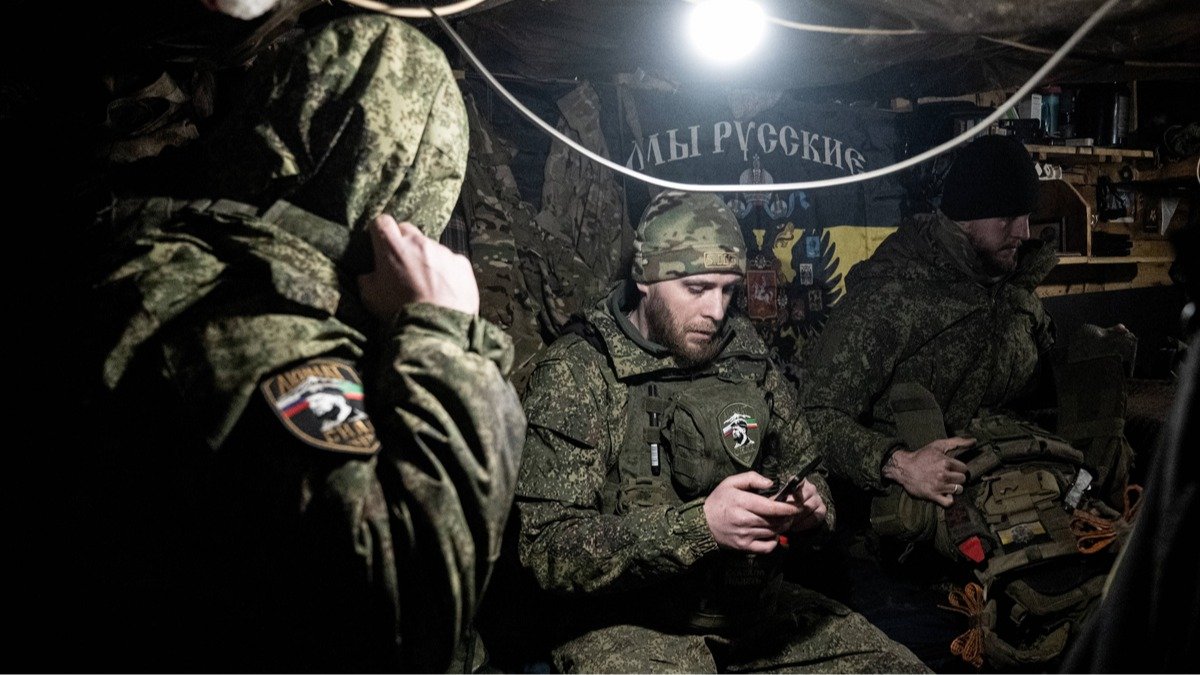
After Elon Musk disabled Starlink terminals for Russian troops and the Kremlin authorities began to slow down Telegram, the Russian army's offensive slowed down, while the Armed Forces of Ukraine, on the contrary, went on the counteroffensive in some sectors of the front. "Novaya Gazeta Europe" tried to find out what Russians are replacing American satellite communications with and how they plan to manage without their usual messenger. Russian servicemen in the Sumy direction, February 10, 2026. Photo: Sergey Bobylev / Sputnik / Scanpix / LETA. Minister of Digital Development, Communications and Mass Media of the Russian Federation Makus Shadaev stated at a meeting of the State Duma Committee on Information Policy that the Russian authorities decided not to restrict the operation of the Telegram messenger in the special operation zone for now. "But we hope that in some time our military will be able to reconfigure and switch to Russian services," said the official. According to Shadaev, at the beginning of the special operation, the military used Telegram as it was considered an anonymous service. However, as the official stated, today there are many facts indicating that foreign special services have access to correspondence in this messenger, and they use the obtained data to conduct combat operations against the Russian army. Deputy Minister of Defense of the Russian Federation Alexey Krivoruchko, in turn, denies that the disabling of Starlink terminals had a significant impact on the command and control system of the Russian troops in the combat zone. "Starlink terminals have been disabled for two weeks now, but this has not affected the intensity and effectiveness of unmanned systems troops, which is confirmed by objective control data on the destruction of enemy equipment and manpower," said Krivoruchko. According to the deputy minister's statement, Starlink in the "SVO" zone was used only by individual units of the Russian Armed Forces, using the satellite system primarily to mislead the enemy. Telegram is "slowing down." "Communication has never been a strong point of the Russian army, and many initiatives of the Ministry of Defense of the Russian Federation in this area have not been fully implemented," says a military analyst from The Conflict Intelligence Team (CIT) to "Novaya-Europe," who agreed to communicate on condition of anonymity. "During the war, life has forced all these processes to be established, especially where life depends on communication, as the military themselves are interested in this. Telegram was traditionally popular in the Russian Federation, so most people have this messenger. It is undemanding to the devices it is installed on and to the quality of communication, and it also has a large set of functions. So, it can be said that the Russian military until recently did not have much choice. Other messengers can be used to replace Telegram, as there is no fundamental difference. It will just be slower, more inconvenient, and without some convenient set of functions. Plus, it will take time for everyone to switch to the new messenger, share contacts, create groups, and so on. Well, the question remains open as to how completely Telegram is blocked. For now, as we understand it, it is still working to some extent." A source in the Russian armed forces tells "Novaya-Europe" that despite Deputy Minister Shadaev's statements, Telegram continues to "slow down" in his unit, with images and videos loading very slowly. At the same time, the military is in no hurry to switch to the MAX messenger imposed by the authorities. The main reason is the promised transparency of the messenger: not everyone wants the command to be able to fully control communication on the front lines. "On the ground, we often see better which orders from the headquarters need to be followed and which ones should be postponed," says a Russian officer. "Besides, events often happen at the front that generals are better off not knowing about. Reports sent to superiors do not always reflect the real combat situation. If this comes to light, many commanders will lose their stars, and some will go to court. So, for now, their own command represents a more serious and real danger, while the machinations of the enemy's digital intelligence remain an ephemeral threat." Starlink terminal. Photo: Nina Lyashonok / Ukrinform / ddp / Scanpix / LETA. No Analogues "For a long time, almost all front-line interaction and communication in the Russian troops were based on the use of 'gray' Starlink terminals as the primary means of communication," says Alexander Kovalenko, a military-political observer for the "Information Resistance" group, to "Novaya-Europe." "At the same time, the use of Starlink is impossible in Russia itself; it is programmatically blocked within the country. But as soon as the terminal approached the border with Ukraine, it started working. The presence of 'gray' Starlink terminals in Ukraine allowed Russian troops to organize not only high-quality satellite communication between their units but also to actively use them for strikes deep into Ukraine's rear. Almost all assault operations of Russian small tactical groups were carried out within stable communication via Starlink. The entire offensive campaign of the Russians in 2025 was tied to the use of this means of communication." In addition, Alexander Kovalenko says that in late 2025 and early 2026, Russian troops began to actively use Starlink terminals for deployment on tactical-level strike drones Molniya-2, on Shahed-136 kamikaze drones, BM-35 "Italmas," as well as decoys like "Gerber." This made Russian drones invulnerable to electronic warfare and allowed operators to control them in real time with minimal signal delay. Thus, according to Alexander Kovalenko, having lost stable satellite communication, the Russians, despite trying to use their own equipment, failed. For one simple reason: Russia has no analogue to Starlink. There are only communication systems of previous generations, significantly inferior in quality to Starlink, and therefore unable to fully replace it. Currently, the Russian army is switching to classic combined-arms communication, trying to establish communication between units both at the 2022 level and taking into account modern trends. In particular, Russian troops are actively building WiFi bridges and switching to satellite internet based on Yamal and Express satellites. In addition, tests of stratospheric 5G platforms of the "Barrazh-1" project have begun. Alexander Kovalenko claims that Russia, critically dependent on NATO technologies in military matters, suddenly found itself cut off from their use and began to sharply "sag" at the front. All the solutions that the Russian command is currently trying to find will, of course, help them restore communication, but they will never achieve the quality level of Starlink. The Russian troops have been thrown back a generation in communication matters, and this has immediately affected their position on the battlefield. In turn, the Ukrainian troops took advantage of this situation in a timely manner, thereby disrupting the Russians' medium-term plans for preparation for the spring-summer offensive. Sow Chaos "Starlink was not only the basis of combined-arms communication for the Russians, actively used at all echelons, from the front line, the near rear zone, and deeper, but also provided Russian troops with systematic strikes into Ukraine's rear," continues Alexander Kovalenko. "Its disabling sowed real chaos in the Russian troops and disorganized them for a certain period. And it was precisely this that the Ukrainian troops took advantage of, launching systematic counterattacks that allowed them to achieve certain successes at the tactical level. As a result, the Russian army was pushed back in the Dnipropetrovsk region from Novoaleksandrivka, Verbove, and Vishneve. In Zaporizhzhia, the Russians were not only driven out of the outskirts of Ternovate and Kosovtseve but also pushed to the left bank of the Gaychur River. In the Stepnohirsk region, the Russian army was driven out of Prymorske and Lukianivka, where they were trying to consolidate in the area of the "Stepnohirsky" landscape reserve." "As for Starlink, the Russians are using all other available means to provide internet," says a CIT analyst. "Where the situation allows, they are laying fiber optic cables to headquarters and command posts. Where not, they can establish radio bridges, in particular, Ubiquiti system equipment is quite common, as well as mesh networks, including with the help of UAV relays. All this, of course, is less convenient, requires significant labor costs, and can also be much easier to detect and destroy. But the Russian army will not be left without the internet. There is also a Russian analogue of Starlink from Gazprom, but it is very much inferior in all characteristics and cannot be a full replacement. In addition, the Russians are trying to technically bypass the blocking of Russian terminals. It's hard to say how successful. The Russian side is also trying by all means to register its terminals in the Ukrainian "white lists."" Russian serviceman preparing a drone at a training ground in the Rostov region, October 24, 2025. Photo: Sergey Pivovarov / Sputnik / Scanpix / LETA. Communication problems, according to CIT analysts, increase the reaction time of commanders in units where the internet has not been established. At the lowest level (assault soldier - his commander), communication is almost always via radio, so there are no changes here. But when transmitting video from all UAVs to command posts or exchanging information between headquarters, broadband internet is crucial. Thus, in the absence of the internet or its low quality, commanders' situational awareness will decrease; they will not be able to understand in real time how the situation is unfolding in their section of the front, where the enemy is attacking, what orders need to be given, where forces should be deployed, what coordinates to provide to fire support assets. But in the end, all this will be done, just with a delay and not as effectively. Full control over troops and the battlefield will not disappear anywhere. CIT analysts do not directly link the slowdown in the Russian offensive to problems in the sphere of the internet. In January-February, according to our interlocutor, the Russian army traditionally takes an operational pause, preparing for the campaign that lasts from the end of March until the end of the year. So, the reduction in Russian attacks is primarily due to this. The Ukrainian Armed Forces, in turn, used local counterattacks throughout 2025 when the situation in a particular sector of the front was favorable for this (liquidation of the breakthrough near Dobropillya, clearing Kupyansk). "Probably, communication problems have added to the headaches of the Russian Armed Forces and did not allow them to act as effectively and promptly as if these problems did not exist," says the CIT analyst. "But this is definitely not a critical element in what is happening."
TL;DR
- Russian military operations are affected by the disconnection of Starlink terminals and the slowdown of Telegram.
- Ukraine has used this disruption to launch counterattacks.
- Russia lacks a direct equivalent to Starlink and is resorting to older communication systems and methods like fiber optics and radio bridges.
- Telegram's slowdown is due to concerns about foreign intelligence access and the military's reluctance to use transparent messengers controlled by command.
- While communication issues are a factor, analysts suggest a traditional operational pause in January-February is also contributing to the reduced Russian offensive.
Continue reading the original article