March 16, 2026
Film about 'changes in schools since the start of the SMO'. How Russia and the world reacted to the Oscar win of 'Mr. Nobody Against Putin'
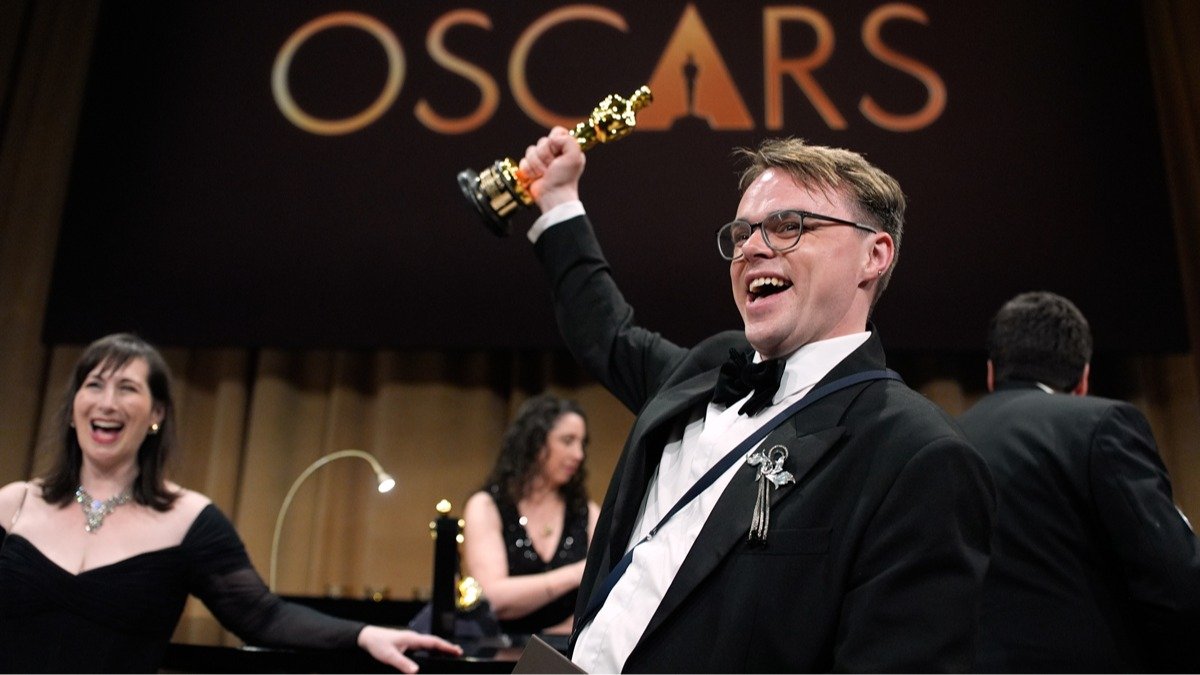
The documentary 'Mr. Nobody Against Putin' about militaristic propaganda in Russian schools won an Oscar for Best Documentary Feature. The creators of the film are American director David Borenstein and Pavel Talankin, a former videographer from School No. 1 in Karabash, Chelyabinsk Oblast, who left Russia. At the ceremony, Talankin called for an end to all wars, and Borenstein drew parallels between the situation in Russia and the US. While the world pays attention to the film's significance and the creators' pacifist speeches, pro-government Russian media ignore the award. Russian publications either distort the film's essence or remove materials about it. 'Novaya-Europe' reports on the reactions to 'Mr. Nobody''s victory. Director Pavel Talankin, Oscar winner for Best Documentary Feature for 'Mr. Nobody Against Putin', Los Angeles, USA, March 15, 2026. Photo: John Locher / AP Photo / Scanpix / LETA. Reaction in Russia Pro-government Russian media and propagandists ignored the Oscar win of 'Mr. Nobody Against Putin.' As noted by 'Agentstvo,' 'Perviy Kanal,' 'Rossiya 1,' and NTV did not report on the event in their morning news broadcasts. Instead, they focused on other topics, including the Paralympics closing ceremony in Italy, the 12th anniversary of Crimea's annexation, the wars in Ukraine and the Middle East, and a referendum in Kazakhstan. State agencies TASS and RIA Novosti published notes on the Oscar winners in major categories and noted that Russian animator Konstantin Bronzit did not receive an award for his animated short film. Both agencies completely ignored the Oscar award for 'Mr. Nobody Against Putin.' TASS also quoted State Duma deputy Nikolai Burlyaev, who called the statuette a 'yellow lump' that is 'improper' to receive. 'Interfax' also did not pay attention to the Best Documentary Feature category but reported on Bronzit. 'Kommersant' briefly wrote about the film's win, stating that Talankin, while working at the school, 'filmed the changes in the educational process after the start of the Russian military operation in Ukraine.' RBC also distorted the film's essence, saying the film 'tells about the changes in Russian schools that occurred after the start of the military operation in Ukraine.' The Telegram channel 'Ostorozhno, Novosti' characterized the film similarly: 'A picture about the changes in Russian schools that occurred after the start of the SMO' and 'a film criticizing the actions of the Russian authorities to control public opinion among children during the SMO.' 'Vedomosti' reported, citing Putin's press secretary Dmitry Peskov, that the Kremlin 'is not familiar with the Oscar-winning film about Putin.' The publication stated that Talankin secretly filmed what was happening at the school and recorded changes in the educational process. Photo: David Borenstein Pavel Talankin / Made in Copenhagen. The propagandistic conservative publication 'Tsargrad' did not explain what the film was about, and another pro-Russian media outlet 'Ura.ru' published a headline: 'Film about President Vladimir Putin received an award at the Oscars.' After some time, as noted by 'Novaya-Evropa,' the material was removed. In another article, 'Ura.ru' expressed the opinion that the film is 'scandalous.' The Chelyabinsk publication 74.ru called the film 'anti-Russian': 'Filming for the project was done secretly, and the students' parents were not delighted with what they saw. However, like the residents of Karabash. The picture that caused dissatisfaction became the best documentary film according to the American Film Academy,' the material reads. Initially, Talankin filmed only officially as an organizer and videographer, documenting 'Conversations about what matters,' assemblies, and other patriotic events for reporting to the Ministry of Education. Simultaneously, he gathered material for a documentary about propaganda. Relatives of some children, as 'Novaya Vkladka' found out, are indeed unhappy with the film, but not all: many say the picture is socially significant. The Chelyabinsk edition of 'Moskovsky Komsomolets' initially published the news under the headline 'Scandalous film, secretly shot in a Karabash school, received an Oscar,' but later removed it, as noted by 'Agentstvo.' The publications Shot and Baza did not publish any news about the event. The Telegram channel Mash did not mention the winner in the Best Documentary Feature category in its list of award recipients. However, the publication noted winners in technical and minor categories, such as Best Sound and Best Costume Design. Propagandist Tina Kandelaki, in her post stating that 'Hollywood remains leftist, anti-Trump, and politically correct,' listed the Oscar winners but did not mention the film by Talankin and Borenstein. A post about the winners on Ksenia Sobchak's Telegram channel also did not mention the win of 'Mr. Nobody.' On the Kinopoisk platform (owned by Yandex), the film is listed among the Oscar winners under its original English title without translation ('Mr. Nobody Against Putin'). This is despite all other film titles presented at the Oscars being adapted into Russian. The film is also not in the service's database; a separate page has not been created. The website 'Kino-teatr.ru' mentions the win of 'Mr. Nobody' but says nothing about the film itself. World Reaction The Guardian notes that 'Mr. Nobody Against Putin' is evidence of how children in Russia are drawn into war propaganda. The publication detailed the speeches that were a central event of the ceremony. Borenstein spoke about how 'a country is lost' through 'countless small acts of complicity.' He also compared the situation in the US and Russia, expressing the opinion that 'Trump is moving much faster than Putin in his early years.' 'When we are complicit, when the government kills people on the streets of our big cities, and we are silent, when oligarchs seize the media and control how we can produce and consume information, we all face a moral choice. But, thankfully, even 'nobody' can be more powerful than you think,' Borenstein said from the stage. Photo: David Borenstein Pavel Talankin / Made in Copenhagen. The publication emphasizes that this is the third time in a decade that an Oscar in this category has gone to a film criticizing the Russian government. Previously, 'Navalny' (2023) and '20 Days in Mariupol' (2024) won. Talankin himself gave a pacifist appeal from the Oscar stage: 'For four years, we have looked at the starry sky and made the most important wish. A very important wish. But there are countries where instead of falling stars, bombs fall from the sky and drones fly. In the name of our future, in the name of all our children - let's stop all wars! Now.' The relevance of the creators' speeches was noted by international publications such as The New York Times, The Washington Post, and Associated Press, the latter noting that Talankin is 'a teacher who spoke out against the war in Ukraine.' As Reuters wrote, the film 'tells the story of a young Russian school teacher waging a quiet resistance to Russia's war against Ukraine.' The BBC notes that Talankin 'quietly spoke out against Putin's war machine': 'The man who called himself 'Mr. Nobody' became 'Mr. Somebody' in Hollywood.' The American trade publication Deadline wrote that the documentary, 'telling the story of a humble Russian educator who challenged the Kremlin,' made a 'real breakthrough.' Ukrainian media also reported on the award. 'Ukrainska Pravda' noted that the teacher-videographer, who 'filmed war propaganda in a Russian school,' spoke in Russian on stage and called to 'stop all wars.' 'Suspilne' writes that, on the one hand, the film shows how Russian propaganda spreads to all segments of society in Russia and how school teachers become complicit in the regime. 'On the other hand, it is sad to admit that the stories of 'opposition' Russians still find more emotional and financial support and understanding in the West than the stories of Ukrainians, who are the unconditional victims of this war and the only ones who truly feel resistance to Russian colonialism,' the article states. Kyiv Independent journalist Myroslava Chairna believes the film 'indulges the infantilism of ordinary Russians': 'I did not notice any attempts at resistance in the film itself. What I did notice was the canonical image of the 'good Russian'—emotionally appealing to a foreign audience and convenient for empathy,' she wrote.
TL;DR
- The documentary 'Mr. Nobody Against Putin' received the Oscar for Best Documentary Feature.
- The film, co-directed by David Borenstein and Pavel Talankin, exposes militaristic propaganda in Russian schools.
- Pro-government Russian media largely ignored the film's Oscar win, with some outlets distorting its message or removing coverage.
- International media, including The Guardian, The New York Times, and BBC, covered the win extensively, highlighting the film's critique of Russian propaganda and the creators' speeches.
- Co-director Pavel Talankin, a former Russian school videographer, called for an end to all wars during his acceptance speech.
- Some Ukrainian media outlets praised the film's message but questioned the Western focus on Russian opposition stories over Ukrainian victimhood.
- Critics like Myroslava Chairna argued the film presents a 'good Russian' narrative convenient for foreign audiences.