April 19, 2026
The Babylonian Ribbon. Why Elon Musk, Imposing Right-Wing Ideology, Made Twitter Speak All Languages
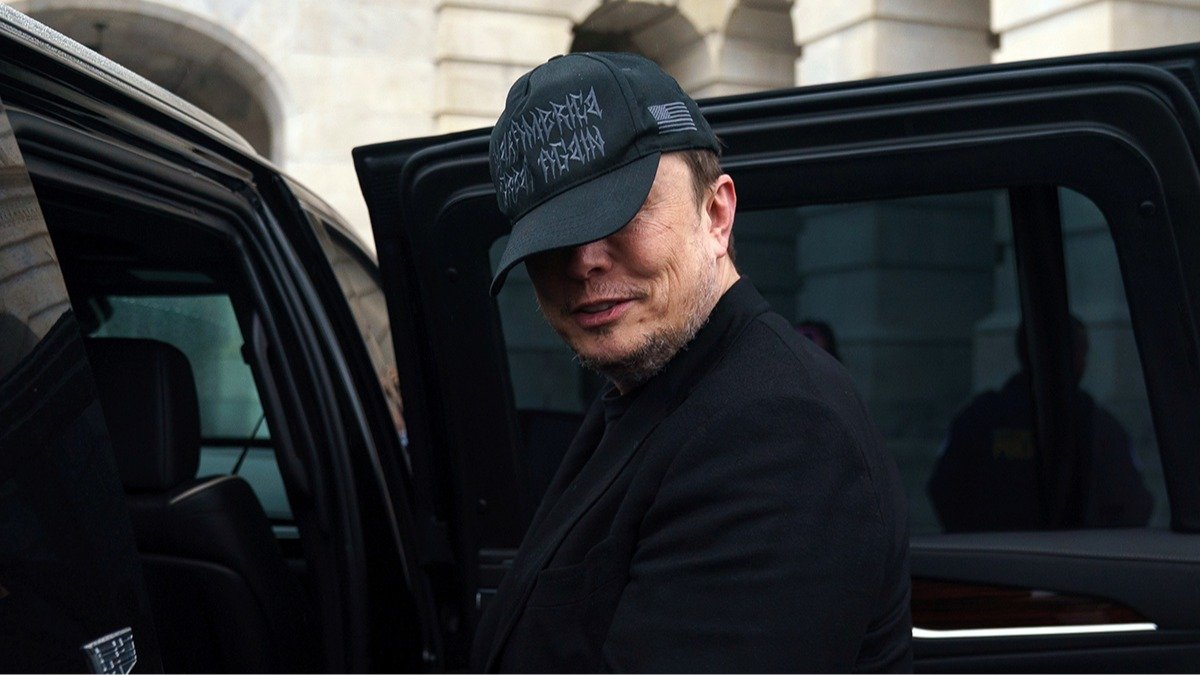
Elon Musk leaves the US Capitol in Washington, DC, USA, May 21, 2025. Photo: Will Oliver / EPA. In the Russian-speaking segment of X (Twitter) in early April 2026, the term "Babylonian Ribbon" emerged – as a response to the mass implementation of the automatic post translation function, powered by the Grok neural network. The "sign inversion" in the biblical story of the Tower of Babel, where people stopped understanding each other due to the confusion of languages, is a hallmark of Russian-language self-irony. After all, Elon Musk "destroyed" not communication, but precisely language barriers. Now the user feed is filled with posts from all over the world, and the quality of AI translation has reached such a high level that it requires philological intuition to realize that you are reading not an original text from a compatriot, but the confession of a strange Japanese or Chilean. People react to the innovation differently: some with admiration welcome the unprecedented expansion of the audience and the opportunity to communicate without regard for languages. Others grumble discontentedly, like in the old Odesa anecdote about the tailor Shlema, who, due to his pathological resemblance to Karl Marx, was forced by the party committee to shave off his sideburns and beard, to which Shlema reasonably replied: "Shaving the beard is not a problem, but what will I do with my ideas?" " And it's true: the fact that a Japanese person will express their thoughts in Russian in my information field does not stop them from being Japanese, with all the unique trail of samurai originality. In this column, I would like to reflect on the place of the "Babylonian ribbon" in the broader context of social experiments to create "filter bubbles," which have been conducted in Web2 for over 20 years. To what extent does it continue the course towards deepening the effect of "social stroking," or, conversely, does it destroy the usual "coziness" of closed circles, which we have all so eagerly built with the help of new information technologies. Let's start with the "Babylonian ribbon" itself. The function began to be actively deployed worldwide in April 2026. The launch was officially announced by X Product Lead Nikita Bier. Key features of the technology: Grok, unlike old translation systems (like Google Translate), uses contextual understanding. It handles slang, memes, and specific "Twitter" language better, trying to preserve the author's irony and emotional tone; the translation function in X is enabled by default, meaning posts in foreign languages are displayed immediately in your interface language; a small label "Automatic translation by Grok" appears above the post. Next to it is a gear icon ⚙️, through which you can disable the function for a specific language or entirely. There is also an option to click "Show original" to see the text in the author's language. The key point here, in my opinion, is the automatic translation by default. We've already seen this on YouTube, where initially there was no option to disable the auto-translation feature in the interface. And this circumstance almost drove me to become a Luddite. On all my devices, operating systems, and social networks, the interface language is set to English (as it has been since 1990, when I first sat down at a computer), so Google stupidly and forcibly translated all Russian-language channels into English. And it was unbearable. Photo: Koshiro K / Alamy / Scanpix / LETA. It seems that at some point the streams of indignation reached a threatening quality, so Google had to back down and allow users to choose which languages to broadcast in. On Twitter, firstly, although automatic translation is enabled by default, it is initially disabled. Secondly, Grok's stylistic talents, reinforced by the lack of need to work in real-time audio mode (as with YouTube's simultaneous interpretation), create a unique effect of authenticity. In the vast majority of cases, X users cannot tell from the text itself that it is not a native speaker's statement, but its translation. Let's now see how the "Babylonian ribbon" fits or does not fit into the reality of "filter bubbles." The phenomenon of hidden personalization of information for social media users was first noticed by Eli Pariser, executive director of MoveOn.org. In 2011, he published the book "The Filter Bubble: What the Internet Is Hiding from You" (Russian translation "Behind the Filter Wall: What the Internet Is Hiding from You"), from which millions of readers worldwide learned that, as it turns out, reality as presented in their social media feeds has very little to do with true reality. At some point, Pariser writes, he noticed that his friends with conservative views began to disappear from his Facebook feed. At the same time, he asked two friends to Google the brand "BP" (British Petroleum) during the oil spill in the Gulf of Mexico. One received news about investments, the other – information about the environmental disaster. " This discovery became the starting point for understanding that objective output no longer exists, and information filtering depends on a) your views and b) automatic algorithms that simultaneously care about both your psychological comfort and the growth of the parent corporation's revenue (by maximizing clicks). As a result, inhabitants of the digital world have long settled in "personalized information spaces" where only pleasant stories, "correct" views, and the only "fair" assessments of events circulate. Everything that does not fit the understanding of correctness and pleasantness is kindly discarded from the feed. Such personalized information spaces were called "echo chambers." The first question to ask today in the context of our topic is: "To what extent does the "Babylonian ribbon" serve to deepen the "filter bubble"? Or vice versa: does it destroy the bubble and release ordinary people into freedom?" Freedom is dismissed outright: although Eli Pariser blamed corporate culture and its automatic algorithms for all the ills, the real inspirer of the "filter bubble" was the digital information consumer himself, who scoured the internet in search of precisely those texts, articles, posts, and statements that confirmed his a priori point of view, and contemptuously rejected any "dissent." As for corporate algorithms, they merely obediently fulfilled the wishes of buyers in the spirit of capitalism's main commandment: "Different strokes for different folks" (this translates perfectly into Russian with the saying "we Tatars don't care...", but it's indecent further, so google it yourself). A van in Whitehall with a sign demanding a ban on the X platform, following a scandal involving the introduction of Grok technology, London, UK, January 14, 2026. Photo: Michael Melia / Alamy / Scanpix / LETA. In short, the ordinary person does not perceive their echo chamber as a lack of freedom. The filter bubble is their conscious and comfortable choice, so there is nowhere to release them. Following the "release of ordinary people into freedom," the illusion of the "collapse of the filter bubble" can also be discarded. Social stroking (acting through the like system) has not been canceled, so there is no doubt that the "Babylonian ribbon" will add not just anything and without discrimination to our feed, but only tweets from "like-minded people" (read: colleagues from echo chambers) from other countries and languages. As a result, the filter bubble will not disappear, but on the contrary, will expand to planetary proportions. So, is everything obvious? Polish the bubble with new technologies? Not quite. I propose to play my favorite antinomy: in the next two paragraphs, I will prove that the "Babylonian ribbon" will not just tear echo chambers to shreds, but will also mark a completely new stage in human socio-information history. Grok can masterfully translate into the user's native language tweets written by representatives of other nations, countries, and cultures. And even with the preservation of all the unique linguo-emotional "tricks": author's expression, humor, irony, slang, and other quirks. The trick, however, is that along with all these beauties, the user will also discover unique – often completely incomprehensible, and perhaps even unpleasant! – features of the national character. Foreign logic, foreign stereotypes, foreign hierarchies of values, formed over centuries (and sometimes millennia) of a unique historical path of peoples and nations. And all these countless nuances, along with, of course, "universal human values," will flow, through the efforts of the "Babylonian ribbon," into our cozy echo chamber. What do you think will happen to our "filter bubble"? Will it retain all its ideological clarity and structural integrity after this? " The question is rhetorical: it will not retain. The Babylonian ribbon will destroy the "filter bubble." Yes, such is the antinomy. And if so, it becomes unclear: why is Elon Musk voluntarily dismantling the echo chambers that his colleagues in the Web2 information business have diligently built for almost a quarter of a century? I think this contradiction is illusory and is easily resolved by moving away from a static perception of reality. If we believe that the world today is the same as it was in the last quarter of a century, then Elon Musk's logic indeed seems flawed. Reality, however, is such that the era of cozy comfort of echo chambers has passed. This global shift was demanded and produced not by corporations, governments, or dictators, but by the pinnacle of creation – homo sapiens. It is he, our dear homo, who got tired of living peacefully and wanted "action." Well, cunning politicians quickly identified the trend and kindly provided the "action." Each, of course, to the extent of their own corruption. But the logic is inevitable: "You asked – we gave you!" Photo: Matthias Balk / dpa / Scanpix / LETA. What is the global shift? Precisely what the "Babylonian ribbon" is designed to ensure: a departure from the comfortable cocoon of familiar ideas and a collision with other ideas, even those close in spirit. A collision due to the aforementioned nuances – national and socio-cultural. Is this a negative or positive shift for us? To begin with, it's good to understand that nothing will change regardless of how we assess it. Alea iacta est ("The die is cast" – Ed.). All that remains is to adapt to the new reality and try to find the positives in it. Fortunately, we don't have to look far. The "Babylonian ribbon" will not only cause friction but also stimulate dialogue! Initially, it may be confrontational activity, but it will inevitably develop into a constructive search for compromises, because the situation bellum omnium contra omnes ("war of all against all" – Ed.) is always unstable and quickly reaches some kind of equilibrium. The expansion of communication by including seamless translations of tweets from representatives of other cultures and languages into the usual feed will quickly lead to confrontations with unfamiliar variations even within one's own filter bubble. One will inevitably have to engage in unplanned discussions, participate in exchanges of views, debate, and defend one's position. That is, to conduct a dialogue! " And any dialogue is the death of a closed system, of any echo chamber, even in its most abstract forms, whether it be a religious cult, state ideology, or national autarky. The last question: why does Elon Musk and the X corporation need our dialogues? For Musk, as one of the dark angels (demons?) destroying Woke culture today, a planetary dialogue outside linguistic contexts is an ideal platform for proselytizing right-wing ideas. For the X corporation, the erosion of user echo chambers through the "Babylonian ribbon" is not a matter of ideology, but a matter of money. Does anyone really think that a corporation with an annual revenue of $3 billion radically changed the established format of communication out of naivety or for a laugh? I venture to suggest that X decided to replace echo chambers with a model of active collision of ideas and forced dialogue only after long tests and closed pilot launches, which confirmed that the "Babylonian ribbon" most accurately corresponds to the global shift towards restless "action." Well, for us users, all that remains is to try to live to see the completion of the experiment.
TL;DR
- X has introduced an automatic post translation feature called the "Babylonian Ribbon" using Grok AI, available globally since April 2026.
- The feature translates posts by default, aiming to preserve the original tone, slang, and irony, making it difficult to distinguish from native text.
- The "Babylonian Ribbon" is discussed in the context of "filter bubbles" and "echo chambers," with debate on whether it deepens or dissolves them.
- One perspective is that it expands echo chambers globally by connecting like-minded individuals across languages.
- An alternative view suggests it will break down echo chambers by exposing users to diverse national characters and fostering dialogue through inevitable friction and discussion.
- The article posits that this shift reflects a broader societal desire for more interaction ('движуха') and that dialogue is inherently destructive to closed systems like echo chambers.
- Elon Musk's motives are interpreted as promoting right-wing ideology, while for X (corporation), it's a strategy to increase revenue by moving away from echo chambers towards active idea exchange and dialogue.
Continue reading the original article