April 27, 2026
Instead of NATO. The EU is discussing the idea of a new defense alliance with Kyiv's participation. What contribution can Ukraine make? And what are the weaknesses of this initiative?
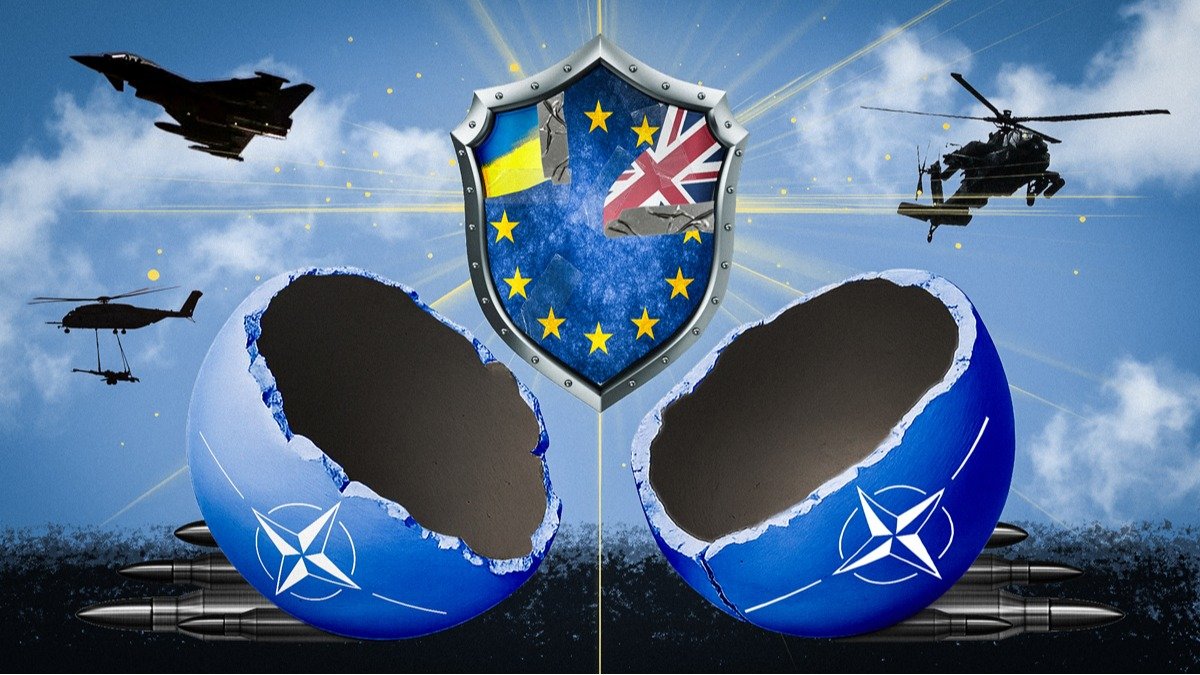
European Commissioner for Defence and Space Andrius Kubilius's statement on the need to create a new defense union has sparked a new wave of discussions about how exactly Europe should respond to the crisis in the transatlantic partnership. Brussels is confident: given the constant criticism from US President Donald Trump and his threats to withdraw from NATO, Europeans can no longer rely on Washington to the same extent. The new treaty, on the basis of which the defense alliance should be created, will be open for signing not only by EU members but also by partners. A key among them is Ukraine, which can teach Western militaries a lot. Active interaction with Kyiv is already underway. "Novaya Gazeta Europe" discusses why a new defense alliance is needed and what vulnerabilities this initiative has. Illustration: "Novaya Gazeta Europe". The Fate of the Alliance For decades, the European Union has stayed away from defense policy to avoid competing with NATO, the cornerstone of European security since 1949. But in recent years, the situation has begun to change: first due to the full-scale invasion of Ukraine by the Russian Federation, and since 2025, due to the confrontational rhetoric of Donald Trump. He constantly muses along the lines of "if they [other NATO members. - ed.] don't pay, I won't protect them," calls the North Atlantic Alliance a "paper tiger," and threatens to withdraw the US from its ranks. A new wave of criticism began against the backdrop of the Iranian military campaign and the Europeans' reluctance to directly participate in this conflict. In response, as Reuters reported on April 24, the Pentagon began analyzing possible ways to pressure European partners. Thus, one option to punish the British is to change the American position on the Falkland Islands, disputed by Argentina. As for Spain, the main European opponent of the campaign against Iran, Washington, according to Reuters sources, wants to expel Madrid from NATO or at least suspend its membership (the alliance has already stated that this is impossible). It's not just about rhetoric. The US no longer guarantees automatic provision of key strategic assets (e.g., intelligence) to allies, without which the armies of EU countries are practically incapable of conducting large-scale operations. Washington is working on scenarios to reduce the American military contingent in Europe. And the American defense strategy now states that the responsibility for resolving the situation in Ukraine lies more with Europe, while Washington's priorities are the Western Hemisphere and the Indo-Pacific region. Analyst Davis Ellison of The Hague Centre for Strategic Studies (HCSS), one of the authors of the combat operations concept adopted by NATO in 2021, commented on the future of the alliance in an interview with "Novaya-Europe": "Given how much transatlantic relations have deteriorated and are likely to continue to deteriorate, relying on NATO is becoming less and less viable." The expert, in particular, noted: "There is no particular reason to believe that NATO has any unique ability to deter Russia or wage war with it." "It is almost unbelievable that all 32 members of the alliance will actually fight together to defend one of them in case of an attack, and the US will almost certainly not use nuclear weapons to defend NATO in a critical situation. These circumstances have long been known, but only now are they beginning to be more widely recognized by European leaders," Davis Ellison explained. At the same time, former Deputy Assistant Secretary General of NATO for Emerging Security Challenges Jamie Shea is confident that the structure of the North Atlantic Alliance itself will certainly be useful in any case. "Europeans are already bound by collective defense commitments under the North Atlantic Treaty, and these commitments will remain even in the event of a hypothetical US withdrawal from NATO," the interlocutor of "Novaya-Europe" stated. According to him, the alliance, with its headquarters, planning structures, and military command, would be useful even without US participation. At the same time, Washington, even if it withdraws from the alliance (which, it should be noted, is still de facto extremely unlikely), could maintain participation in some structures and leave some of its military bases in Europe. Jamie Shea considers the fact that Canada, Turkey, Norway, and the United Kingdom will remain in the alliance to be important for the European Union. "Of course, without the US, it would no longer be the same NATO. But it is not a foregone conclusion that it would be less effective than the new structures that Europeans might try to create now," Jamie Shea noted. Three Levels of Readiness The European Commission is indeed actively considering alternatives to NATO. Another round of discussions on what Europe should do in this context was launched by the European Commissioner for Defence and Space, Andrius Kubilius. On April 17, at a conference of the EU Legal Service, he posed the question: "Are the existing treaties and the institutions created on their basis more of an aid or an obstacle to European defense – so that Europe can fight as a single entity, rather than just a collection of 27 countries?" And, as if answering this question, the member of the European Commission called for "the creation of a genuine European Defense Union, which would include Great Britain, Norway, and Ukraine." French President Emmanuel Macron, German Chancellor Angela Merkel, and European Commission President Jean-Claude Juncker before a meeting at the Élysée Palace, Paris, March 26, 2019. Photo: Philippe Wojazer / Reuters / Scanpix / LETA. "Let's conclude an additional new intergovernmental treaty," said Kubilius, suggesting modeling it after the Schengen Agreement. Schengen was created as an intergovernmental initiative of five countries outside the official treaties within the framework of the then-existing European Economic Community (the predecessor of the EU). The agreement, initially signed in 1985, allowed a group of willing countries to move forward faster than others, before the system was integrated into the bloc's common legislation. At the same time, there is still no equality sign between EU membership and Schengen: Norway, Switzerland, Iceland, and Liechtenstein, for example, are not members of the European Union but have joined the Schengen Area. Andrius Kubilius believes that "Europe's readiness for defense" consists of three key components, problems with at least one of which are fatal for the entire system. Material readiness: money, production, armaments; Institutional readiness: how Europe's defense will be organized, especially if the US reduces its presence in the region; Political readiness: the will to deter and defend, and, if necessary, to wage war. In 2025, according to Kubilius, the EU focused on the material component. In particular, the EU's strategic plan "Readiness 2030" was developed and adopted. It involves allocating up to 800 billion euros to strengthen Europe's defense infrastructure in response to geopolitical threats, as well as increasing procurement efficiency. Also among the achievements of 2025 in terms of increasing material readiness is the commitment undertaken within NATO to increase defense spending to 5%. Not all countries readily agreed to this, and Spain even negotiated an exception for itself. But in general, the decision was welcomed by the leadership of NATO and the EU, and by the US White House. However, as noted by the Supreme Allied Commander Europe of NATO, General Alexis Grenkevich, simply injecting additional funds into old defense structures will never ensure the necessary qualitative transformation. New approaches and new decision-making mechanisms are needed. At the center of the new architecture proposed by Kubilius is the European Security Council (ESC). The new body, designed to respond quickly to emerging threats, should be based on the successful experience of interaction in the E5+ format. This refers to informal meetings of representatives of the five key European states in terms of defense spending and military power - France, Germany, Italy, Poland, and the United Kingdom - plus their partners. This will be the core of the new body. In addition, it is planned to leave room for several rotating members, including the country holding the presidency of the Council of the EU (which changes every six months). The participation of the presidents of the European Commission and the European Council is also envisaged. European Commissioner for Defence and Space Andrius Kubilius at a press conference in Brussels, Belgium, March 25, 2026. Photo: Olivier Matthys / EPA. In total, according to Andrius Kubilius's plan, there should be "about 10-12 participants." The structure resembles the UN Security Council, which has five permanent and ten rotating members. The ESC's task will be not only to discuss the most important defense issues but also to promptly prepare key decisions. For example, the European Security Council is planned to be empowered to take steps within the framework of Article 42 (7) of the EU Treaty on collective defense. What is Article 42 (7)? "In the event of an armed attack against the territory of a Member State, the other Member States shall afford it assistance and support by all the means in their power, in accordance with Article 51 of the Charter of the United Nations. This shall not prejudice the specific character of the security and defense policy of certain Member States [this refers to EU Member States pursuing a policy of military neutrality, such as Austria and Ireland. - ed.]. Commitments and cooperation in this area shall continue to be compatible with commitments undertaken within the framework of the North Atlantic Treaty Organization, which, for its participating States, remains the foundation of their collective defense and the forum for its implementation." Article 42 (7) is formulated more strictly than Article 5 of the Washington Treaty on NATO's "collective defense." The European document states that in the event of aggression against one of the EU countries, the other countries are obliged to provide assistance and support by all means at their disposal. Article 5 of the NATO Charter requires allies to take "such action as they deem necessary." So far, clear procedures for the use of this article have not been established anywhere, which complicates its practical application (the provisions were activated only once - after the terrorist attacks in Paris in 2015). For example, some confusion was felt in European structures against the backdrop of the war between the US and Israel against Iran, which also affected Cyprus, an EU member state where British military bases are located: Iranian drones attacked the island. The Cypriot authorities did not activate the article but raised the issue of specifying the procedure for member states' actions in such a scenario. It later became known that the European Union is beginning to develop guidelines for the application of Article 42 (7) and will also conduct a training exercise of the implementation mechanisms of the collective defense provisions. The simulation will be carried out within the framework of the EU's Committee on Political and Security. Speaking in January, Andrius Kubilius listed some of the issues the Council would have to address: "First of all, it must answer the question: what will we do if the Americans leave Europe? And when should we start such preparations? How to build the European dimension of NATO? How to choose a European Supreme Commander of the Allied Forces [this post in NATO has always been held by an American. - ed.]? How to create a European Command and Control System, as well as a European headquarters? And, most importantly: how to replace the 100,000-strong American military contingent, which is currently the backbone of military power in Europe?" Flags of the European Union, Estonia, and NATO against the backdrop of the Ivangorod fortress in Narva, January 15, 2026. Photo: AFP / Scanpix / LETA. Learning from Ukraine The fundamental principle of the planned security architecture is the involvement of non-EU countries on equal terms. Andrius Kubilius pointed to three states without which the new structures would be incomplete: Great Britain, Norway, and Ukraine. The inclusion of the United Kingdom in the initiative is necessary due to its nuclear arsenal, intelligence capabilities, modern high-precision weapons, and leadership in naval operations. Norway is already deeply integrated into EU defense projects and is also of fundamental importance in terms of the unfolding geopolitical confrontation around the Arctic. As for Ukraine, it will significantly strengthen this initiative, especially if it is based on the combat experience of the Armed Forces of Ukraine. This is particularly emphasized by People's Deputy of the Verkhovna Rada Serhiy Taruta, who is involved with dozens of defense sector enterprises (which, as the legislator explained to "Novaya-Europe," are owned by his associates whom he advises). According to Taruta, "Ukraine can be one of the foundational actors of this process, its backbone." The EU expresses similar sentiments. As Andrius Kubilius rightly noted, the Ukrainian Armed Forces have unique combat experience that no NATO army possesses. NATO military personnel can learn a lot from their Ukrainian colleagues. For example, a report in The Wall Street Journal (WSJ) in February, which described the Hedgehog 2025 exercises, is telling. Ukrainian drone operators "destroyed" alliance troops who did not know the basics of battlefield behavior in conditions of mass drone deployment. WSJ sources told the story of one commander who observed the exercises and concluded: "We are fucked." Servicemembers during the Verboom engineering exercises at the Adaži military base, Latvia, August 14, 2025. Photo: Valda Kalnina / EPA. Direct interaction between NATO countries and the Ukrainian army and industry began in the summer of 2022, after the Ukrainian Armed Forces exhausted their stocks of Soviet-caliber shells and began mass supplies of various Western artillery systems (most often produced in the 1970s-1980s). NATO artillery calibers 155 and 105 mm have become the main ones in the Ukrainian armed forces forever. The issue of repairing artillery systems of a completely different, non-Soviet class of execution immediately arose (American howitzers widely featured titanium alloys). Ukrainians quickly learned to weld titanium plates and perform deep repairs of guns near the battlefield. The abundance of American weapons in the Ukrainian army forced the US Army to deploy a Remote Repair Center in Poland in 2022: American specialists began providing instructions to Ukrainian military personnel through secure digital chats and transferred drawings for manufacturing necessary components. 40 technical specialists worked there, maintaining contact with Ukrainian logistics forces in 14 closed chats - separately for each type of armament. Similar "service stations," as Ukrainians jokingly call them, were also created by the Germans, but this definition is more of a criticism. "Initially, only routine repairs were carried out at these service centers; all complex breakdowns and combat damage - for example, to Leopard 2 tanks - led to the machines being sent for repair to Germany. This is no different from a branded Mercedes car service in Ukraine," says Kirill (who asked not to reveal his real name), the executive director of one of the defense complex enterprises in Ukraine, to "Novaya-Europe." Kirill's network specializes in drones with a combat load of "over a kilogram," i.e., loitering munitions and long-range strike UAVs hitting targets at distances of 500 to 1000 km. At the same time, Kirill's enterprises also carried out repair work on German Gepard anti-aircraft gun systems and Polish Krab self-propelled howitzers. According to the interlocutor of "Novaya-Europe," this was very niche repair, more like restoration of old equipment - only about ten Gepards and two batteries of Krab self-propelled howitzers passed through his plant over these years. "We received several machines taken from storage. I thought our storage was bad... In Europe, as it turned out, it's the same," says Kirill. "For example, you try to start the equipment, and it doesn't work: it was loaded as scrap. Is there an acceptance certificate for the Gepard? OK, take it! Whether it drives or not, nobody cares." According to the interlocutor of "Novaya-Europe," Ukrainian specialists "most struggled with hydraulics and electronics," and each time the repairmen had to "invent unique solutions because spare parts for this old, decommissioned equipment are nonexistent and cannot be." "You replace a tube block with a modern one, and then you write a program to slow it down because it works too fast for this equipment," the interlocutor of "Novaya-Europe" pointed out, highlighting just one of many problems. The next huge step was attracting Western money and expertise to the Ukrainian defense market. 2024 became a turning point when the Ukrainian leadership realized that budget capabilities cover only a third of the domestic arms industry's potential, and there are no more reserves - the government had just redistributed 90 billion hryvnias (1.74 billion euros) from local budgets to defense. It was decided to ask Western partners to direct money to Ukrainian production. The campaign was global, and a special promotional video was even made to promote it. The model was called "Danish" - after the first country to cooperate in this way. Initially, the kingdom agreed to allocate 28 million euros to finance the purchase of Ukrainian-made weapons. Subsequently, this amount was increased to 170 million euros. The next country was Canada, followed by the Netherlands. A real challenge was attracting giants like Germany, Great Britain, and the USA to the Ukrainian market, which had their own defense corporations for almost every need. In this case, the focus was initially on after-sales service. "Ukroboronprom" established a joint venture with Rheinmetall to produce the latest Lynx infantry fighting vehicles. The German government allocated funds for Ukraine for the BMPs, effectively financing its own company, but the final assembly of the combat vehicles is to take place at Ukrainian factories. Then, Ukraine established joint production with the British company BAE Systems and the American corporation Amentum Services. Supreme Allied Commander Europe of NATO, General Alexis Grenkevich, at a press conference of the Military Committee in Brussels, Belgium, January 22, 2026. Photo: Olivier Matthys / EPA. Now, in 2026, it is already about a full-scale and comprehensive exchange of competencies, technologies, and combat experience between Ukraine and NATO countries. Among other things, this is happening within the framework of the Joint Analysis, Training and Education Centre (JATEC), which opened in February 2025 in the Polish town of Bydgoszcz. This is NATO's first project of its kind, involving equal cooperation with a non-alliance country. In its year of operation, as reported by DW, representatives of Ukraine and NATO have developed new solutions for the front and accelerated important processes within the alliance. Such cooperation will likely also take place within the framework of the new European security architecture. "I hear simple things from Europeans now: they say that if they used to teach us, now they need to learn from us," Serhiy Taruta tells "Novaya-Europe." While acknowledging that Europeans undoubtedly have "a better scientific and technological base," the People's Deputy notes: "In classical development, they would have surpassed us, of course. But they lived as pacifists for a long time, and Putin is not a pacifist at all." Political Deadlock The main challenge for Brussels and its initiatives lies in the shrinking window of time: European intelligence agencies predict a potential for Russian aggression against EU or NATO countries within the next two to three years. At the same time, Europe's institutional readiness for such a scenario without US support remains highly questionable. European leaders will have to find the best possible course of action that would allow Europeans to create a defense system without relying on American forces and capabilities. But one should not forget the third component from Kubilius's speech: political readiness. "Is now the right time to offer EU citizens another treaty on European integration? Will the start of discussions about the future of the Union, new obligations, and the transfer of sovereignty lead to more problems than solutions?" asks Jamie Shea, pointing to the rise of populism in European countries. A Ukrainian pilot from the 93rd Separate Mechanized Brigade "Kholodnyi Yar" practices piloting the Vampire unmanned system during exercises, Ukraine, March 10, 2026. Photo: Maria Senovilla / EPA. "A new European defense treaty like NATO may be desirable from a strategic point of view (given the continued dependence on an unstable US), but it is extremely complex from a political and legal point of view," agrees Davis Ellison. "Such a treaty would almost certainly require the consensus of all EU member states and its ratification in each national parliament. This means that if at least one parliament does not ratify it, the entire project will not happen." The process, according to the interlocutor of "Novaya-Europe," is also complicated by the fact that "from a legal point of view, the differences between countries are too great." The new structure, Davis Ellison continues, "would most likely focus entirely on the territorial defense of the EU, as participants would avoid using such a mechanism outside the Union." With Ukraine's participation, as the expert notes, referring to his conversations with informed sources in Brussels, not everything is simple either: it will be possible only in case of a long and stable ceasefire. Employees of Rheinmetall AG in the production workshop for Lynx infantry fighting vehicles in Unterlüss, Germany, June 6, 2023. Photo: Hannibal Hanschke / EPA. Meanwhile, Jamie Shea noted that relations with non-EU states are already regulated by bilateral security agreements. In addition, regional formats are effectively operating - the Allied Rapid Reaction Corps [a UK-led structure designed for rapid deployment of armed forces in situations where NATO's Article 5 is not invoked. - ed.], the "Bucharest Nine," coalitions for military planning regarding Ukraine and the Strait of Hormuz, consortia for arms production for Kyiv, the Eurotroika [France, Germany, UK. - ed.], the Weimar Triangle [France, Germany, Poland. - ed.], and so on. In the same vein are regional projects for developing defense capabilities (e.g., the Anglo-Norwegian naval shipbuilding program or the Franco-German SCAF fighter project). "In my opinion, Europeans should focus on how to better utilize existing programs and formats, rather than adding new initiatives and structures to this already long list," Jamie Shea concluded. "Much is already possible within existing mechanisms," Davis Ellison agreed with him. "The main task is to effectively utilize these mechanisms at the pan-European level and adapt them to high-intensity warfare. This requires a new focus exclusively on the territorial defense of Europe, as well as European leaders abandoning any ambitions of global influence or turning the Union into an instrument of power on the world stage." The latter, however, according to the interlocutor of "Novaya-Europe," is unlikely to be realized in practice under current conditions anyway.
TL;DR
- The EU is discussing the creation of a new defense union due to declining reliance on the US and NATO.
- European Commissioner Andrius Kubilius proposed a new intergovernmental treaty, modeled on the Schengen Agreement, to form this defense union.
- The proposed alliance would be open to EU members and key partners, including the UK, Norway, and Ukraine.
- Ukraine's significant combat experience is seen as a valuable asset for the new defense union.
- The initiative aims to address Europe's institutional, material, and political readiness for defense independently of the US.
- Potential challenges include political hurdles, legal complexities, and the need for unanimous ratification by member states.
- Existing NATO structures and other regional formats are also being considered as part of the solution.
Continue reading the original article