March 27, 2026
US Deploys Airborne and Marine Troops Near Iran. Media Discusses Potential Capture of Kharg Island. "Novaya Gazeta Europe" Consults Military Experts on Washington's Objectives
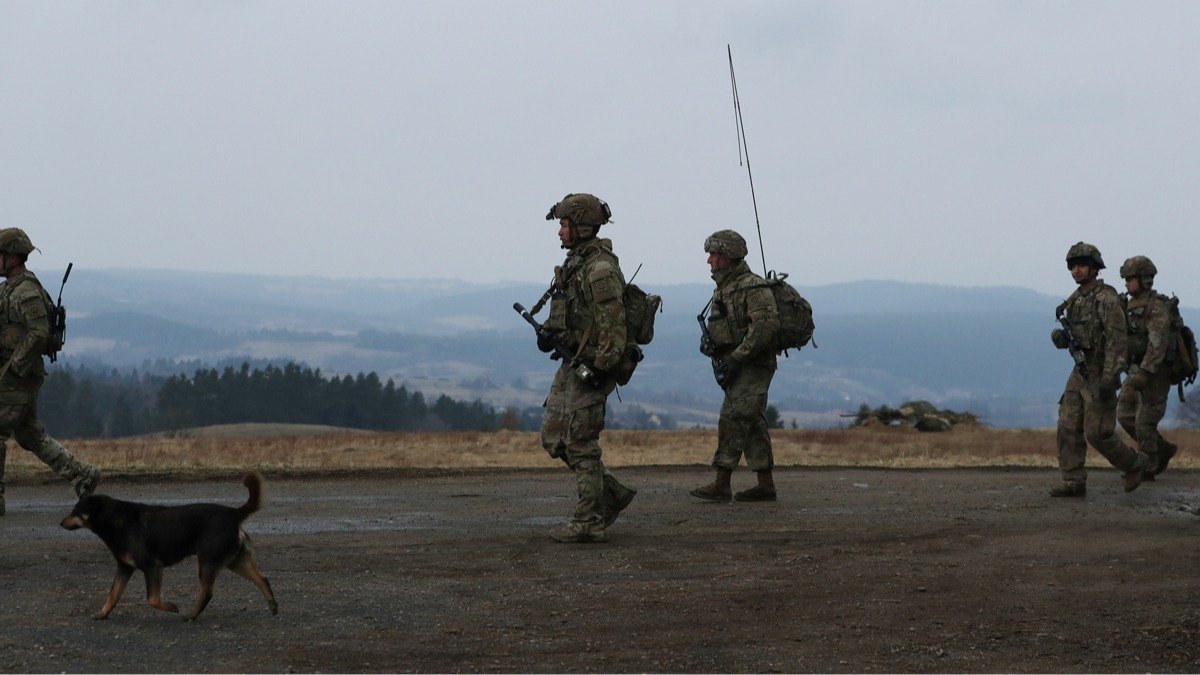
The potential redeployment of U.S. Army's 82nd Airborne Division units to the Middle East, reported by major media outlets, has intensified discussions about a ground operation against Iran. Central to these scenarios is Kharg Island, a key hub for the country's oil exports. "Novaya Gazeta Europe" delves into what Washington might achieve with such a scenario. U.S. Army's 82nd Airborne Division soldiers are seen heading to an airbase in Poland on April 5, 2022. Photo: Kacper Pempel / Reuters / Scanpix / LETA. The U.S. Central Command stated on Tuesday that since February 28, American aircraft and missiles have "destroyed over 9,000 military targets" in Iran. Concurrently, Washington is increasing its forces in the region, with 2,200 U.S. Marines being sent to the Middle East. One Marine expeditionary unit will arrive this week, while another is already in the process of deployment. The command of the 82nd Airborne Division has been ordered to redeploy an infantry brigade, numbering several thousand soldiers, to the Middle East. The troop movements are intended to compel Iran to accept Trump's ceasefire terms and to ensure the reopening of the Strait of Hormuz, stated Michael Eisenstadt of the Washington Institute for Near East Policy, a former U.S. government military analyst, in an interview with Fox News. "If Iran rejects [Trump's] terms, it creates military options [for the U.S.]," Eisenstadt asserts, suggesting that in such a case, the U.S. military might attempt to seize territory, such as Kharg Island. However, Iranian mainland units "can shell the island and inflict losses on American troops there," Eisenstadt warns. A satellite image of Iran's Kharg Island in the Persian Gulf, August 31, 2002. Photo: NASA / dts Nachrichtenagentur / Imago Images / Scanpix / LETA. What else is known about the U.S. military deployment to the Middle East? The 82nd Airborne Division is one of the leading rapid response units of the U.S. armed forces. This division, capable of deploying within 18 hours of receiving an order, specializes in parachute assault operations anywhere in the world. The paratroopers are equipped with artillery and tanks. According to Reuters, units of the 82nd Division are stationed at Fort Bragg, and a decision on their direct involvement in combat operations in Iran has not yet been made; in any case, their task is to build capacity for potential operations in the region. The contingent will likely include Major General Brandon R. Tefftmeyer, the division commander, elements of his staff, and infantry battalions from the division's rapid response forces, notes Fox News. "The arrival of various special forces units by transport aircraft is not being publicized, which may include the legendary "SEALs," "Delta," as well as the 75th Ranger Regiment," says military observer David Sharp in conversation with "Novaya-Europe." Military expert Sergey Migdal also claims that these special forces have been redeployed to the Middle East. Sharp adds that by Friday, March 27, a U.S. Marine expeditionary group from the 31st Marine Expeditionary Unit will sail from Japan to the Middle East. This comprises approximately 2,200 personnel trained for amphibious assaults and airmobile operations using tiltrotors or helicopters. According to The Wall Street Journal, the Pentagon is discussing the possibility of sending an additional 10,000 ground troops to the Middle East. The contingent would likely include infantry and armored vehicles and would supplement the five thousand Marines and paratroopers from the 82nd Airborne Division already sent to the region. "The exact location of the troops in the Middle East is not yet known, but they will most likely be within range of Iran and Kharg Island," the report states. Why is Kharg Island the focus? Many media outlets have recently reported that U.S. troops might capture Kharg Island. In such a case, it would block Iranian oil exports, as up to 90% of supplies pass through Kharg. It would also provide a staging ground for attacks on mainland Iran, notes "BBC." "Kharg is located in the northwestern Persian Gulf, 20 miles from the Iranian coast near the border with Iraq. Underwater pipelines from all over Iran run there, loading oil at port terminals onto supertankers," explains Sergey Migdal, a military expert and former Israeli intelligence and police officer, in an interview with "Novaya-Europe." On March 13, Trump stated that U.S. military forces had conducted an airstrike on Kharg Island. The U.S. President then wrote that the island's military facilities had been "completely destroyed," but troops refrained from striking its oil infrastructure. What might the U.S. undertake in the end? Sources told Axios that the U.S. is considering options for a "final strike" against Iran, which could include the use of ground troops and massive bombing, in case of failed negotiations with Tehran. In particular, a sharp escalation is possible if the Strait of Hormuz remains closed, the sources added. Axios sources name four escalation options: an invasion of Kharg Island or its blockade; an invasion of Larak Island, which helps Iran strengthen control over the Strait of Hormuz—Axios writes that Iranian bunkers, fast attack craft capable of detonating cargo ships, and radars tracking movements in the strait are located there; the seizure of the strategically important island of Abu Musa and two smaller islands near the western entrance to the strait, controlled by Iran; the blockade or seizure of vessels exporting Iranian oil in the eastern part of the Strait of Hormuz. However, Axios notes: Trump has not yet decided to implement any of these scenarios, and White House representatives describe any potential ground operations as "hypothetical." The very fact of troop buildup represents a sharp escalation of the American-Israeli war against the Iranian regime and increases the likelihood that U.S. servicemen will enter Iran, according to Politico sources. U.S. intelligence indicates that Iran is already preparing for such a development. CNN, citing sources familiar with intelligence information, reports that a multi-layered defense system has been established on the island. In recent weeks, Tehran has redeployed additional forces, reinforced the garrison with portable anti-aircraft missile systems, and begun mining the coast—including anti-personnel and anti-tank mines designed to disrupt a possible landing operation. Sergey Migdal recalls that U.S. military bases are located in many Middle Eastern countries: in the UAE, Qatar, Kuwait, Jordan, Iraq, and others. Currently, up to 50,000 U.S. Army personnel are stationed at American bases in the Middle East, most of whom are support staff for aviation, logistics and communications units, analysts, and other non-combat elements. Among them is an elite combat formation for special operations, consisting of several thousand fighters. "Two U.S. Marine expeditionary groups are heading to the region. The first is expected to arrive from Okinawa around March 27 on the ship "Tripoli," carrying about 2,200 infantrymen, as well as vertical takeoff aircraft, tiltrotors, and helicopters. It is likely accompanied by destroyers and frigates. The troops of this group could, for example, be deployed by air to Kharg Island," says Migdal. U.S. Navy amphibious assault ship USS Tripoli enters the Singapore Strait on March 17, 2026. Photo: Edgar Su / Reuters / Scanpix / LETA. He specifies that for strikes against Iranian islands and coastline, U.S. B-52 bombers use heavy GBU-72 bunker-buster guided bombs weighing 2.5 tons. They destroy air defense, headquarters, missile systems, underground command posts, and other military objectives. Additionally, the expert says, the U.S. is already employing A-10 "Warthog" attack aircraft, which hunt IRGC crewed and uncrewed boats and destroy Iranian army positions on the shore. "Another group, consisting of the 11th U.S. Marine Expeditionary Unit, approximately the same size as the first, is redeploying from San Diego on the amphibious assault ship "Boxer," carrying small landing craft. It will arrive slightly later. This group could be used to capture Qeshm Island in the Strait of Hormuz. Qeshm also has an oil terminal through which 10 percent of Iran's oil exports pass. Several small islands in the strait nearby are disputed territories. The Iranian Shah occupied these islands decades ago, located near the main fairway of the strait, previously considered property of the United Arab Emirates. There is a hypothesis that the U.S. plans to involve UAE army formations in landing on these islands," comments Migdal. "In total, over 10,000 elite U.S. Army infantrymen, paratroopers, and special forces personnel are concentrated around Iran," Migdal concludes in his conversation with "Novaya-Europe." In his opinion, this number is sufficient for island capture. Sharp agrees with this sentiment. "Before such an operation, we will likely see intensive air strikes by allied aviation on the positions of Iranian security forces. In the case of Kharg Island, this is precisely the task for a special division. There are also islands in the Strait of Hormuz that are disputed territory between Iran and the UAE and are currently occupied by the Iranian army," explains Sharp. According to him, unblocking the Strait of Hormuz requires a comprehensive set of measures: involving naval and air forces, and possibly ground forces, if they are used to capture islands. "These are not simple operations, with possible losses. There is no talk of a global ground operation to occupy Iran and enforce regime change at this time. The U.S. does not currently have the forces necessary for such an operation. The minimum required for a full-scale invasion is a force of 200,000 soldiers. This option is not even on the agenda," emphasizes the "Novaya-Europe" interlocutor. This week, Iran threatened to mine the Strait of Hormuz if the U.S. attempted to land on Kharg Island. Migdal believes that the American command will take this into account and involve sappers. "The ground forces that the U.S. has amassed near Iran will not be enough to unblock the Strait of Hormuz. But they are not supposed to do that either. Currently, the most realistic option for safe passage of civilian vessels in this area is their escort by a convoy of U.S. and allied warships. The impression is that Trump will eventually decide to conduct a limited ground operation to capture islands. It's not for nothing that so many forces have been gathered in the Middle Eastern theater of operations. I am sure this could happen in the near future. At the same time, American military personnel will face the problem of shelling from Iran with all available means of the ayatollah regime, from missiles and drones to long-range MLRS," the expert points out. The execution of other special operations by American special forces, Marines, and paratroopers is possible but unlikely, he believes. Migdal recalls an operation by the Israeli military in Syria in 2024, where they destroyed an underground missile assembly plant. Preparation of an F/A-18E Super Hornet fighter for takeoff from the aircraft carrier USS Abraham Lincoln on March 22, 2026. Photo: U.S. Air Force / U.S. Central Command / AFP / Scanpix / LETA. "If we talk about more than 400 kilograms of enriched uranium, which is allegedly located at one of the bombed nuclear program facilities, then the Americans could land and try to retrieve it. But guaranteeing success is difficult. Leaders and high-ranking officers of Iran's security agencies have begun hiding from air attacks. Sometimes they live in safe houses with minimal security. In such a situation, they could be captured. But it's not certain that the Americans would want to risk their people. It is quite possible that they would use Israeli experience and simply eliminate their targets," says the source. However, such operations carry high risks: Iran has declared its readiness to launch strikes even on its own territory if American troops are present there. Washington also fears that escalation could lead to a protracted conflict beyond initial projections. Against this backdrop, diplomatic contacts through third countries, including Pakistan, continue, but the parties' positions remain rigid. Does the Pentagon have the resources? Is the operation supported in the U.S.? The Pentagon is considering redirecting weapons intended for Ukraine to the Middle East, as the war in Iran is depleting the U.S. Army's most critical ammunition stocks, The Washington Post reports, citing anonymous sources. The weaponry that could be redirected from Ukraine includes anti-aircraft missile systems ordered under a NATO program launched last year, through which partner countries purchase American weapons for Kyiv. In response to the newspaper's questions, NATO did not specify whether the military alliance is aware of the possible redirection of American equipment or whether it causes concern. An alliance representative merely noted that countries "continue to contribute to the Ukraine Priority Needs List (PURL) program, and equipment is continuously supplied to Ukraine." Earlier, WP reported that the Pentagon had asked the White House to approve a request to Congress for over $200 billion to finance the war in Iran. However, some White House officials believe that the Pentagon's request has no real chance of being approved by Congress. Any use of U.S. ground troops—even for a limited mission—could pose significant political risks for Trump, given the low public support for the Iranian campaign in the U.S. and Trump's own campaign promises to avoid involving the U.S. in new conflicts in the Middle East, writes Reuters. A Reuters/Ipsos poll published on March 24 showed a growing decline in public support for the war: 35 percent of Americans approve of U.S. strikes. A poll conducted last week showed that 37 percent of Americans support the war. Overall, 61 percent of respondents disapprove of the strikes, compared to 59 percent a week earlier.
TL;DR
- The U.S. is deploying units from the 82nd Airborne Division and thousands of Marines to the Middle East.
- This military buildup is fueling speculation about a potential ground operation against Iran, with Kharg Island being a key focus.
- The objective is potentially to force Iran to accept ceasefire terms or to disrupt its oil exports.
- Iran is reinforcing its defenses, anticipating possible U.S. military actions.
- While the U.S. is escalating its military posture, a large-scale invasion of Iran is considered unlikely due to insufficient forces and political risks.
- Public support for military action against Iran in the U.S. is declining, and the Pentagon is considering redirecting weapons intended for Ukraine to the Middle East.
Continue reading the original article