March 9, 2026
Love for a Price. Historian Rustam Alexander recalls how the Soviet leadership tried to befriend students from Africa and what came of it
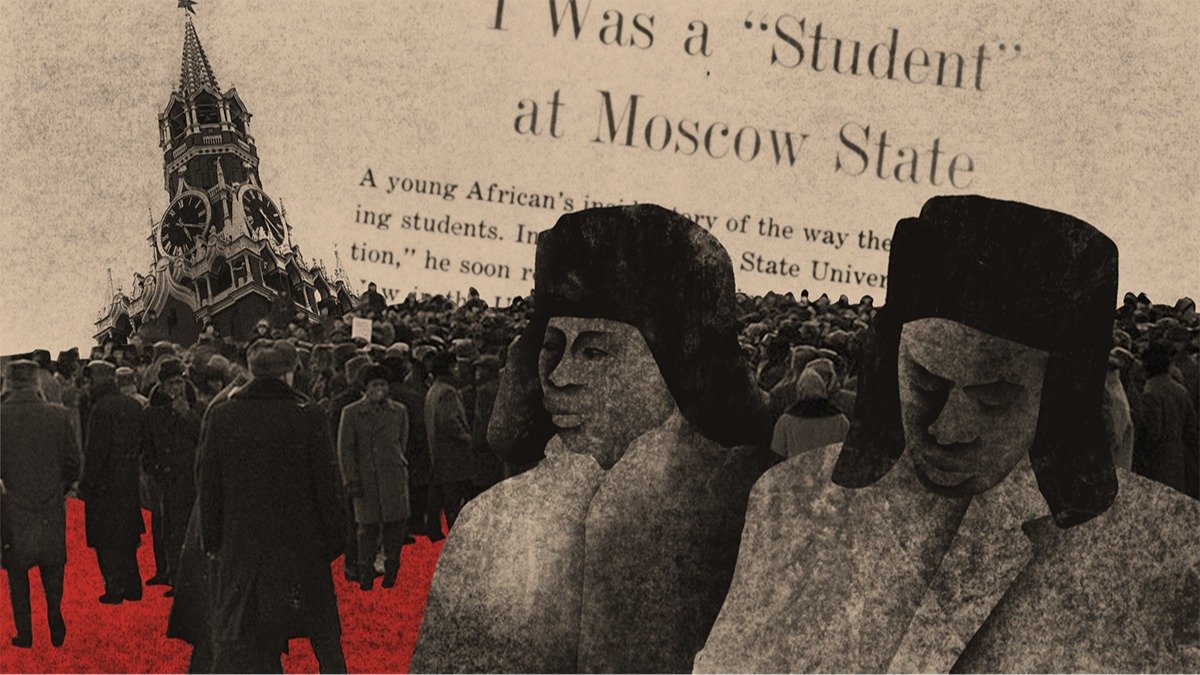
Russia is actively working to promote the image of a "friendly great power" on the African continent, including through the large-scale expansion of the Russian Orthodox Church, which has expanded its presence to at least 34 African countries from 2022 to 2025. Russian authorities are trying to attract Africans to work in defense enterprises and even to participate in the war with Ukraine. Illustration: Lyalya Bulanova / "Novaya Gazeta Europe". In the 1960s, as African countries gained independence one after another, the USSR rushed to establish friendly relations with them and spread its influence on the continent. This was done through the promotion of Soviet education: African students were actively invited to study in the USSR. Outwardly, such an invitation looked attractive: friendship of peoples, international solidarity, prestigious education in the country of communism, and social elevators. But the reality often turned out to be much less rosy. When in the late 1950s, Everest Mulekezi, a native of Uganda, received a six-year scholarship to study at Moscow State University, he was convinced that the Soviet Union sincerely wanted to help him and other Africans "gain knowledge and forge their free destiny." But when he arrived in Moscow in October 1959, his illusions began to crumble very quickly. Firstly, he was very surprised by the living conditions: a small dormitory room that he had to share with two other students – "specially selected" Russians. Hot water in the dormitory was turned on only once a week, on Wednesdays, from 5 to 11 p.m. But most of all, he was outraged by the fact that Soviet propagandists actively "brainwashed" African students with communist propaganda. Over time, this even led some African students to seek a way to leave the USSR. In October 1960, Mulekezi also managed to leave, and he continued his studies in the USA. II World Festival of Youth and Students for National Independence and Liberation, Kremlin Palace of Congresses, Moscow, September 16-23, 1964. Photo: from the archive of Boris Kosarev. In addition to "brainwashing" and poor living conditions, African students faced other serious problems: restrictions on movement within the country, bans on creating national and ethnic student associations, and even bans on meetings and communication with Russian girls. But the main problem was racism. In December 1963, the body of 29-year-old medical student Edmond Asare-Addo from Ghana was found in Khovrino. According to a TASS report, there were no signs of violent death on Edmond's body, and doctors allegedly found traces of alcohol in his blood – the theory was put forward that he got drunk and simply froze in the snow. But two Ghanaian medical students present at the autopsy reported that there were bruises on the man's arms and knees, and a wound under his chin. Other students said that Edmond was going to marry a Russian girl, but her friends and parents objected to the marriage. The students suspected that Edmond might have been killed to prevent the wedding. Rumors that Edmond was killed on racial grounds angered African students in Moscow. About 500 young men and several girls organized a protest demonstration, hoping to reach the Kremlin. As historian Maxim Matusevich notes, the Africans' march was the first unauthorized demonstration in the USSR since 1927 – when Trotsky's supporters protested against his removal from leadership. The students carried banners "Stop killing Africans", chanting slogans in English and French. The rally was dispersed, after which the USSR Minister of Education Vyacheslav Yelyutin received about a hundred participants in his office near the Kremlin. For two hours, the students demanded an investigation into Edmond's death, and also told the minister that they constantly felt threatened to their own safety. "African students are beaten every day," said one African. "The Soviet militia does nothing to help Africans if they are attacked," said another. The African press also expressed indignation at how African students were treated in the USSR. One newspaper wrote: "Why did our students recently protest in Moscow? Isn't it because... our guys were insulted and attacked on trams, on streets, in restaurants and in practically all public places? Isn't it because our students are tired of the hypocrisy of communism and the Soviet system?" Protest on Red Square, Moscow, December 1963. Photo: from the archive of Boris Kosarev. Despite the scandal, students continued to come to the USSR to study, but the tension between them and Soviet citizens grew even stronger. In the mid-1960s, 800 African students announced a week-long strike – in protest against the expulsion of a 23-year-old student from Czechoslovakia for marrying a Nigerian classmate. Around the same time, in Lviv, a drunken Russian student attacked a sleeping Nigerian student in the dormitory with a chisel. He did this because he was furious about the African's success with Russian and Ukrainian girls. The incident immediately escalated into a mass brawl involving other Nigerian students. As a result, three of them were expelled for attacking and "beating a Soviet citizen." There were also many cultural differences. As one African student from Moscow State University recalled, in the USSR there were "no cars, no cafes, no good clothes or food, almost nothing in the shops to buy or even look at; no bright colors to dispel the raw grayness of Moscow." The Soviet-African "friendship" of that time initially had many incompatibilities – including on an ideological level. Africans came from countries where decolonization was in full swing and political disputes were raging. Unlike their Soviet comrades, they were not afraid to openly express their dissatisfaction. Many actually became conduits of dissent: they brought a different, more cosmopolitan way of life and worldview into the USSR. They had more freedom of movement (at least outside the USSR), more space for self-expression, and often more money. As a result, many were disappointed when they encountered Soviet reality. Based on: Maxim Matusevich, “Expanding the boundaries of the Black Atlantic beyond the Iron Curtain: African Students Encounter the Soviet Union”.
TL;DR
- The USSR invited African students to study as a means of spreading influence, mirroring current Russian strategies in Africa.
- Students encountered poor living conditions, including cramped shared rooms and limited hot water.
- A significant issue was pervasive racism, leading to student protests and fueling dissatisfaction with the Soviet system.
- Restrictions on movement, forming ethnic groups, and interactions with locals created further friction.
- The murder of Ghanaian student Edmond Asare-Addo triggered a large, unauthorized protest, highlighting the deep-seated racial tensions.
- Despite promises, the Soviet experience often led to disillusionment due to cultural differences and the reality of Soviet life.
- Incidents like expulsions for interracial relationships and violent attacks underscored the problems faced by African students.
Continue reading the original article