April 18, 2026
Uu U. Half of the library fund will have to be withdrawn due to foreign agents, Oleg Novikov, head of Eksmo-AST, informed Sergey Naryshkin. But what about the other half?
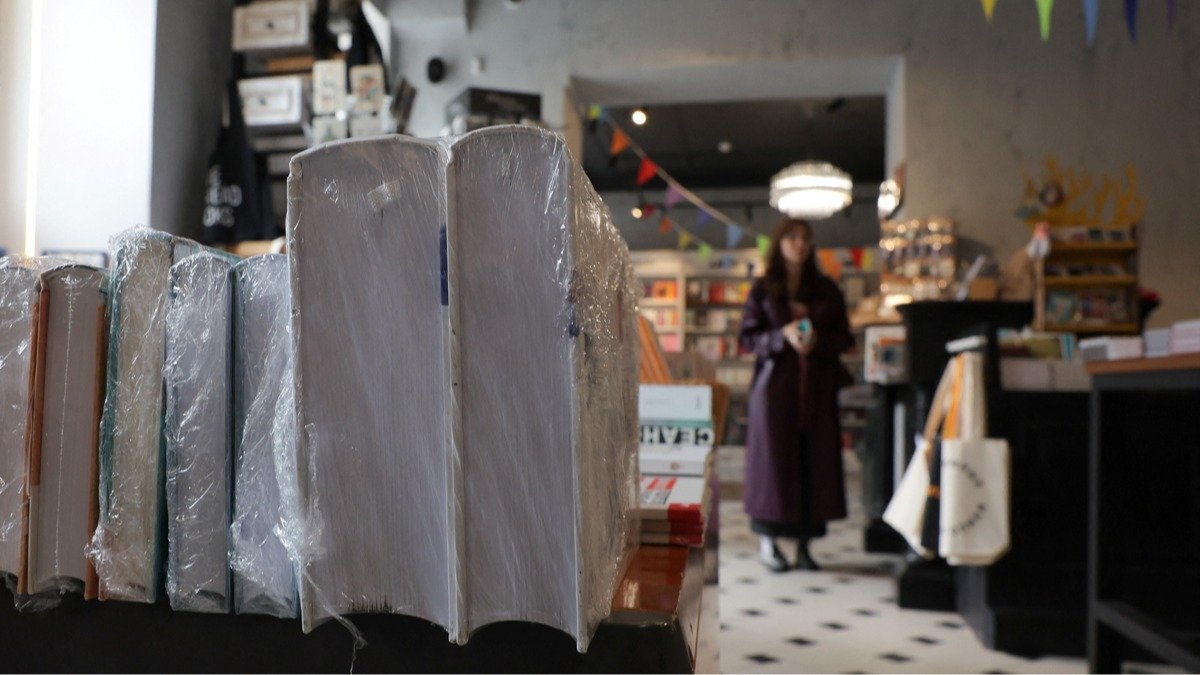
Books by authors included in the "foreign agents" register in a bookstore, St. Petersburg, September 1, 2025. Photo: Anton Vaganov / Reuters / Scanpix / LETA. Oleg Novikov, president of the Eksmo-AST publishing group, told intelligence officer Sergey Naryshkin (at a meeting of the Organizational Committee for the Support of Literature, Book Publishing and Reading in the Russian Federation, chaired by the head of the SVR) that if the legislation on foreign agents and undesirable organizations were literally enforced, more than 50% of Russia's library collections would have to be withdrawn. "Foreign agents," Novikov explained, did not only harm culture through their authorship of books: they left traces in others' books with numerous comments, annotations, and created publication layouts. However, at that time, they did not yet know that they would later become foreign agents. It is interesting, by the way: it turns out that among those who continued to engage in cultural activities in the nineties and two-thousands, despite everything, there is a high percentage of future foreign agents. This work was poorly paid at that time, although it did not become very profitable later either. But it is so pleasant to organize the cultural coherence of eras, to weave one's voice into the general choir, that many scholars and writers continued to do so even in lean years. It is natural that these creatively active people could not tolerate massacres and repressions years later. It should be noted that Novikov's speech is an example of a maneuvering strategy: to "naively" explain what would happen with the conscientious application of the proposed insane measure. Like in the anecdote about Peter I and the court truth-teller Yaguzhinsky: all thieves can be hanged, "however, most gracious sovereign, do you want to remain emperor alone, without subjects?" It is not a sin to exaggerate slightly. Although there is always a risk that the sovereign will not fear such consequences either: half of the library funds? Well, that's great, they only take up space. However, the picture painted by Novikov is true regardless of the specific percentage. Text is fabric. If a moth eats holes in many places, the scarf will gradually unravel, and the fact that the moth will not handle 50% and that the loops in other places are still clinging to each other will not help. If we pull out the thread of LGBT even from a book where this thread is not the main one, the text will cease to hold. But the meta-text, as a collection of all texts, is also structured as a single fabric. Novikov clearly demonstrated in his speech: individual names are firmly woven into the meta-text of "educational and enlightenment activities." The question is not how many books will remain on library shelves, but the principle of pulling out, isolation itself. Censorship deprives culture of coherence. Each of the individual authors performed not just a separate job, but part of a whole. It wasn't for nothing that a humanities scholar decided to research Baba Yaga or pricing issues. It is a process of questions and answers, the development of ideas and objections to them. Thought begets thought, the meta-text grows. Adam Smith begat Marx, Marx begat (let's say) Keynes, Bakhtin and Buber begat someone else. In an intellectual sense, each author has not one, not two, but many proto-authors, and each contributed something, enriched him with something. Speech begets speech, meaning - meaning, style - style. "We do not always understand, due to the culture of authorship, the fact that the meta-text is the only possible form of existence of culture. Isolationism is not "harmful," it does not "limit," it is impossible. The moth does not just make holes, it collapses the entire structure. A few years ago, a brilliant meme appeared about Roskomnadzor, which first banned the letter A, and then all the other letters in turn, so that only "uu U" remained at the end. And then - silence. Roskomnadzor banned the letter A Roskomnadzor banned the letter B Roskomnadzor banned the letter V Roskomnadzor banned the letter D Roskomnadzor banned the letter E Roskomnadzor banned the letter Z Roskomnadzor banned the letter I Roskomnadzor banned the letter K Roskomnadzor banned the letter L Roskomnadzor banned the letter M Roskomnadzor banned the letter N Roskomnadzor banned the letter O Roskomnadzor banned the letter P Roskomnadzor banned the letter R Roskomnadzor banned the letter S Roskomnadzor banned the letter T Roskomnadzor banned the letter U And the meta-text itself does not hang alone in the noosphere. It is published on paper, authors are paid money, economic entities and relations arise. Novikov explains to Naryshkin: undesirable organizations that published books include, for example, foundations that "in the 1990s and 2000s published quite a lot of Russian classical and local history literature," as well as leading international scientific centers and universities. So, everyone who touched them should be removed? This is no longer a moth, but some kind of pestilence: a contagion against which only self-immolation helps. To avoid absurdity, Novikov proposed to exclude from the scope of the law all literature published during the period when foreign agents and undesirable organizations did not yet have such a status. Most likely, the proposal will be accepted, but considerable effort will be required to bring the law into working order. A law that has insane goals is usually insane, contradictory, unenforceable itself, and it is very difficult to adjust it to work. Jurisprudence is invented to serve human interests, not detached arbitrariness. Yes, that's right: laws are also woven into this common fabric of human activity, and when they detach from reasonable grounds, no amount of resourcefulness will help. In the absence of the unifying spirit of the laws, their letters eventually crumble, and only one solid black hole remains, in the center of which sits a moth and howls: "Uu U".
TL;DR
- Strict enforcement of "foreign agent" laws could lead to the removal of over 50% of Russia's library collections.
- The issue extends beyond authorship to include comments, annotations, and publication layouts by individuals who later became designated as foreign agents.
- Many culturally significant figures from the 1990s and 2000s, who worked for low pay, may be affected.
- The proposed solution is to exempt literature published before the individuals/organizations were designated as foreign agents or undesirable.
- The argument emphasizes that censoring and isolating specific works fragments the interconnected nature of culture and knowledge (meta-text).
Continue reading the original article