April 18, 2026
And We Will Sing Again. Russian-speaking emigrants are forming amateur choirs in Barcelona, Warsaw, Amsterdam, and other cities: collective singing helps them cope with loneliness and anxiety.
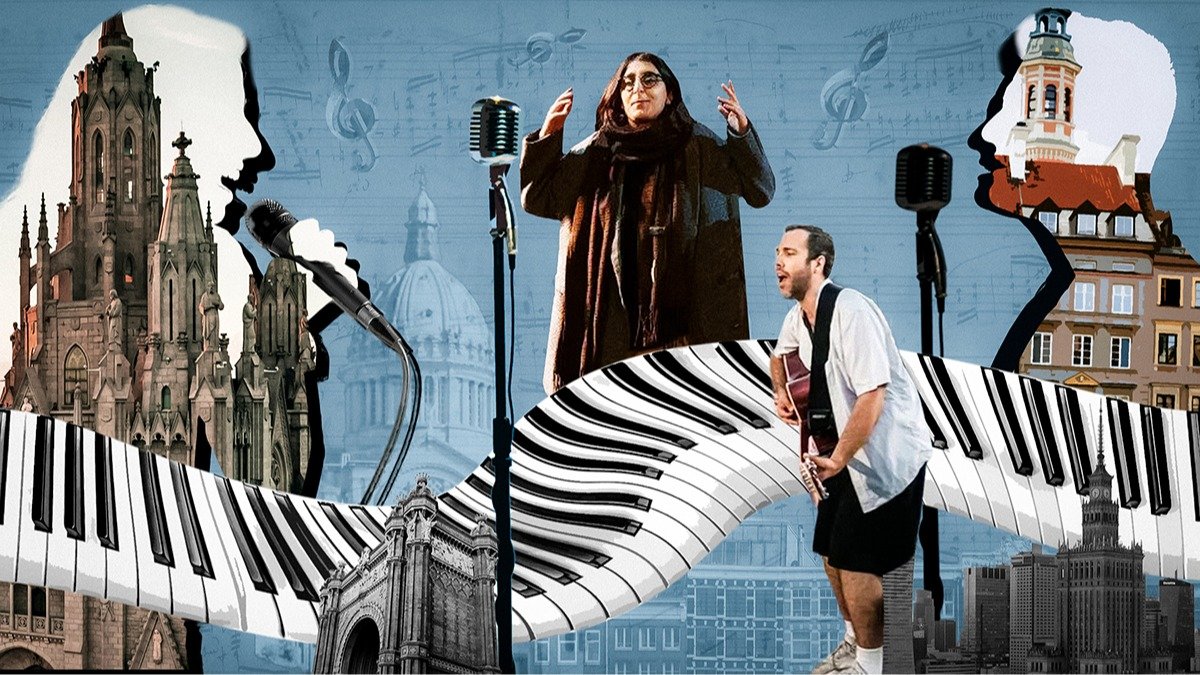
Illustration: Novaya Gazeta Europe. The text was first published on the website of the project "Veter". The Catholic church in the center of Barcelona is almost empty this evening. The padre rolls a piano to the altar. In a few minutes, music will fill the vaults. Not a liturgy, not a gospel, and not a church hymn. People gather at the altar. Most of them hold sheets of song lyrics. Choir director Elsa sits down at the piano, raises her head, and counts in Russian: — One, two, three. The church fills with voices. The sound rises under the high vaults, enveloping from all sides. The song "The Last Poem" from the 1981 film "You Never Dreamed Of" sounds: "The eternal law that conquers death is my love..." After the wave of emigration in 2022–2025, amateur choirs began to appear in various cities around the world: in Tbilisi, Yerevan, Batumi, Amsterdam, Belgrade, Warsaw, Lisbon, Barcelona, Haifa. These are groups of ten people and large collectives. Somewhere there is an audition. But most often, the doors are open to everyone. Choirs perform on the streets, in metro underpasses, on rooftops, at concert venues, and sometimes — as in Barcelona — under the vaults of a church. "Veter" correspondent attended a rehearsal of the "Saturday Choir" in a church, spoke with participants and organizers of choirs in Warsaw and Barcelona, and also asked a psychologist why collective singing is especially important for people in emigration. Rehearsal in Barcelona In the evening, Consell de Cent street is as noisy as usual. People are walking, sitting on benches, talking in different languages. The Catholic church Parroquia de Sant Gaietà hardly stands out among the neighboring buildings. From the street, it looks small. Closer to five in the evening, a group begins to gather at the entrance — about fifty people, all speaking Russian. A mother and son walk by, he looks at the crowd and asks: — Why are they all gathered here? The mother shrugs: — Probably to protest. A girl standing nearby laughs and replies: — No. We've gathered to sing. We have a choir. Join us. At five o'clock, the church doors open, and everyone goes inside. From the outside, the room looked small, but inside, the height of the vaults is striking. Small stained-glass windows under the roof provide almost no light. Chandeliers light up above the altar, casting a yellow glow throughout the church. Saturday Choir, Barcelona. Photo: Asya Moroz. People sit on wooden benches. Choir director Elsa introduces herself and asks how many newcomers there are today. Several hands go up. Padre Miguel — a silent, white-bearded man — comes to the altar. He places a music stand next to the piano, casts a short, intense glance at the attendees from under his glasses, and leaves. Elsa leads breathing exercises. „ With their eyes closed, people repeat sounds and scales after her. Rhythmic breathing gradually fills the space. The participants look more relaxed, smiles appear on their faces. Psychologist and consultant on child-parent relations and adaptation to emigration, Elena Aaron, explains: — Singing has a direct physiological effect on the nervous system. It is associated with a long, slow exhalation and the vibration of the vocal cords, which stimulates the vagus nerve — one of the key mechanisms of stress regulation. Breathing becomes deeper and more rhythmic, heart rate stabilizes, and tension levels decrease. The exercises end, and the choir members gather at the altar. Everyone has sheets of song lyrics in their hands. Elsa begins to play the piano. An elderly man enters the church with the help of a walker — the only listener. He quietly sits on a bench in the distance and stays until the end of the rehearsal. Don't Be Afraid to Sound The "Saturday Choir" in Barcelona was founded by three girls: Lana, Arina, and Elsa. Each came to this idea in her own way. Lana is the founder of the community "Kvartirnik," one of the most prominent organizers of Russian-speaking cultural events in Barcelona. She is Kurdish by origin. Her family fled war and genocide from Kurdistan when Lana was still a child. They first lived in Armenia, then moved to Russia. Lana grew up in a very traditional family where women are taught to become wives and mothers. Her sister got married at fourteen, woke up at five in the morning, tended livestock, and managed the household. Kurds have their own schools and cultural centers, so Lana rarely attended Russian school. She started learning Russian at sixteen, and by eighteen, she was thinking in it. Now it's part of her identity. That's why "Kvartirnik" was created — a place where Russian-speaking people meet, where you are welcome regardless of origin, where friendliness and safety are the norm. Lana got the idea for the choir while watching a scene from a Pedro Almodóvar film where women walk to a river and sing. — I can't cry, — Lana admits, — so the choir became something like an alternative to tears for me. It's meditation, and symbolic crying. Or maybe laughter. I was literally shaking when I heard over seventy people singing. It seems healing after the experience we've had in recent years. Lana, choir organizer in Barcelona. Photo: Asya Moroz. Arina moved to Spain about nine years ago from Ufa. — I've never felt exclusively Russian, — she says. — I'm from Bashkortostan, I have Tatar roots, but also Polish and Ukrainian. Arina studies art history at the University of Barcelona and teaches Spanish and Catalan. At "Kvartirnik," she gives lectures on art and music, organizes concerts by musicians, and conducts tours of lesser-known places in Catalonia. Arina had long dreamed of organizing a concert in a church. In the autumn of 2025, she talked with Lana and Elsa, who also dreamed of creative collaboration with different people. Arina took on negotiations with the church. According to her, each community in Catalonia lives by its own rules. Some strictly adhere to canons, while others work on social projects and host concerts. The Parròquia de Sant Gaietà church belongs to the latter category. When Arina approached them with the idea of an emigrant choir, the administration was cautious. — The padre showed some skepticism because he didn't believe we would gather a large number of people, — she recalls. — He agreed to provide us with space, but on the condition that we would have at least 40 people. Despite the priest's expectations, over 70 people attended the first meeting. According to Arina, Padre Miguel was so surprised that he walked around and filmed the singers on his phone. Elsa had dreamed of creating her own choir for about two years. Once, she saw a group of Catalan elderly people in the metro at Passeig de Gràcia station: they had set up a piano and were singing. Later, Elsa often came to listen to them in different parts of Barcelona. She doesn't have a higher musical education. This used to bother her, but now she sees it as an advantage. Many of her students talk about childhood traumas from music school, after which they forbade themselves to "sound." „ "If you want to sing, then you can, everyone can sing, and I embrace those who are afraid to sound," she repeats at rehearsals. One of Elsa's students once burst into tears, saying, "I've been given the right to make mistakes." — A choir can be seen as a space for play, — believes psychologist Elena Aaron. — Canadian play researcher Stuart Brown describes it as a state in which a person is temporarily freed from the pressures of reality and social roles. Choral singing creates such a space. During singing, a person can express emotions through their voice, immerse themselves in music and the experience of the moment. The atmosphere of safety is important: without fear of judgment or condemnation. Kvartirnik. Photo: Asya Moroz. Singing Means I'm Alive In the "Saturday Choir," you can find people with musical education, former street musicians, and those who have never even sung in the shower. Everyone has their own reason for coming. Anastasia moved from Russia to Spain in the winter of 2022. She lives an hour and a half from Barcelona but doesn't miss rehearsals. — I have depression, — Anastasia shares. — I've been in therapy for six months. Now I'm going through a period where I experience few emotions: neither negative nor positive. I've wanted to find a place where I can sing not alone, and in a beautiful church. At the first rehearsal, when "You are not alone" started playing, tears welled up in her eyes: "I felt: here I am breathing, here is my voice, I am alive." Elina was born in Lithuania but lived most of her life in Russia. In 2022, her employer organized the relocation of its employees to Spain. Elina expected her colleagues to communicate with each other as they did in Moscow, but this did not happen. Elina had a problem at work: she spoke quietly and was often not heard. After consulting with a psychologist, she decided that a choir could help. — Elsa's charisma just swept me away, — says Elina. — She is calm and accepting. And when I hear my voice merging with the voices of others, and I watch videos of our rehearsal — it's pure delight. Elina noticed that from rehearsal to rehearsal, it became easier for her to sound, to sing louder. Liliya is a nutritionist from Rostov-on-Don. She moved to Lithuania in 2016. Since then, she has lived in Sweden, Estonia, Andorra, and several other countries. Barcelona became her sixteenth move. „ — The hardest thing about moving, — says Lily, — is the lack of a stable social circle. I didn't have a huge number of friends in Russia, but I had a sense that somewhere nearby there were people with whom I could eat or sing a familiar song. Lily studied at a music school, learned to play the guitar on her own, became interested in Tolkien, elven songs, and hitchhiking. She sang in Moscow underpasses and in a church choir. — I wanted to befriend a girl from the choir, so I started singing there, — recalls Lily. — Orthodox traumas are a separate story. When you are an 11-year-old child, and you are forced to take a caffeine pill every hour during the night service so you don't fall asleep, what's good about that? Parroquia de Sant Gaietà Church, Barcelona. The padre closes the piano. Photo: Asya Moroz. Despite her past experience, she now enjoys singing in church. Katya works in the IT field. Immediately after the start of the war, she relocated to Spain with her husband. But literally a month later, they divorced. In the new country, Katya had a difficult time both emotionally and financially. After learning about the choir, she decided to join to expand her circle of friends. Singing itself was secondary. — Right during the rehearsal in the church, I would spot girls I found appealing and suggest going for coffee after the session, — Katya recalls. — Or just chat a bit. Katya has already made some acquaintances and hopes these relationships will grow into friendships. — Several studies have shown that collective singing can increase oxytocin levels — a hormone associated with trust and social contact. This explains why after choir rehearsals, people often report a feeling of closeness, improved mood, and a sense of belonging to the group, — explains psychologist Elena Aaron. Kristina came to Barcelona to her Catalan husband in November 2021. Before that, she had a career in Moscow, working as a project manager. Now she is studying psychology at universities in Barcelona and Moscow and simultaneously trying to adapt to the new country. The most difficult part turned out to be communication. She knows Spanish well, but she is still shy about speaking. Kristina has never sung — neither in the shower nor on stage. „ — I allowed myself to relax, release my emotions, have a great time, enjoy myself, and communicate with people, — says Kristina. — There are many reasons for sadness now, but I still want to improve our overall well-being, at least a little. "Wind of Change" over Warsaw In the Barcelona "Saturday Choir," there are no language restrictions: songs in any language of the world can be performed — Spanish, Russian, Armenian, Catalan. For the first rehearsal, Elsa chose Michael Jackson's song "You are not alone." Later, people suggested their own options, and "The Last Poem" won by vote. — I'm not surprised by the choice of Russian songs, — says Lana. — Everyone is tired. Many people live here without the possibility of returning home. For four years now. It feels like many are in some kind of pit. The choir is a living organism and a good indicator of what's happening with people, what they need now. And I hope it will remain so alive. But the choice of songs can still lead to unpleasant situations. This happened to Katya, the creator of the choir in Warsaw. She moved to Poland from St. Petersburg in 2021 and planned to live in two cities. But in February 2022, returning home became impossible for her. Choir in Warsaw. Photo: Katerina's personal archive. Katya sang since childhood — first in a group where she was a soloist, then performed in club projects. In the autumn of 2024, she simply decided to form a choir. Without a grand plan or long preparation. Various people came: some with musical education, some without, some out of curiosity, others because they had long wanted to sing. After that meeting, it became clear that this could become a regular project. Before one of the rehearsals, Katya suggested performing the song "Seventh Petal." Someone remembered that it was performed by Mitya Fomin from the group Hi-Fi, who now supports the war. And people wrote in the chat that they wouldn't come because of the song choice. Katya hadn't even thought to check the song in that context, as she found it in an acoustic performance by another artist. — It's sad that someone was upset, — she says. — I just want to enjoy the music, the company, the atmosphere. But now the Russian-language repertoire has to be checked additionally. It's tiring. Nevertheless, conflicts are rare. The main mission is to create a safe space where you can feel at home and "scream it out" for emotional release. One of the most memorable rehearsals of the Warsaw choir took place on a rooftop. It offered a view of the Palace of Culture and Science — the city's main Stalinist skyscraper. All participants were dressed in white. The sun slowly set behind the buildings, and lights began to turn on in the windows. Then the pianist started playing, and the choir sang "Wind of Change." "It was very beautiful, inspiring," recalls Katya. Rooftop choir in Warsaw. Photo: Katerina's personal archive (Warsaw choir leader). Psychologist Elena Aaron comments: — When people sing together, another important mechanism arises — co-regulation of the nervous system. Participants begin to breathe in a similar rhythm, hear each other's voices, and feel the collective sound. Music psychology research shows that collective singing can reduce the stress hormone cortisol and enhance the sense of social connection between participants. Galina moved to Poland from Ukraine back in 2013. First, she lived in a small town where she couldn't integrate due to the closed nature of the local society. But after moving to Warsaw, Galina found friends. Choir organizer Katya is one of them. Once, as a child, Galina sang loudly and passionately. Doors were not locked. Suddenly, a neighbor ran into the room: "God, who is shouting so terribly?!" After this incident, Galina stopped singing for a long time. While living in Warsaw, she often got tonsillitis. Somewhere she read that throat illnesses can be linked to suppressed emotions. So she joined the choir. „ — I feel fine about Russian songs, — says Galina. — We sang them all our childhood, we grew up with them. I believe that in every country there are both good and bad people. I don't distinguish them by their place of birth. Katya selects the repertoire for the Warsaw choir herself or proposes a vote. But there is one tradition. It appeared by chance. At the end of the first meeting, someone asked: "Can we do one Meladze song?" Katya quickly found the backing track, and the choir sang. And since then, it has become the final ritual. — Every rehearsal, regardless of the style, we end with Meladze, — laughs Katya. Under One Umbrella... The rehearsal in the Barcelona church is coming to an end. An elderly woman from the church administration stands at the door, holding a box of "buñuelos," national Catalan pastries resembling round donuts covered in sugar, and asks everyone to help themselves, to take plenty. The padre, still silent, covers the piano keys with a cloth, closes the lid, and turns off the light above the altar. It's raining outside. Some people leave immediately, but many remain standing under the church canopy, arranging to meet, sharing their impressions of the rehearsal. Someone timidly asks: — Excuse me, which way are you going? — I'm going to Plaça Catalunya, by metro. And you? — Oh! Me too! Are you without an umbrella? Come under mine... Asya Moroz
TL;DR
- Russian-speaking emigrants are forming amateur choirs in cities like Barcelona and Warsaw to combat loneliness and anxiety.
- Collective singing offers physiological benefits, reducing stress and enhancing social connection.
- These choirs provide a safe space for emotional expression and a sense of belonging for those in displacement.
- Initiatives like the "Saturday Choir" in Barcelona and a choir in Warsaw involve participants from diverse backgrounds, united by a shared love for music.
- Organizers and participants share personal stories of how singing helps them cope with emigration challenges and trauma.
Continue reading the original article