March 2, 2026
US and Israel War with Iran: Will there be a ground operation? And 11 other key questions after the first days of the new phase of the conflict
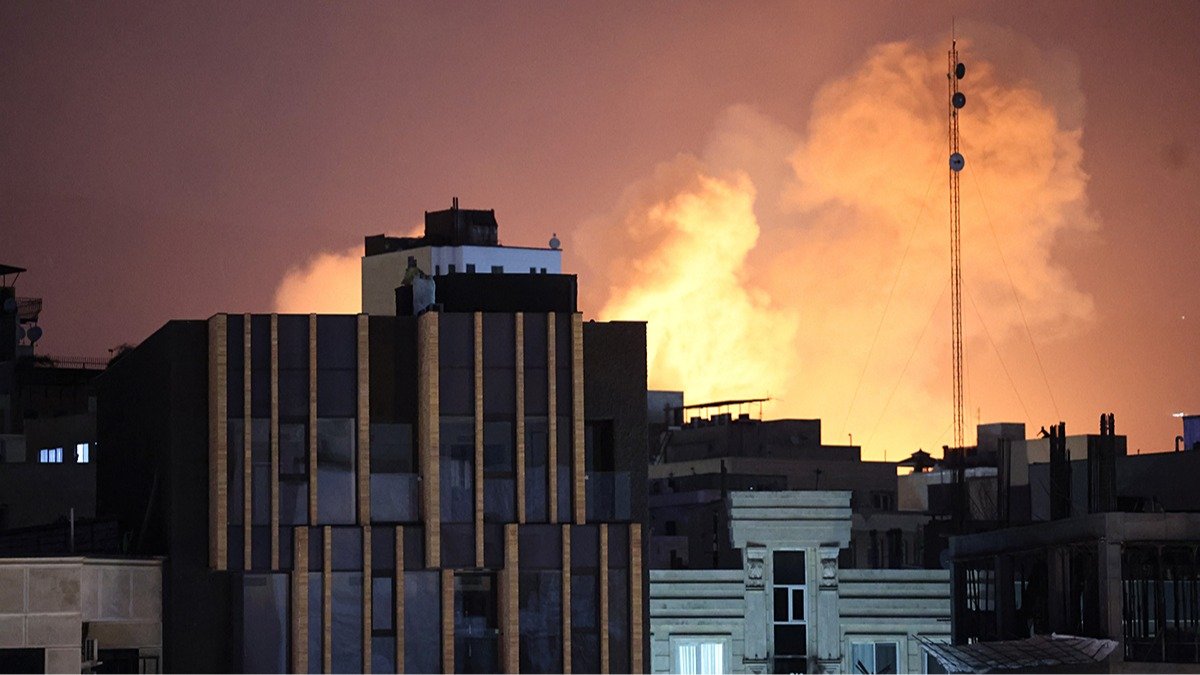
The attack on Iran has become one of the largest military operations in recent times: the US and Israel have not only struck nuclear facilities but also eliminated Ayatollah Ali Khamenei, the man who ruled Iran for 37 years. Trump is calling on Iranians to "take power into their own hands," Tehran is shelling American bases throughout the Persian Gulf, tankers are stuck in the Strait of Hormuz, and oil and gold prices are sharply rising. Why did Trump take this step, how is the war already affecting the whole world, and what will happen to the ayatollahs' regime next? "Novaya-Evropa" answers the main questions about the new war. Smoke and fire rise behind buildings after an explosion in Tehran, Iran, March 1, 2026. Photo: Abedin Taherkenareh / EPA. Who started the war and does everyone consider it a war? In the morning of February 28, Israel announced the start of a military operation against Iran called "Roaring Lion." Almost immediately, US President Donald Trump confirmed that Washington had joined the strikes. The Pentagon called its part of the operation "Epic Fury." The attack began two days after US-Iranian negotiations on Tehran's nuclear program in Geneva ended without an agreement. According to the Israeli military, strikes were carried out on hundreds of targets in western Iran, including missile launchers and air defense sites. The first strikes hit Tehran and other major cities: Isfahan, Qom, Karaj, and Kermanshah. The main target was also the residence of Iran's supreme leader, Ayatollah Ali Khamenei. In response, Iran launched massive counterattacks. Meanwhile, the US Central Command stated that its forces "successfully repelled hundreds of Iranian missile and drone attacks" and that damage to American bases in the region was "minimal and did not affect operations." The current escalation began in January when Trump promised to help Iranian protesters after the country's authorities brutally suppressed popular unrest. Why is Iran not only striking Israel in response, but also across the Middle East? Iran is hitting American targets wherever they are. Iran's targets were not only Israel (particularly Tel Aviv and Jerusalem), but also US military bases throughout the region: in Bahrain (Fifth Fleet headquarters), Qatar, Kuwait, the UAE, as well as targets in Saudi Arabia and Jordan. Where are the US striking, and where is Iran striking? What goals do the parties declare and why did the war start now? Israeli Prime Minister Benjamin Netanyahu said in an address that the operation would last several days and its goal is to prevent the ayatollah regime in Iran from obtaining nuclear weapons. Trump, in turn, stated that Iran is the "largest sponsor of terrorism" that will never obtain nuclear weapons, and that the US intends to "destroy Iranian missiles and level their missile industry." The American leader also claimed that Iran had resumed its nuclear program and was developing missiles capable of reaching US territory. However, The New York Times writes that many of Trump's statements are either false or unproven: according to the newspaper, intelligence agencies found no evidence that Iran was actively trying to create a bomb, and uranium stockpiles were buried after last year's strikes. Orientalist Ruslan Suleymanov suggested in a commentary to "Novaya-Evropa" that Trump had cornered himself: for months he had been building up a huge troop contingent in the region, using it as leverage in negotiations. But Iran did not yield, and the longer the troops remained idle, the more it looked like the president's indecisiveness. To save face, Trump needed to strike. Negotiations had reached a deadlock just before the attack. Iranist Mikhail Borodkin, in a conversation with "Novaya-Evropa," added that for Iran, meeting US demands (giving up uranium enrichment, shutting down its missile program) would mean capitulation. Tehran reasoned that it was better to go to war now than to surrender first and then still be attacked. How is the war affecting the global economy already? One of Tehran's goals was to block the Strait of Hormuz, a key artery for global oil transportation. Due to the hostilities, shipping companies stopped sending their tankers through it. According to Bloomberg, oil tankers began to avoid the Strait of Hormuz immediately after the attacks on Iran began, although several vessels continued to move through the strait. In the wake of the strikes, oil prices have sharply increased: as Bloomberg notes, on the IG Group platform, WTI oil rose to $75.33 per barrel, 12% higher than the closing price on Friday. "Oil and gold prices have already begun to rise sharply on Monday morning. Brent crude oil jumped 6.4% to $77.57 per barrel (at one point briefly exceeding $82). American crude oil (WTI) rose 6.2% to $71.17 per barrel. Gold rose 1.6% to $5360 per ounce. Goldman Sachs analysts predict that the halt of shipping through the Strait of Hormuz for even a month could lead to a sharp spike in gas prices in Europe. According to Bloomberg, citing a bank report, about a fifth of the world's liquefied natural gas exports (mainly from Qatar) pass through the strait. If supplies are interrupted for a month, European prices and spot LNG prices in Asia could rise by 130%. What have the US achieved with its military operation? One of the main targets of the US was the residence of Iran's supreme leader, Ayatollah Ali Khamenei. By March 1, Iranian authorities officially confirmed his death. Ayatollah Alireza Arafi has been appointed interim supreme leader of Iran. Also, according to the Israeli military and Iranian confirmations, key regime figures were killed: IRGC commander Mohammad Pakpour, Defense Minister Amir Nasirzadeh, Khamenei advisor Ali Shamkhani, and others. Trump stated in an interview with Fox News that "48 Iranian leaders disappeared in one blow," and also reported that the US Navy sank nine Iranian warships. In addition, the US, as reported by the country's Central Command on March 2, hit over 1000 targets in Iran. Targets included command posts, ballistic missile deployment sites, and the joint headquarters of the Islamic Revolutionary Guard Corps (IRGC). Iranian authorities neither confirmed nor denied such losses. What are the losses on both sides? The number of deaths in Iran was "at least 555 people," according to data from the Iranian Red Crescent, cited by Al Jazeera. The society also reported that 131 Iranian cities were subjected to attacks by the US and Israel. There is no other independent data on the dead. The strike on a girls' school in Hormozgan province, where, according to Iranian authorities, up to 165 people died, caused particular outrage. This information is difficult to confirm with independent sources, but the BBC and Washington Post have confirmed the authenticity of footage from the scene of the tragedy. Israel also carried out missile strikes on Beirut targeting "Hezbollah" sites. According to the Lebanese Ministry of Health, at least 31 people died as a result of Israeli airstrikes, and another 140 were injured. As a result of an Iranian missile hitting residential buildings in central Tel Aviv, one person died, and more than 20 were injured. At least nine more people died in a strike on a synagogue in Beitar Illit. The city of Beersheba in southern Israel was also hit, resulting in at least ten people injured. The Pentagon also confirmed the deaths of US military personnel: three US servicemen were killed (as part of a support unit in Kuwait), and five were seriously injured. Several others sustained shrapnel wounds and concussions. Later, the US Central Command stated that another of the injured servicemen died from his injuries. Iran launched 165 ballistic missiles, two cruise missiles, and 541 drones at the UAE, according to the country's Ministry of Defense. As a result, according to the authorities, three people died: citizens of Pakistan, Nepal, and Bangladesh. In Kuwait, one person died and over 30 were injured. A five-star hotel building was damaged in the capital of Bahrain. A motorboat sails along the coast near the city of Al-Jir in the Strait of Hormuz in the northern emirate of Ras Al Khaimah, with a tanker visible in the background, February 25, 2026. Photo: Fadel Senn / AFP / Scanpix / LETA. Has the war really led to a collapse of air travel? The closure of airspace over the conflict zone has paralyzed air traffic in the region. According to The Guardian, the aviation crisis has become the most severe since the COVID-19 pandemic, with over 1000 flights canceled worldwide. Israel, Iran, Iraq, Bahrain, Qatar, and Kuwait closed their airspace. Oman closed its capital's airport. Leading world airlines, including Lufthansa, Air France, British Airways, Turkish Airlines, and Qatar Airways, have suspended flights. "Russian carriers have also suffered: Aeroflot has urgently changed flight routes to Dubai, Abu Dhabi, Doha, and the Maldives, and canceled some flights. An S7 Airlines plane flying from Novosibirsk to Dubai was forced to land at a reserve airfield in Karachi, Pakistan. Russians planning trips or returns home through the Persian Gulf countries faced mass delays and cancellations. In the United Arab Emirates, some tourists are unable not only to leave the country but also to pay for subsequent accommodation in Dubai. According to the Russian Association of Tour Operators, about 20,000 Russians are stranded in the UAE. Will the regime in Iran change now? This is one of the main questions for which there is no definitive answer yet. On the one hand, the US killed a key figure, Ali Khamenei, who ruled for almost 37 years. Trump, in his address, directly called on Iranians to "take power into their own hands." There were also reports that people in Tehran and other cities were celebrating the ayatollah's death. On the other hand, according to orientalist Ruslan Suleymanov, there is no united opposition in Iran capable of taking power, and the influence of Prince Reza Pahlavi, who lives in exile in the US, is small within the country. Furthermore, formally, power has temporarily passed to a council that includes President Masoud Pezeshkian and the head of the judiciary. However, the new Supreme Leader must be chosen by a council of theologians, which is extremely difficult to convene in wartime conditions, notes the BBC. Iranist Mikhail Borodkin, in a conversation with "Novaya-Evropa," urged "not to rush with predictions," but noted that if the Iranian regime is significantly weakened now, "various processes could begin in Iran that would lead to its collapse": from civil war to "semi-dissolution of the state," where separate groups would control separate territories. However, as the expert noted, a normal transformation as a result of a transitional period is quite possible. Are the US at war with Iran? Formally, no. From a legal point of view, as the BBC notes, the situation is complex. De facto, the US is waging a full-scale air and sea war with Iran, but de jure, a state of war has not been declared. The US Constitution (Article I, Section 8) requires Congress to declare war, but it has not done so. However, President Trump initiated what he himself called "major military actions," using his constitutional powers as commander-in-chief. Democrats have already accused Trump of violating the Constitution and called for the adoption of a War Powers Resolution, which could block the president's actions. However, given that Congress is controlled by Republicans, the chances of such a resolution being adopted are very slim, the BBC reasons. Will the US risk a ground operation? According to available data, a ground operation is not planned. Republican Senator Tom Cotton stated that the president has no plans to deploy large ground forces into Iran. According to him, the operation will be limited to an air and naval campaign, with the only possible exception being search and rescue missions to evacuate downed pilots. According to The Guardian columnists Rajan Menon and Daniel DePetris, neither the US nor Israel will deploy ground troops. However, Iran cannot be destroyed by air and missile strikes alone; organized resistance on the ground is needed, analysts noted: "By calling for a mass uprising, they are essentially asking unarmed Iranians to act as their ground troops." A building of a primary school for girls, which, according to Iranian television, was hit by a missile, February 28, 2026, Iran. Photo: AFP / Scanpix / LETA. Meanwhile, on March 2, the Israeli army stated that it does not rule out a ground operation in Lebanon: according to a military representative, "all options remain on the table." "Hezbollah," an Iranian proxy created in 1982 by IRGC fighters and remaining Tehran's main ally in the Middle East, is based in Lebanon. Today, Lebanese Prime Minister Najib Mikati announced a ban on "Hezbollah's" military activities, apparently trying to distance the legitimate government from the escalation of the conflict with Israel. How is the world reacting to the new conflict? Russia has taken a sharply critical stance towards the US and Israel. The Russian Ministry of Foreign Affairs called the attacks a "planned and unprovoked act of armed aggression." Vladimir Putin expressed condolences over Khamenei's death, calling him an "outstanding statesman." Europe has called for "maximum restraint": European Commission President Ursula von der Leyen expressed "serious concern." France requested an urgent meeting of the UN Security Council. Norway directly stated that the attack may not comply with international law. Great Britain, Italy, and Spain limited themselves to calls for de-escalation and concern for the safety of their citizens. Neighbors in the region found themselves in a difficult position. Officially, the UAE called the strike a violation of Iran's sovereignty and reserved the right to respond. Kuwait, Qatar, and Bahrain, whose bases were hit by Iran, reported repelling attacks. At the same time, Saudi Arabia, which publicly called for diplomacy, as The Washington Post found out, privately pushed Trump to strike, fearing Iran's strengthening. The Chinese Ministry of Foreign Affairs stated that "Iran's sovereignty, security, and territorial integrity must be respected." The Pakistani Ministry of Foreign Affairs condemned, in its words, "unjustified attacks on the Islamic Republic of Iran," as well as Iran's retaliatory attacks. Smoke over the port of Jebel Ali after debris from a shot-down Iranian missile hit it in Dubai, United Arab Emirates, March 1, 2026. Photo: EPA.
TL;DR
- US and Israel launch a major military operation against Iran, codenamed "Roaring Lion" and "Epic Fury," targeting hundreds of sites.
- Supreme Leader Ayatollah Ali Khamenei is reported killed, with Ayatollah Alireza Arafi appointed interim leader.
- Iran retaliates with missile and drone attacks on US bases in the Persian Gulf and Israeli cities, including Tel Aviv and Jerusalem.
- The conflict has caused a surge in oil and gold prices and disrupted global shipping, particularly through the Strait of Hormuz.
- Air travel is severely impacted, with over 1000 flights canceled globally as multiple countries close their airspace.
- The US claims to have hit over 1000 targets and eliminated key Iranian figures, while Iran reports minimal damage to its bases.
- Casualties reported include hundreds in Iran, dozens in Lebanon from Israeli strikes, and three US military personnel.
- The international community's reaction is divided, with Russia condemning the attacks and Europe calling for restraint.
- The long-term impact on Iran's regime remains uncertain, with potential for internal instability or transformation.
- The US has not formally declared war, raising legal and constitutional questions about military actions.
- A ground operation is not currently planned by the US, but Israel has not ruled out one in Lebanon.
- Saudi Arabia privately encouraged the US strike, while China and Pakistan have called for respect for Iran's sovereignty.
Continue reading the original article