February 18, 2026
Listen to the BBC at Night. Russian authorities continue to block Telegram, while simultaneously limiting propaganda capabilities. Soviet officials also struggled with radio
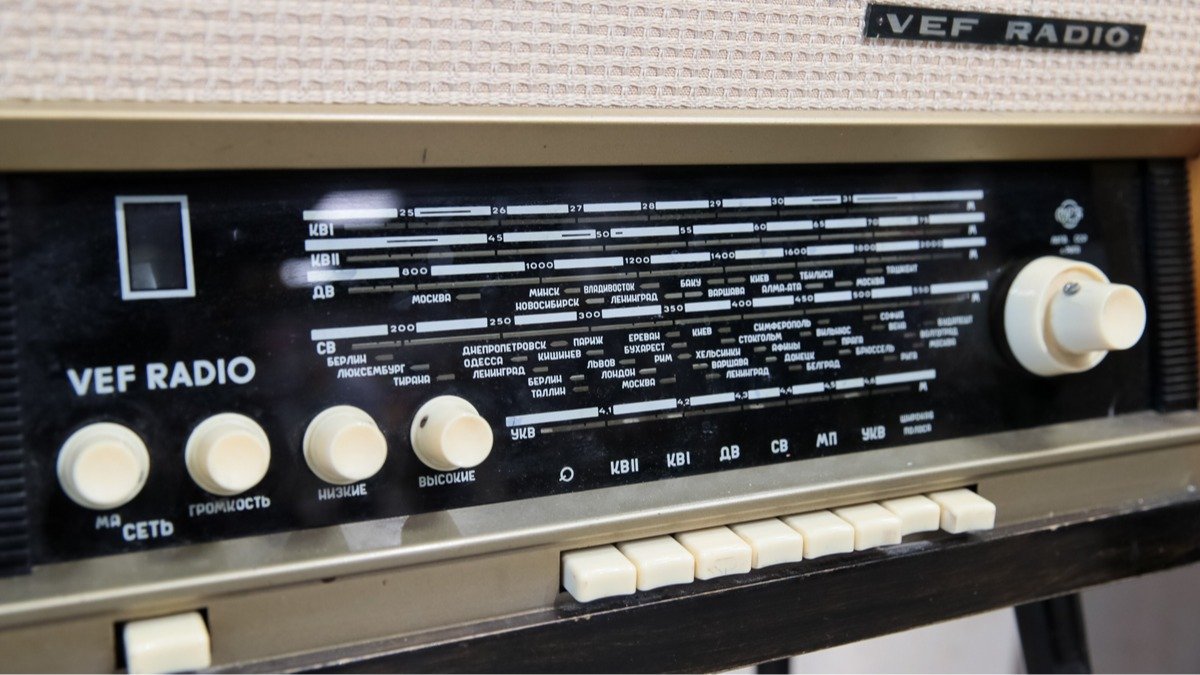
For Russian citizens, Telegram is no longer just a messenger. It is a full-fledged mass media, one of the main platforms for receiving news, discussing public events, and exchanging opinions. The motives of the state, which is trying to block the platform, are understandable: at least to transfer users to the controlled Max application, and in the long term, to bring Russian society under total information control. A VEF Radio radiola (Riga, 1972), presented at the opening of the Museum of Radio and Television, Moscow, March 27, 2024. Photo: Vasily Kuzmicheonok / AGN "Moscow". It is quite obvious that such measures will inevitably worsen the quality of life for Russians. At the same time, they will almost certainly interfere with Russian propaganda itself, as many pro-government media and channels actively use Telegram as the main platform for disseminating their messages. Not to mention that participants of the "SVO" often use Telegram for communication. In this sense, the current situation is largely reminiscent of the blocking of Western radio stations during the USSR. Then, the Soviet leadership, on the one hand, sought to limit the penetration of Western information and culture, and on the other hand, weakened its own broadcasting and propaganda system. Already in the first post-war decade, a massive radiofication campaign began in the USSR. In 1955, the total number of radios in the country reached 33 million, and ten years later, this figure doubled. These were no longer street loudspeakers, but autonomous wireless receivers. „ So, if earlier listening to the radio was a collective practice (for example, on the street), now it has become an individual activity, much more difficult to account for, observe, and control. Moreover, these receivers had a serious "shortcoming" - they could receive short-wave transmissions. This meant, as the head of Glavradio A. Puzin complained, that with their help it was possible to listen not only to Soviet but also to foreign programs with "vile slander against the Soviet Union." But the production of radios with short-wave capabilities continued anyway, as such receivers were the fastest way to bring radio to the people, especially in villages where there was often no electricity and the necessary infrastructure. And a short-wave receiver could work in such conditions. "VEF Spidola-10" radio receiver, intended for the domestic market. Photo: Pudelek / Wikimedia (CC BY-SA 3.0). In 1958, the Central Committee conducted an investigation: it turned out that up to 85 percent of short-wave receivers were located in the European part of the USSR, where, as officials noted, "there was nothing to listen to except enemy radio." Moreover, by the end of the 1950s, about sixty foreign radio stations could be heard on the territory of the USSR. The Soviet leadership had to use a "jamming" system. The costs of "jamming" were colossal - "hundreds of millions of rubles," according to Central Committee officials. This amount exceeded the USSR's expenses on domestic and international broadcasting combined. But despite the entire jamming system, in many places outside Moscow and Leningrad, "enemy voices" could be heard without much difficulty. Moreover, due to jamming, republican and all-Union radio did not work in many places - it turned out that the system limited itself. As a result, "enemy radio" essentially remained the only accessible one, and sometimes collective farmers listened to "Voice of America" and BBC in their villages. In 1953, the Council of Ministers announced the accelerated construction of radio jamming stations. In response, the US, UK, and other foreign broadcasters developed effective ways to bypass blockages - for example, they broadcast on waves as close as possible to Soviet ones. The USSR built even more jamming stations. But by the mid-1950s, the Soviet side was clearly losing this war. „ One Soviet official admitted that even with "unlimited funds," it was impossible to isolate the USSR from foreign radio broadcasts, and jamming threatened to paralyze the Soviet radio network itself. Many Soviet citizens tried to tune into foreign radio themselves. In the 1960s and 1970s, many Soviet citizens bought high-quality radios - the Latvian "Spidola" or, if possible, the German "Grundig." People turned the receiver on its side or upside down, stuck the antennas out the window; and even left big cities for dachas, where jamming was less effective. "We even listened to Vatican Radio, which gave a good overview of what was happening in the Soviet Union, and we were not bothered that the announcer at the end added 'God bless you,'" recalled historian Sergey Ivanov about his experience. When the Soviet army invaded Czechoslovakia in the summer of 1968, vacationers listened to news on the beaches of the Baltic Sea. Political scientist Masha Lipman, who was in Lithuania at the time, recalled: "That summer, antennas soared everywhere on the beach. And in our circles, if they said they heard about it 'on the radio,' it meant only one thing - the Russian-language broadcasts of 'Voice of America,' BBC, or 'Deutsche Welle.'" Technician at the control panel of "Radio Free Europe" and "Radio Liberty" stations in Munich, West Germany, August 11, 1977. News broadcasts in 22 languages to the USSR and Eastern Bloc countries were broadcast from here. Photo: AP / Scanpix / LETA. Listening to foreign radio in itself was not a crime. It all depended on who listened to what. Estonians, for example, listened to Finnish radio, residents of Tajikistan listened to religious broadcasts from Iran, and Siberians learned about the cultural revolution in Beijing. In 1957, a young Ukrainian plumber was arrested under Article 58 for "recounting foreign radio broadcasts and anti-Soviet poems to workers since the summer of 1956." At the same time, in 1968, a man on an Estonian beach accidentally broadcast a "Voice of America" report to the entire beach - his receiver turned out to be connected to the public address system. But he managed to avoid punishment. Soviet authorities did not know exactly what percentage of citizens listened to foreign broadcasts. In the mid-1970s, the KGB cited a study by the USSR Academy of Sciences, according to which 80% of Moscow students listened to foreign radio stations. Some students posted texts rewritten from BBC broadcasts on the walls of institutes. „ Others openly asked officials when they visited universities: "What is shameful about a person listening to the BBC? Who is interfering with broadcasts from abroad and why?" In 1958, Soviet industry nevertheless stopped producing short-wave receivers with high-frequency ranges. Then listeners began to use low-frequency "evening bands." It is not for nothing that the famous rhyming saying appeared at that time: "There is a custom in Russia - to listen to the BBC at night." The rise to power of Mikhail Gorbachev in 1985 and the policy of glasnost put an end to the jamming of foreign radio stations. Based on: Kristin Roth-Ey, Moscow Prime Time: How the Soviet Union Built the Media Empire That Lost the Cultural Cold War (Cambridge, MA: Harvard University Press, 2011).
TL;DR
- Telegram is a primary news and discussion platform for Russians, and blocking it aims for information control.
- The state's motive for blocking Telegram is to shift users to controlled platforms and exert total information control.
- Blocking Telegram may degrade the quality of life for Russians and hinder pro-government media that use the platform.
- The situation is compared to the Soviet era when Western radio was jammed, which also weakened Soviet broadcasting.
- The USSR's extensive efforts and costs to jam foreign radio proved largely ineffective.
- Despite jamming, many Soviets could still access foreign broadcasts, and censorship often backfired.
- The end of foreign radio jamming in the USSR coincided with Gorbachev's policies of glasnost.
Continue reading the original article