April 19, 2026
“This Church is God’s and answers to no one.” How a women’s monastery linked to the “Putin’s godson’s” family and visited by Patriarch Kirill lives in Ukraine? Material from hromadske
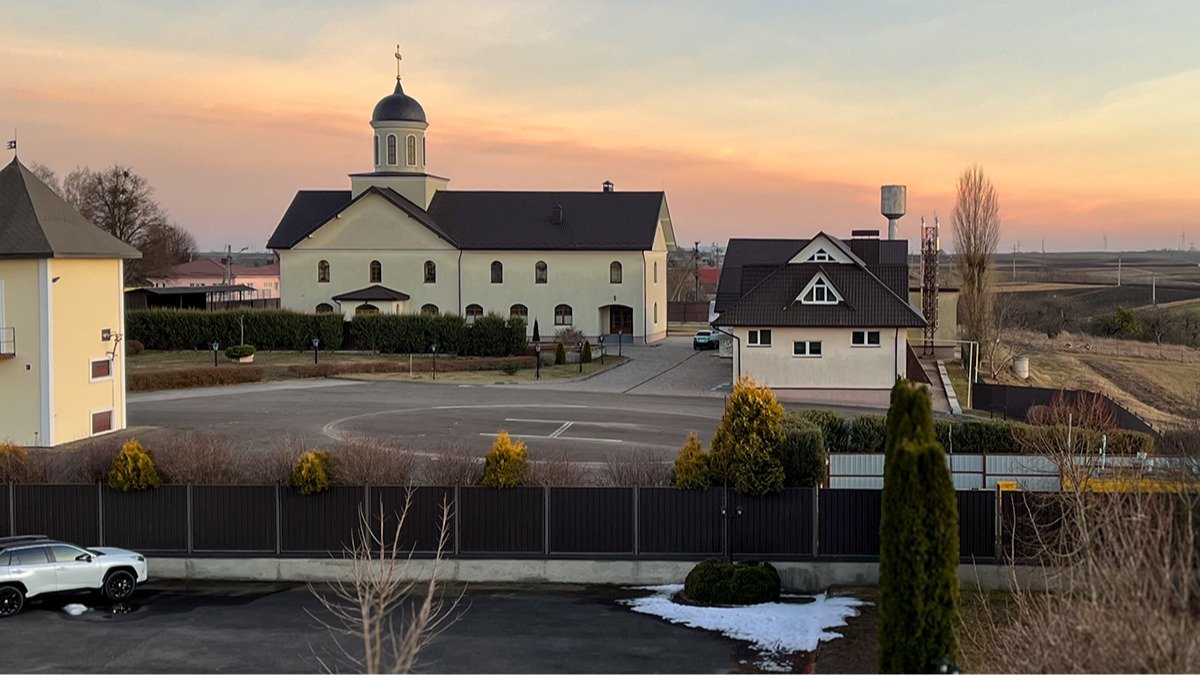
View of the helipad on the grounds of the Zymne Monastery. Photo: hromadske. The material was originally published by hromadske. With the permission of our colleagues, we are publishing its full translation with minor edits. The Zymne women's monastery in the Volyn region is one of the oldest in Ukraine and a national architectural monument. It is also a point of contention in discussions about the activities and influence of the UOC (MP) religious structures. From ruins in 1991 to a modern complex spanning over 16 hectares, including utility buildings, a hotel, and a helipad, the monastery has been restored over decades with the involvement of political elites. In the past, it was visited by ex-presidents Leonid Kuchma and Viktor Yanukovych, and the head of the Russian Orthodox Church, Kirill. Also present were leaders of the banned “Opposition Platform — For Life” (OPZZh) party, including Viktor Medvedchuk, who is known as Vladimir Putin’s godson. He is considered the politician most connected to the monastery, a connection confirmed, according to him, by the abbess. “As far as I remember, Abbess Stefana [the monastery’s abbess] was always called Medvedchuk’s godmother,” says Zoryana Bodyalova, a journalist from the Volyn region. Where are rumors and where is truth? What were the results of the SBU’s checks on the monastery? Are its cult buildings indeed owned by the UOC until 2069? Journalists from the Ukrainian publication hromadske found out how the monastery lives. “We revived this monastery. Why destroy it?” The first written mention of the Zymne Monastery dates back to the late 11th century. The first Volyn saints resided here. Nestor the Chronicler was also here. According to legend, a century earlier, Prince Volodymyr founded the monastery, building two churches and a winter princely residence on the high bank of the Luga River. Around it were fortress walls and defensive ramparts. Initially, the monastery was male. In the 18th century, it suffered destruction during the rule of the Uniates. A hundred years later, monastic life began to revive, but as a women’s monastery. In 1939, it was closed by the Soviet authorities. It wasn't until 1991 that the first inhabitants arrived in the village of Zymne (a suburb of Volodymyr), to the monastery, which was in ruins. Among them was Stefana, who has been the abbess of the Holy Dormition Zymne Women's Monastery for 34 years. “We came to ruins after the communists. [There was] not a stone on a stone, the walls were dismantled. But we did it, we revived this monastery for the Ukrainian people. Not Muscovites travel here... And the church simply flourished. Why destroy it today?” said Abbess Stefana in her last interview in 2023, responding to accusations of the convent's benefactors having ties to Russia. Ruins of the Zymne Monastery, 1988. Photo: Wikimedia. Two years earlier, she had welcomed Viktor Medvedchuk’s wife, Oksana Marchenko, with embraces onto the monastery grounds. Marchenko was filming another episode of “The Pilgrimess” in Zymne, called her “dear mommy,” and said they had known each other for many years. Matushka Stefana was among the honored guests at Medvedchuk and Marchenko’s wedding in 2003. A hotel for 100 hryvnias and few pilgrims — “Are many people visiting now?” — “Few, very few…” laments a security guard. The four-story monastery hotel, which can accommodate over 150 pilgrims in six-bed rooms and housed displaced persons at the beginning of the full-scale war, is now practically empty. Although accommodation here (including meals) costs only 100 hryvnias per day. The grounds are well-maintained: besides churches, a bell tower, and cells, there is a regency school, its own small dairy farm, plots for gardening, a refectory, a sewing workshop, and even an ophthalmology center where a doctor from Lutsk visits every weekend. About a dozen workers take care of the farm. Zymne Monastery hotel complex. Photo: hromadske. Services are held in Church Slavonic in the main stone church of the Zymne Monastery, the Dormition Cathedral. However, during the liturgies, there is a prayer “for the soldiers.” — Soldiers are remembered every day. For all soldiers on the battlefield, those who perished and those missing in action. These are terrible times. Now prayers must be directed to God to stop the war... And to stop the persecution of the Orthodox faith, — says one of the respected nuns. There are about forty nuns here. — In our [village], almost every house has someone either at war, killed, or captured. Here we have a matushka whose son is an officer. And he has been in captivity since the first days of the war, — says a local resident, a parishioner of the monastery. She adds with a sigh that there are few people here now: — They used to visit. But now things are stirred up everywhere... — referring to the transition of some communities from the UOC to the OCU. — They are pounding away, dividing, and turning people against each other... They say: “Ah, these are ‘katsaps’ here, they are Russians!” How are they Russian when this has always been the Ukrainian Orthodox Church? What is Russian about it? It is God’s Church. And it answers to no one. Well, Patriarch Kirill visited... So what. That’s history, — a nun laments. The pilgrim hotel comes alive when organized groups arrive. For example, for the third time, an event was held here for women and children of fallen soldiers — the program included master classes, a tour, psychological sessions, and a meeting with the abbess. According to the monastery, 30 women found “spiritual support, peace, and comfort” here. At the same time, how psychologists are selected and where the funding comes from, including for the maintenance of the large complex, the convent did not answer by the time of publication. Abbess Stefana refused an interview during Lent. “No contact with the Medvedchuks, but I pray for them” After spending a few days at the Zymne Monastery, we did not notice any overtly pro-Russian narratives there. The monastery has stavropegia, meaning it is directly subordinate to the head of the UOC, Metropolitan Onufriy, but not directly to the Russian Orthodox Church, unlike, for example, the Korets Monastery. Regarding possible ties with Medvedchuk and financing, we could not communicate with the abbess. During a service in the Dormition Cathedral on the grounds of the Zymne Monastery. Photo: hromadske. Judging by her last interview with local journalists, she responded to the question about the possibility of the monastery joining the OCU by saying: “You have a director. And I am a novice under our Beatitude (Onufriy. — Editor’s note). We are, as they say, on obedience to our primate. Therefore, we personally should not make any decisions. We pray, and our main task is to pray for all people, so that there may be peace, tranquility, and prosperity in our Ukraine, and that people may live in abundance. We pray for everyone who has turned to me... I have many soldiers written down for whom I pray. Morning and evening. And our church prays. And I personally,” said the abbess. She then confirmed that the monastery had received funding from Medvedchuk in the past and maintained close ties with him. However, despite his suspicion of treason and current presence in Russia, she remained steadfast. Abbess Stefana (right), Viktor Medvedchuk, and Oksana Marchenko (center). Photo: open sources. “Just as I do not betray God, I never betray people. Those who helped, who revived it, I pray for them. But we have no contact (with the Medvedchuk family — Editor’s note). But I pray for them. I pray daily. Because they did a lot for the revival of the convent. When our cathedral was in a dilapidated state, he was no longer involved in politics but helped a lot personally. I do not interfere in politics. I never asked him such questions. (...) I gave him a sermon. About the church. About the convent, about history. I know how to live according to the Gospel. I know that,” noted the abbess, finally adding: “Let them decide themselves, these politicians. But do not touch the church. For it is not without consequences, you understand? The church is eternal, God is eternal. The communists fought against it, and who only fought against it. But godless authorities always suffer defeat here.” A question for the Security Service? From the window of the pilgrim hotel, the helipad is visible. In the past, it was used by both Metropolitan Onufriy and Medvedchuk with Oksana Marchenko. Practically adjacent is the village council. Its head, Vyacheslav Katolyk, says he cannot say anything bad about the monastery. And he knows nothing about their financing beyond charitable contributions. Memorial plaque for fallen defenders near the Zymne village council. Photo: hromadske. — The helipad is just a parking spot with an 'H' drawn on it. There is more fiction than reality. It is often confused with Yanukovych's construction of a helipad over the Dnipro (referring to costs of 290 million hryvnias. — Editor’s note). No one flies there today. Honestly, I have never heard the monastery, during services or from the abbess or nuns, say anything against Ukraine or the army, or utter any pro-Russian statements. Never, — assures the headman. According to him, the SBU conducted a check of the Zymne Monastery in 2022 and found nothing. Regarding whether the village council considers it necessary to terminate the lease agreement with the Zymne Monastery (given the entry into force of the law prohibiting religious institutions linked to Russia), he says it is not within their authority. — First, the decision must be made by the church community, and then the decision goes to the regional administration level. I don't see a problem at all. It is overblown. If there are any issues (regarding pro-Russian sentiment. — Editor’s note), it's a matter for the Security Service, not the monastery. But a check was conducted. A bus with armed men cordoned off the territory and checked from the south, but found nothing similar. Therefore, there were no grounds. Under one of the posts by the community head who went to bless willow branches at the Zymne Monastery, many in the comments expressed indignation that he was a parishioner of the UOC-MP church. He responded that he has been attending the monastery since childhood and his greatest dream is for the UOC and OCU to unite. 50-year lease agreement Through decisions of the village council, at least five land plots totaling almost 16 hectares were transferred to the Zymne Monastery for permanent use at various times (from 1992 to 2021). This is effectively a perpetual lease. According to the lease agreement for the buildings, obtained by hromadske, the cult buildings, which are state property, were transferred to the monastery for gratuitous use for 50 years, until December 31, 2069, by a decision of the Volyn Regional State Administration in 2020. The main church of the Zymne Monastery — the Dormition Cathedral. Photo: hromadske. The Volyn Regional State Administration has the right to initiate changes to the agreement or to terminate it, but it is worded such that unilateral termination of its terms is not permitted. The state has leverage to reclaim the monastery, believes MP from the Volyn region Ihor Huz, who appealed to the National Security and Defense Council regarding the check of the Zymne Monastery. — There are possibilities to rely on court decisions, and the state is moving slowly but surely [in this direction]. But if there is a threat to national interests, given the decisions made by the National Security and Defense Council during the war, sanctions and other measures can be taken. I believe that for individual institutions of the UOC, and effectively the ROC in Ukraine, this approach can be taken. Here (in the monastery. — Editor’s note), Medvedchuk was closely integrated, and this is not easily dismantled. Belief in loyalty to Ukraine is possible only by breaking with the ROC and the UOC. But they will likely not go for it, — stated Huz. The State Service for Ethno-politics and Freedom of Conscience, which, in accordance with the adopted law, is conducting research on the affiliation of the Kyiv Metropolis of the UOC with the ROC, states that they have not yet reached the Zymne Monastery. So far, court cases have only been initiated regarding two monasteries: Korets and Holosiivskyi. On the grounds of the Zymne Monastery. Photo: hromadske. — Regarding the research on religious organizations of the UOC, we are moving from the top down within the hierarchical structure of the UOC. We cannot conduct many studies at once because the law requires us to go to court if a religious organization does not comply with our order. Therefore, we must rely on the capabilities of the Service for the Enforcement of Judgments, — noted Vyacheslav Horshkov, coordinator of cooperation with religious communities at the State Service. *** According to the latest sociological survey by the Razumkov Center on the church-religious situation in Ukraine, after the start of Russia's full-scale war against Ukraine, the number of those who identify themselves as adherents of the UOC (MP) has significantly decreased: from 13% in 2021 to 5% in 2025. The largest number of UOC (MP) adherents are currently in the Western region — they constitute 10% of respondents. In the Central and Eastern regions, it's 4%, and in the Southern region, it's 3%. The largest proportion of OCU adherents are among residents of the Central region (53%). In the South, it's 40%, in the East, 37%, and in the Western region, 30%. At the beginning of the full-scale invasion, there were 8,782 churches of the Moscow Patriarchate operating in Ukraine. In almost four years of war, 934 religious communities have officially transferred to the Orthodox Church of Ukraine. Some communities have ceased their activities, but most continue to function, often without indicating their connection to the MP. Therefore, 7,826 churches with ties to the aggressor country remain. At the same time, the OCU notes that they currently have about 9,000 religious communities under their jurisdiction. With the support of "Media Network"
TL;DR
- The Zymne Monastery, a historically significant site, faces scrutiny over its ties to politicians like Viktor Medvedchuk and its affiliation with the UOC (MP).
- The monastery's abbess, Stefana, claims it is independent and solely focused on prayer, despite past funding from Medvedchuk.
- Recent checks by the SBU found no evidence of pro-Russian narratives or activities within the monastery.
- The monastery operates a large complex including a hotel, farm, and workshops, though it currently sees few pilgrims.
- Sociological data indicates a significant decline in adherents to the UOC (MP) since the full-scale invasion, with a rise in communities joining the OCU.
- Religious buildings are being transferred to the monastery on long-term leases, with legal mechanisms existing for the state to potentially reclaim them.
Continue reading the original article