March 19, 2026
Why are cows, goats, and pigs being mass slaughtered in Siberia? No one knows the exact answer yet. An analysis of the main theories, including conspiracy theories.
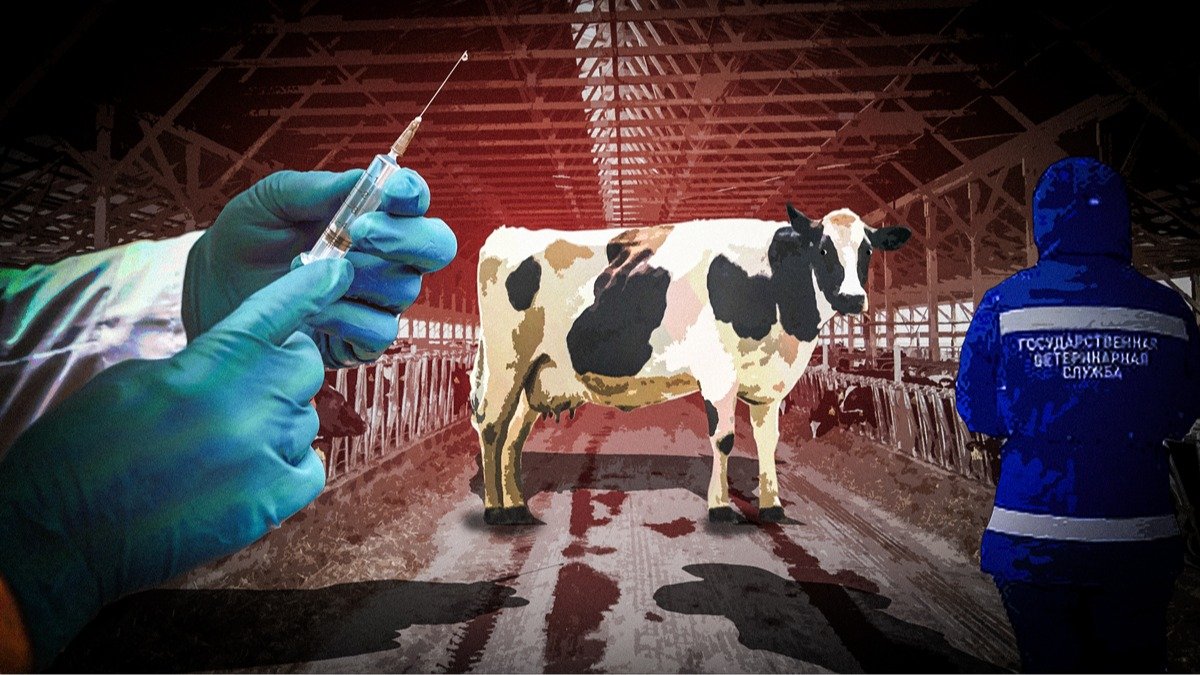
Mass slaughter of livestock is taking place in Siberian villages. Cows and bulls are being destroyed, and their carcasses are burned in special landfills. The authorities often do not tell the owners of the households the reasons for the slaughter of livestock and do not show any documents, only referring to some kind of "especially dangerous disease". All this has given rise to a mass of conspiracy theories – from the fact that foot-and-mouth disease, dangerous for livestock, is raging across Russia, to the fact that the lobby of agroholdings is behind what is happening. We analyze the main versions. Illustration: "Novaya Gazeta Europe". The text was first published on the website of the "Veter" project. One of the first announced reasons for the destruction of livestock was an outbreak of pasteurellosis. The discovery of the infection in the Novosibirsk region became known in early February 2026. Later, rabies was added to it. To deal with the situation, the regional authorities first imposed a quarantine in five municipal districts of the region. But soon veterinarians and police went to private farms. They began to euthanize cattle, the carcasses were taken to a landfill, where they were burned. Even vaccinated animals without any signs of disease were destroyed. Judging by what the farmers themselves say, the owners were not shown any documents, not even a quarantine decree was published or presented to the villagers from whom the animals were taken. At the same time, many experts said that pasteurellosis in domestic animals is easily treated with antibiotics. Rabies is a more serious disease, but the extermination of livestock because of it is an extreme measure and has never been used before, although outbreaks of rabies occur quite often in different regions. In this information vacuum, farmers began to discuss that the real reasons for the slaughter of livestock might be something else. "Veter" tried to figure out these versions. Version 1. There is actually an epidemic of foot-and-mouth disease in the Novosibirsk region. The authorities are hiding it because this disease would require the closure of all meat exports. Photo: Ilya Naymushin / Reuters / Scanpix / LETA. Foot-and-mouth disease is a much more dangerous disease for livestock than pasteurellosis or rabies. It is characterized by lesions on the limbs, udder, and ulcers in the mouth. Foot-and-mouth disease is extremely contagious. It is susceptible not only to animals but also to humans, especially children. Infection can occur through milk or meat of infected cows. However, foot-and-mouth disease does not pose a serious threat to humans. The last time foot-and-mouth disease was recorded in Russia was in 2021 in the Orenburg region, in the village of Karagach. The disease appeared for the first time in more than 50 years and, as farmers assume, was brought from neighboring Kazakhstan. "If it is not localized, it can lead to a major political and economic catastrophe. " And if we assume that it is not rabies, but foot-and-mouth disease in the Novosibirsk region, then the authorities' actions become more understandable," zooprotectionist Yuri Koretskikh told "Veter". At the same time, the authorities have reasons to hide the epidemic. "If the authorities announce this, then problems with meat exports may arise. That's why they might be silent about it. If there is indeed foot-and-mouth disease in the region, then the authorities' actions become understandable. And their secrecy too – they don't want information to leak out, and so that countries like, for example, neighboring Kazakhstan, to which a large export of meat, products, and livestock goes, do not block exports. And large holdings do not lose profits," Koretskikh believes. What confirms or refutes the version About the possibility of foot-and-mouth disease in the Novosibirsk region, the deputy head of the Bagansky rural council, Valentina Zenkova, accidentally let slip when she was called by Ivan Frolov, a journalist from "Narodnoye Televideniye Sibiri". To Frolov's direct question about how long the foot-and-mouth disease epidemic would last in the region, Zenkova replied: "We know that there is such a situation, but no one specifies the deadlines. But this information is not for open discussion." At the same time, other officials interviewed by Frolov denied the foot-and-mouth disease epidemic. Shortly after the story was published, the journalist was detained in Novosibirsk. At the police station, where he was taken in handcuffs, he was told that a check was being carried out under Article 207.1 of the Criminal Code of the Russian Federation (public dissemination of knowingly false information about circumstances that pose a threat to life and safety of citizens). In what capacity Frolov is in the case, he was not told, and he was soon released from the police station. The publication "Ostorozhno Novosti", citing sources, also reported that the governor of the Sverdlovsk region, Denis Pasler, spoke about foot-and-mouth disease at a closed meeting with representatives of the agro-complex. Pasler allegedly also stated that the disease entered Russia due to sabotage. However, there was no official confirmation of these words. The authorities of the Novosibirsk region deny the possibility of foot-and-mouth disease in their region. What local residents say A resident of one of the affected villages: "One of our neighbors has cattle (livestock. – editorial note). And back in February, they told us that foot-and-mouth disease was spreading and a large number of cows were being burned. But there was no information online. It all surfaced recently. Residents are already afraid to buy dairy products, fearing infection, and are increasingly choosing long-life milk." Version 2: agroholding conspiracy Activist Sergey Krupienko with a picket against the destruction of livestock in Kozikha near the building of the Novosibirsk region government, March 19, 2026. Photo: RKP(i) / Telegram. Another version that farmers are talking about and which is widely discussed on social networks is that there is no infection at all. Instead, there is a conspiracy of agroholdings. Social media is already calling for a boycott of large companies, including the "Miratorg" enterprise. "Miratorg" itself reported that they do not have farms in the Novosibirsk region, and they themselves do not compete with small farms. What confirms or refutes the version Due to the secret nature of the possible conspiracy, this version is quite difficult to confirm or refute based on objective facts. " Supporters of this theory refer primarily to the fact that the slaughter of livestock did not affect, for example, the large enterprise "Plemzavod Izmen". "Livestock owned by private farms (personal subsidiary farms. – editorial note) are being destroyed, and this not small organization has no prohibitions on selling products," journalist from Novosibirsk Ivan Frolov tells "Veter". – And many questions arise." Plemzavod "Izmen" is a large enterprise with over a thousand employees. The main owners of the company are Yuri Bulgakov and his sister Svetlana Ivanova. Bulgakov is a member of "United Russia" and a deputy of the local legislative assembly. "Izmen" receives state contracts for the supply of milk and butter to local hospitals and municipal enterprises that serve people with disabilities. It is difficult to judge what is actually happening at "Plemzavod". For example, on March 10, the publication "Sib.fm", citing representatives of the enterprise itself, reported that a quarantine was introduced at "Izmen". And then local publics even published an official letter from the main owner of the plant. However, a day later, it turned out that fresh batches of milk from "Plemzavod" continued to arrive in stores, despite the restrictions introduced. After that, the management changed its public position and began to say that there was no quarantine at all. "We have no quarantine. We have preventive measures. Quarantine is in Kozikha and Novopichugovo," said Oleg Bugakov, chairman of "Izmen", to "Interfax". "Veter" could not reach the enterprise management quickly. Representatives of large farms, who spoke with "Veter" on condition of anonymity, said that large agroholdings in Siberia are not interested in small farms and will not gain anything from the destruction of livestock. "For any large enterprise, openly talking about quarantine and the destruction of livestock is a reputational cost," believes one of "Veter's" interlocutors. He does not rule out that there were confiscations at "Izmen" as well, but the management decided not to talk about it publicly. Livestock is being confiscated on other relatively large farms in the region. " Local residents told "Veter" that they are aware that the authorities have visited the "Kolos" farm in Novopichugovo and the "Vodoley" company in Kozikha. What local residents say Svetlana Panina, head of one of the farms in the region: "I, as someone who has been involved in agriculture for over 20 years, hardly believe in foot-and-mouth disease. If it were foot-and-mouth disease, then animals all over the village would get sick. Now people are leaning towards the idea that large agroholdings want to enter our territory. And they need arable land for growing feed, abandoned territories, and people driven into a corner who will work for pennies." Elena, owner of a personal subsidiary farm: "Even if you think logically: the authorities announced a quarantine zone. All animals must be isolated. I specify – all. We, the animal owners, come into contact with them, consume meat and milk. If there is pasteurellosis, then we are also carriers of the infection. They do not remove stray dogs and birds. And all the livestock that was euthanized lies there, and birds carry everything away. There is no disinfection in the village. Quarantine has been introduced, but all people, including the employees of "Kolos", move around, as they say, in the infected territory without any protection. They leave the village." Version 3: low-quality domestic vaccines Photo: Yuri Kadobnov / AFP / Scanpix / LETA. There is another version according to which livestock are indeed suffering from either pasteurellosis or foot-and-mouth disease. But the epidemic has become so serious because low-quality domestic vaccines were used for disease prevention this year instead of higher-quality imported ones. Moreover, this happened with the initiative of Rosselkhoznadzor, which indicated specific vaccine suppliers to work with. This was reported, for example, by the local publication "Argumenty i Fakty". What confirms or refutes this version A large milk producer, who spoke with "Veter" on condition of anonymity, noted that farms buy vaccines themselves. He did not rule out that Rosselkhoznadzor may recommend something to businesses, and as a rule, businesses agree to such recommendations. But the publication's interlocutor did not receive such recommendations. "Such recommendations did not pass through us. But I don't know what happened at the local level. " There are also preferential programs for farmers to purchase Russian drugs," notes the milk producer. But he hasn't heard anything about Russian vaccines. At the same time, a representative of a large cattle breeding farm told "Veter" that Russian vaccines have been purchased for the last few years. "Indeed, holdings purchase some vaccines themselves, but vaccines against particularly dangerous diseases are provided by the veterinary service in accordance with the plan for anti-epidemic measures. The veterinary service purchases vaccines under state assignments and vaccinates. Some veterinary services cannot cope due to a lack of personnel, vaccines are handed over, and farms administer them themselves. Russian vaccines have been used for many years, only suppliers may change." Be that as it may, the Novosibirsk regional Investigative Committee announced that it would conduct a pre-investigative check of officials of the regional Ministry of Agriculture for negligence due to the outbreak of pasteurellosis. What local residents say Svetlana Panina, farmer: "Some vaccinations were indeed done. I only know that now all my animals were healthy. In early March, when I was not at home, they came and took samples from the animals. The results were never shown. They said that we have a focus of a particularly dangerous disease, and the danger is unclear." *** The regional authorities began to react to the situation almost two weeks after the massive slaughter of livestock began. On March 17, a press conference was held by Yuri Shmidt, head of the Novosibirsk Regional Center for Veterinary and Sanitary Security. According to him, it is still about pasteurellosis and rabies. "Regarding rabies, it is a natural focus, but such a number of extreme cases of its occurrence has not been registered for a very long time. We are dealing with a so-called epizootic storm. The disease is deadly, a sick animal cannot be treated and is destroyed. With pasteurellosis, the story is very subtle in terms of the variability of the pathogen. The infection has now acquired malignant aggressive forms of development," said Shmidt. According to him, due to the high survival rate of the pathogen in the environment, "colossal efforts" are required to disinfect the territory. That is why the removal of animals is the only way to solve the problem, he noted. Moreover, the method has already shown its effectiveness – veterinarians have not recorded new outbreaks of pasteurellosis for 10 days, Shmidt emphasized. Sergey Dankvert, head of Rosselkhoznadzor, arrived in the region with an inspection, and he also insists that there is a problem with pasteurellosis in the region. On March 18, Denis Subbotin, a member of the Legislative Assembly and a "United Russia" member, addressed the residents of the Novosibirsk region. He apologized to the Siberians for the mass slaughter of livestock. "I understand that we, as the authorities, are not working correctly with the people. We will try to fix this now. On behalf of the authorities of the Novosibirsk region, I apologize to you for how this was done. It was wrong. And to the maximum extent, we will try to correct the injustices that have been committed against you, concerning all people," said Subbotin. At the same time, Subbotin did not provide any explanations about the real reasons for what was happening. On March 19, for the first time since the quarantine began, the situation was commented on by the Governor of the Novosibirsk Region, Andrey Travnikov. For more than two weeks, his social media has been attacked by users demanding comments. And Travnikov was brief: he called the measures applied in the region strict, but absolutely necessary. He did not go into details of what was happening and did not provide any data that would help dispel the doubts of local residents. Yulia Sokolova
TL;DR
- Mass slaughter and incineration of livestock are occurring in Siberian villages, with authorities citing pasteurellosis and rabies as reasons.
- Residents report a lack of documentation and clear explanations from authorities, fueling suspicion and conspiracy theories.
- One theory suggests a hidden outbreak of foot-and-mouth disease, which authorities might be concealing to avoid impacting meat exports.
- Another theory posits a conspiracy by large agroholdings seeking to acquire farmland by displacing small farmers.
- Questions arise about the effectiveness of current disease control measures, especially given the ambiguity surrounding the illnesses and the methods used.
- Officials, including the governor, have acknowledged the measures are strict but necessary, without providing detailed explanations.
Continue reading the original article