March 9, 2026
Oil prices soar to record highs, Trump dissatisfied with successor. What is happening in Iran after the election of a new leader - the son of the murdered ayatollah
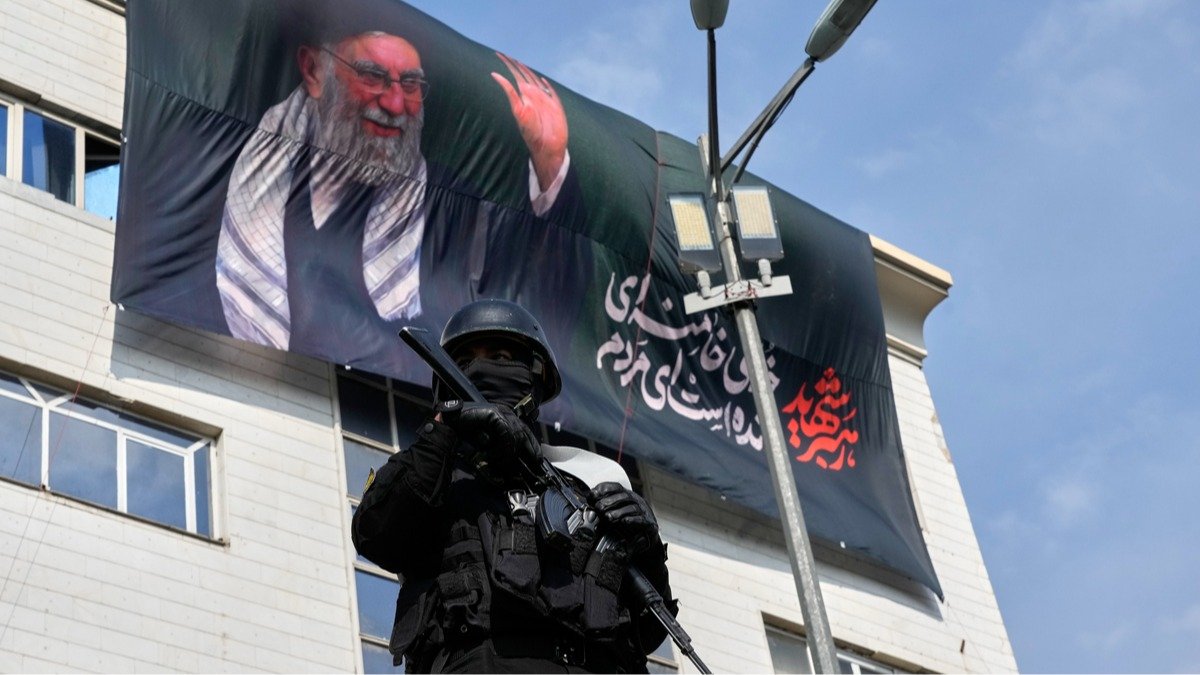
In Iran, a new supreme leader has been elected - Mojtaba Khamenei, the son of the murdered Ayatollah Ali Khamenei. His appointment has already provoked a sharp reaction from the US, and Israel has promised to eliminate him. At the same time, Putin congratulated the ayatollah on his appointment. Simultaneously, the conflict continues to affect the global oil market and fuel prices. The main points about what is happening in Iran are in the material by 'Novaya-Europe'. Security forces employee during a rally in support of Mojtaba Khamenei's nomination for the post of Supreme Leader of Iran, Tehran, March 9, 2026. In the background, a poster with a portrait of Mojtaba Khamenei. Photo: Vahid Salemi / AP Photo / Scanpix / LETA. Editorial note 9.03. Shortly after publication, the material was supplemented with a comment by Tatyana Mitrova. New Supreme Leader of Iran. What's new? The Assembly of Experts of Iran has elected Mojtaba Khamenei, son of the murdered Ali Khamenei, as the new supreme leader of the Islamic Republic. The Islamic Revolutionary Guard Corps (IRGC) has pledged allegiance to him and stated that its members are ready for full obedience and self-sacrifice. Iranian President Masoud Pezeshkian called Mojtaba's appointment "a manifestation of the Islamic nation's desire to strengthen national unity." According to him, the son's election "will herald a new era of dignity and power for the Iranian nation." 56-year-old Mojtaba Khamenei, according to media reports, was the main favorite for the post. The New York Times also wrote that the IRGC had been actively lobbying for his appointment. Orientalist Ruslan Suleimanov, in a conversation with 'Novaya-Europe,' noted that Mojtaba Khamenei is known for enjoying support not only in religious circles but also among security forces. In addition, Marianna Belenkaya pointed out that "Mojtaba is more radical than his father: he actively participated in suppressing the protests of 2009. Moreover, Mojtaba has always remained in the shadows and has never held official political posts." The Iranian General Staff issued a statement after Khamenei's appointment. It states that under the new command, the country's armed forces "will be even more powerful and steadfast." "They will make the enemies of the Islamic Ummah, especially America, regret their aggression, encroachments, and attacks on Muslims and... the Iranian people. They will resist and stand firm against the plots of the enemies of Islam and Iran," the statement reads. How Russia, the US, and Israel reacted. Vladimir Putin sent a congratulatory telegram to Mojtaba Khamenei on his election. He expressed "unwavering support for Tehran" and "solidarity with Iranian friends." Putin also confirmed that "Russia has been and will be a reliable partner of the Islamic Republic." "Now that Iran is facing armed aggression, your activities in this high post will undoubtedly require great courage and dedication. I am sure that you will worthily continue your father's work and unite the Iranian people in the face of severe trials," the telegram reads. Israeli Defense Minister Israel Katz, even before Mojtaba's appointment, stated that any leader appointed in Iran "to continue the plan to destroy Israel and threaten the US" "will become an unconditional target for liquidation." According to him, this does not depend on his name or place of residence. US President Donald Trump was dissatisfied with the appointment of the new leader of Iran. According to Axios, he wanted to personally participate in the choice of the new ayatollah, "as was the case with Delsy [Rodriguez] in Venezuela." "They [Iranian authorities] are wasting time. Khamenei's son is a lightweight. Khamenei's son is unacceptable to me. We need someone who will bring harmony and peace to Iran," Trump said. The President added that he would not accept the new leader of Iran, as he would continue the policies of the murdered Ali Khamenei, and the US would have to return to war "in five years." Meanwhile, at least 8 American soldiers have died since the beginning of the last operation. The US Central Command reported that a National Guard soldier died in Kuwait on March 6. Fuel price board at a gas station in Berlin, Germany, March 7, 2026. Photo: Clemens Bilan / EPA. What about oil? Energy markets reacted to the war in the Middle East with a price surge: oil, breaking $100 a barrel for Brent benchmark, rose to levels not seen since the summer of 2022 (and its intraday fluctuations reached 20%), gas on European trading platforms last traded above $800 per 1000 cubic meters in early 2023. The reason is the closure of the Strait of Hormuz and production cuts by the region's largest producers: Saudi Arabia, the United Arab Emirates, Kuwait, and Iraq. The main question now is how long energy prices will remain at extremely high levels. Neither the US, nor Europe, nor China - the largest consumers of oil and gas (the US is also a major exporter at the same time) - are interested in the high cost of fuel. If the price of Brent stabilizes significantly above $70-80 per barrel, it will cause a surge in global inflation, which national central banks will have to combat by raising interest rates. "This is fraught with economic slowdown and even recession in some countries - precisely what politicians are least eager for where they come to power through elections. The second reason why the West does not need a long era of expensive oil is the financing of the Russian military budget. Already, the world's largest countries are trying to mitigate the energy shock. In particular, the G7 is discussing the possibility of releasing emergency oil reserves, and the Japanese authorities have already instructed to draw oil from reserves created for emergencies. This may temporarily hold back prices and prevent them from soaring much above $100. However, UBS bank analyst Giovanni Staunovo, in light of the halted tanker traffic through the Strait of Hormuz, calls this "a drop in the ocean." South Korea and Taiwan are forcibly limiting domestic oil product prices. Residents of Tehran during a rally in support of the newly appointed Supreme Leader of Iran, Ayatollah Mojtaba Khamenei, March 9, 2026. Photo: Abedin Taherkenareh / EPA. Therefore, the future depends on the extent to which the US and Israeli authorities, as well as the new spiritual leader of Iran Mojtaba Khamenei and the leaders of the Islamic Revolutionary Guard Corps, are willing to make mutual concessions. As Tatyana Mitrova, an expert at the Center on Global Energy Policy at Columbia University, told 'Novaya-Europe,' prolonged disruptions to supplies from the Persian Gulf could keep prices at elevated levels for much longer, and the stabilization process is also likely to be extended. "If the active phase of the conflict ends within the next few weeks and supplies through Hormuz are restored, the market will likely begin to correct itself quite quickly: it has a certain flexibility due to reserves, redistribution of flows, and increased supply outside the region," Mitrova emphasized. At the same time, in her assessment, the risk premium for oil may persist longer: "Even after the formal end of the conflict, insurers, shipping companies, and traders will factor in increased risks, so prices may fall gradually rather than all at once." For now, Mitrova notes, the main production, refining, and liquefaction capacities in the Gulf are only slightly affected - they are mostly shut down preventively, after the first drone attacks or as storage fills up. "Accordingly, their restart is a matter of weeks. However, if there are serious damages, the process may take years," the researcher added. As for the benefit for the Russian treasury, which is already being called the main beneficiary of the new war, it is far from obvious. Of course, Russian oil has significantly increased in price now - since the end of last week, it has been sold at a price above $70. And some batches to India are sold with a premium of $4-5 to Brent after the US allowed Indian refineries to resume purchases of Siberian crude. However, a few days or even weeks of supply at such prices are not enough to compensate for the losses of January and February 2026, when the budget earned half as much from hydrocarbon exports as a year earlier. To offset this shortfall in oil and gas revenues, the Russian Urals grade must be sold at around $70 and above not for a few days, as in early March, but for several months. In addition, the war may help Russian coal producers, who have been in crisis for the third year precisely because of low raw material prices: now the Newcastle benchmark has risen to $150 for the first time since the fall of 2024.
TL;DR
- Mojtaba Khamenei, son of the late Ayatollah Ali Khamenei, has been elected as Iran's new supreme leader.
- The IRGC has pledged allegiance to the new leader, and the Iranian President views the appointment as a positive step for national unity.
- Mojtaba Khamenei is considered more radical than his father and has support within religious and security circles.
- Russia congratulated Khamenei, while the US expressed dissatisfaction, and Israel threatened to eliminate him.
- The conflict in the Middle East has caused oil prices to surge above $100 per barrel, affecting global markets and potentially leading to inflation and economic slowdown.
- The long-term impact on oil prices depends on the de-escalation of the conflict and the restoration of supply routes.
Continue reading the original article